





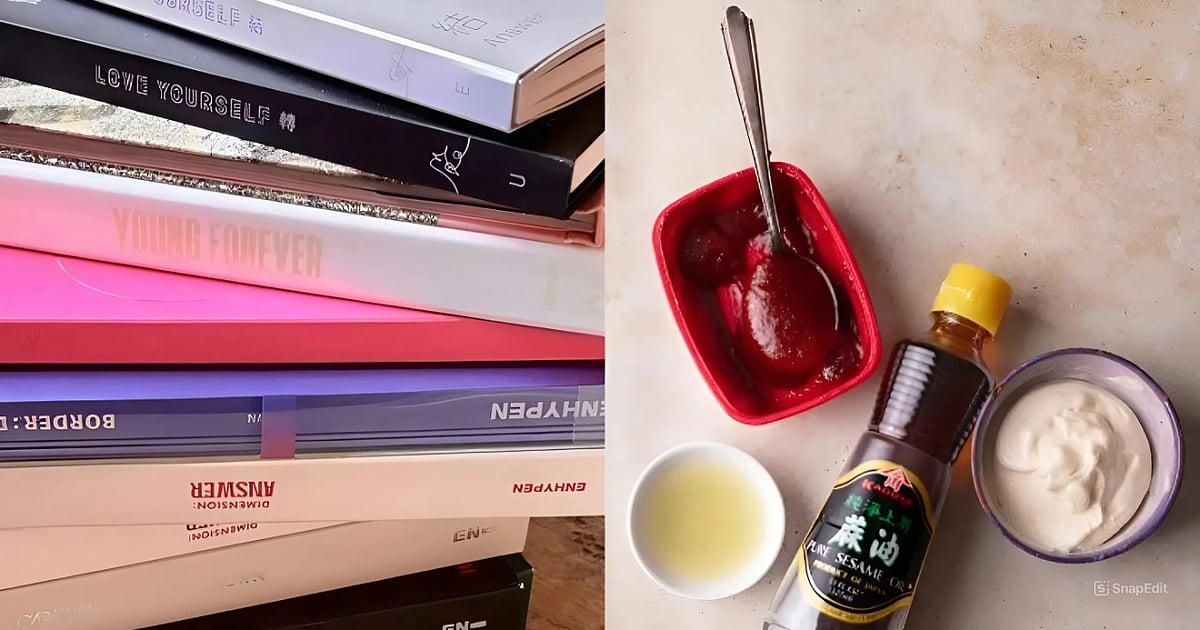
South Korean cultural exports expand from physical K-pop albums to premium culinary ingredients.
K-pop Albums and K-Food Exports are Thriving and Cooking!
New export data shows Korean culture translating into sustained consumer spending far beyond entertainment.

Highlights
- Physical K-pop album shipments are rising sharply, underscoring the enduring commercial power of fandom-driven consumption.
- Korean sesame oil exports are reaching new highs as overseas demand shifts toward core culinary ingredients.
- Gochujang's steady overseas growth points to a broader normalization of Korean flavors in global food markets.
South Korea’s export economy is finding powerful momentum in the tangible choices of global consumers. According to Korea Customs Service data, the latest overseas growth is not just anchored by physical K-pop album exports but by specialized K-food ingredients like sesame oil and traditional Korean chili pastes.
Notably, the deep-seated global fandoms and digital streaming saturation led to physical album exports skyrocketing by 131.8% year-on-year to reach $160 million USD between January and April. The metrics depict consumers uniquely shifting back to physical media as the main tool for cultural engagement, thereby converting listeners and passive streamers into active collectors.
K-Food Boom Exports Hit Record High Led by Sesame Oil
This desire for a hands-on Korean cultural experience is also reflected in the kitchen, where global consumers are evolving their tastes from instant noodles to core culinary staples of Korea. Leading the K-food items surge is sesame oil, whose exports reached a record $6.14M during the same four-month window as the K-pop albums, says Korea Customs Service data cited by The Seoul Economic Daily. Notably, the amount marks a 37% year-on-year value increase.
On the other hand, sesame oil's outbound volume increased by 47.6% to 657 tons. Both metrics signal historic highs for the period, boosting a multi-year trajectory that saw this item's exports attain the $13.01M-mark in 2024 (up 20.3%) while hitting $16.68M last year (up 28.2%).
The United States dominates the biggest market share of the sesame oil export with 41.7%, yielding about $2.6M. Following the US are the countries of Canada, Taiwan, Australia, and the Netherlands. Driven by health-conscious and vegetarian trends in developed nations, consumers who first encountered Korean cuisine via social media are adopting the additive-free, minimally processed sesame oil as an everyday finishing oil, just like olive oil.
Gochujang Strengthens its Presence Across Key Markets
The shift in kitchens around the world is simultaneously also diversifying the broader sauce market of Korea. The exports related to the country’s famous chili paste Gochujang rose 2.1% to $22.9M from January through April. The K-food ingredient notably showcased a double-digit demand in the nations of China (27.3%), Canada (33.1%), and the Netherlands (36.4%).
The export performance of Gochujang highlights its persistent multi-year trajectory, climbing from its original $60M baseline in 2023 to $62M in 2024 and $64M in 2025. Together, these trade numbers unveil an intimate structural integration, where global consumers are no longer just consuming Korean culture through screens but are aggressively utilizing it in their daily lives.

Author
Diya Mukherjee is a Content Writer at Outlook Respawn with a postgraduate background in media. She has a passion for writing content and is enthusiastic about exploring cultures, literature, global affairs, and pop culture.