


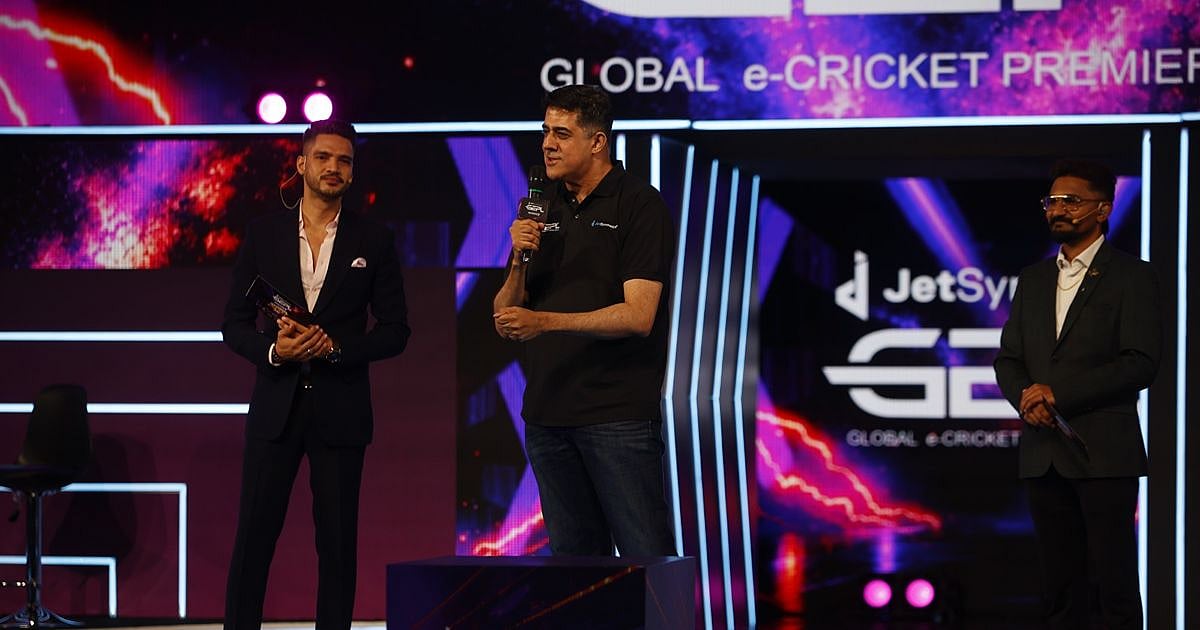
The third season of the Global e-Cricket Premier League opened in Pune on August 1 with eight franchises, up from six, and the largest prize pool in its history at ₹3.1 crore. It runs for nine days at the Jairaj Sports and Convention Centre and ends with a finale on August 9. In India it airs six hours a day, from 4 PM to 10 PM, on Star Sports Select, Star Sports Khel and JioHotstar. In the United States and Canada it airs on Willow TV, the first international television deal any Indian e-cricket property has signed.
The owners' list has grown alongside it. Returning franchises are backed by Peyush Bansal (Delhi Sharks), Nikhil Kamath, Ankit Nagori and Prashanth Prakash (Bengaluru Badgers), Sara Tendulkar (Mumbai Grizzlies), Suniel Shetty (Pune Stallions), Amit Mehta (Hyderabad Rhinos), and Gopal Srinivasan, Madhusudanan R and Arjun Santhanakrishnan, whose Chennai Falcons won Season 2. Two names are new. Playback singer Sonu Nigam owns the Kolkata Hawks. Tanmay "Scout" Singh owns the Gujarat Wolves and is the first person from Indian esports to buy into the league.
That combination, a franchise league with a national television footprint and owners drawn from finance, film, music and gaming, is rare in Indian competitive gaming. It is also the thing Rajan Navani, the chairman of league owner JetSynthesys, says he set out to build from the first season, and the thing Jogesh Lulla, the company's senior vice president for sports, has spent three years assembling on the ground.
The franchise problem
Franchise leagues are the structure Indian esports has wanted for a decade and has repeatedly struggled to hold on to. Skyesports launched the country's first franchised Counter-Strike league in 2023 with eight partners, then moved away from the franchise structure the following year. Krafton opened bidding for a BGMI franchise league in June 2025 and shelved it weeks later, saying conditions did not support the scale it had originally envisioned. BGMI is a much larger competitive title in India than Real Cricket. The model still did not hold.
Lulla, who runs the league day to day, from the franchise relationships and the player auction through to the broadcast, says GEPL got there by absorbing the risk itself in year one.
"Was it a risk in the beginning? Of course it was. That's why we went ahead and did the first season on our own," he said. "We did the entire investment to prove to people this can work. What we did to get the people on board was we showed them our proof of concept. They actually saw what was happening. They saw the excitement and they've seen the vision."
He reaches for the obvious Indian comparison without hesitation. "What happened when IPL started? It wasn't easy. No one believed in what could happen. That's exactly what we're trying to do here."
He also thinks broadcast alone would not have closed those conversations. "Unless you're on ground and you see what is happening, no quality of broadcast is going to get the excitement out for you. It's similar to being in a stadium where you sense the energy of the crowd as opposed to watching it on TV."
Navani's answer is about the audience rather than the balance sheet. "It is a sport that goes into every household. Everybody who understands it is viewing it," he said. "So to build a fan community, which cuts across from a child to a grandmother in India, is what makes this viewing experience better. When there is viewing experience, then you have the opportunity to build franchises and all that."
He declines to comment on why others have not managed it. "Why other companies are not able to do it? I mean, I don't want to get into that. Obviously, everyone has their own reasons. But we know why we made it happen."
The argument, stripped down, is that franchise economics follow legibility. Brands, media rights and team valuations need an audience that can follow the product without being taught it first. A viewer who has never opened Real Cricket still knows what a wicket is.
This is the key differentiator.
Navani's case for the title
Navani makes a narrower and more technical claim about the game itself. Several cricket games sit on Indian phones. He argues only one of them can carry a competitive league.
"None of them are e-sportable," he said. "An e-sportable title is one where the complexity of the sport is significantly high and therefore the talent needed to be the best in that requires effort, time, maturity. Second, hard work, consistency, coaching, playing more, investing more time, and that leads to a better player in addition to the talent that comes. The third thing is that the best talent continues to perform and win. Like in any sport. A good cricketer or a good tennis athlete will win nine out of ten times, or eight out of ten."
He credits Anuj Mankar and the Nautilus Mobile team in Pune for building a simulation that behaves that way, and says the company avoided the two easier routes the category offered. "We never looked at Real Cricket going down the path, many others did (either casual or they went down the real money gaming path)," he said. "We never stood distracted. We were very focused on building an e-sportable game with that same vision."
He is also careful about how the league is described. Real-world cricket bodies have stayed away from esports, and Navani does not expect a conversation with the BCCI, because he does not think the two products compete.
"Whenever BCCI and ICC would build a video game, they will always look at it as an enhancement of the real world of cricket. We are looking at this as a sport," he said. "The fact that the viewing experience is cricket-like, or it's got six balls, it's got wicket, is true, but the talent needed to be the best in this is nothing to do with that talent. So the sport itself is very different. And I think this message is the key message that we need to build awareness with media and those who understand sports."
Which is why, when he benchmarks the league, he skips esports entirely. "With GEPL, we have an opportunity to be a sports IP that could be as large as the English Premier League or the Indian Premier League. I mean, nothing prevents us from getting there."
What changed in Season 3
The July auction was the most competitive of the three seasons. Fifty-six players sold across eight rosters for ₹62.75 lakh against a ₹64 lakh purse, with each franchise retaining one marquee player and filling seven slots, taking the league pool to 64. All-rounder Jetha Ram went to the Mumbai Grizzlies for ₹3.5 lakh, the highest fee in GEPL history. Sagar Aanjana went to Pune Stallions for ₹3.4 lakh, Sachin Chavan to Hyderabad Rhinos for ₹3.3 lakh and Golden Kumar to the new Kolkata Hawks for ₹3.1 lakh. Four of the five most expensive players changed franchises, which suggests teams are buying form rather than continuity.
Lulla says the bigger change this season is on screen. "We haven't changed the gameplay format, that stays the same, but the viewership format we have made a drastic change this year where people are generally very hesitant to do it," he said. Reality content has been added and the segment structure rebuilt.
Navani projected that Season 3's reach would land somewhere "15, 20x larger than season two" on the back of Star Sports Khel carriage into Hindi-speaking homes and the Willow deal in North America. Season 2 generated more than 174 million impressions and drew 910,000 player registrations, up from 200,000 in Season 1.
"If I compound 20x, 20 into 20 into 20 into 20 into 20, I think we'll be serving 8 billion people in the next 10 years," joked Navani.
Scout, and the pipeline
Tanmay Singh's arrival as an owner reads as a course correction. Navani says the league kept a deliberate distance from the esports scene early on. "One of the reasons we didn't want to do it in the beginning is because we believe this is much bigger than just e-sports. But e-sports will definitely be a component."
Lulla says the fit was immediate. "For Scout this was natural. It was very easy for him to understand that this is an esports league. That's what he does day in and day out, so it was exciting for him. For the others of course it was a little more difficult because they didn't understand the space."
Among the non-endemic owners, he singles out Sara Tendulkar as the most hands-on. The Mumbai Grizzlies squad was taken to meet her before the season and shot content with her, and she is expected at the finale. "They are constantly following up to find out what's happening, what's not happening, to make sure everything is on track, asking what else they can do and how they can help."
What comes after Season 3 is the part Lulla says has not started yet. "The biggest learning and change that has not happened yet, is going to happen, is we want to start focusing very heavily on community building now," he said. "Post GEPL Season 3, you will see a lot more avatars of GEPL coming out for colleges, for pro organisations, where we can now start getting the youth more involved in competing in smaller tournaments. Just like in cricket you would have your Ranji Trophy and then you keep growing until you make it to the Indian team. We are going to follow a similar concept here."
The title sponsorship, and after
JetSynthesys is currently GEPL's title sponsor as well as its owner, an arrangement Navani treats as scaffolding rather than a permanent feature.
"If you're referring to the title sponsorship of GEPL, which JetSynthesys is doing today, it is because we truly believe that it is valuable for our company," he said. "So when we do find other companies that find that value, we will always do what is the best for the IP. I don't think the day is far when you will see some other title sponsor. Of course, we had a title commitment for a certain number of years and that will move at the right time."
Navani started JetSynthesys in 2014 and has spent the decade since buying into most layers of the Indian gaming business: the tournament organiser, the studio, the roll-up vehicle Jetapult, and last year an overseas title, Big Fish Games' EverMerge. Krafton, which took control of Nautilus, is now also an investor in JetSynthesys itself. He has made a version of the same argument throughout: that India accounts for roughly 17 percent of the world's gamers and under 2 percent of the industry. GEPL is his attempt to build one of the assets on the other side of that gap.
"The vision of GEPL is that you can talk of it in the same breath as any other sport and have that level in scale," he said. "Of course, that's the ambition. That's the vision. What will it take us to get there is what we have to be working on."
Disclaimer: Outlook Respawn travelled to GEPL Season 3 as a guest of JetSynthesis with accommodation and travel covered, but this article is not sponsored, commissioned, or edited by any external organisation.