




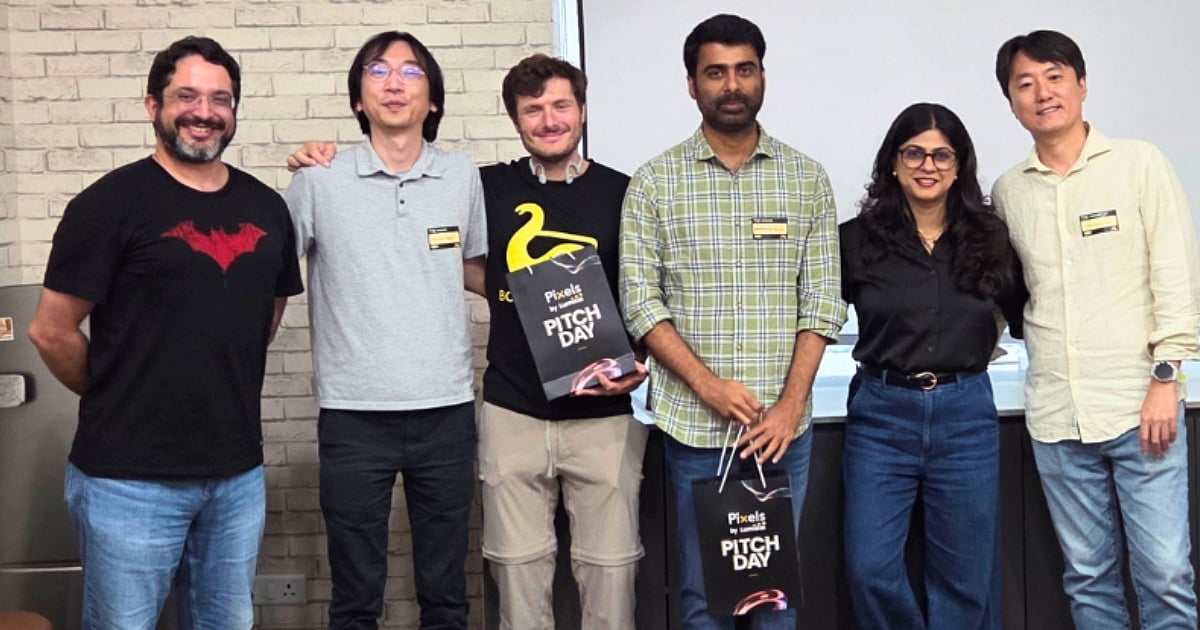
Lumikai’s Pixels Pitch Day evaluated six startups and, in the process, sketched out what the next phase of India’s gaming, AI, and interactive media market will demand from founders. Across several conversations with the investor jury members, Salone Sehgal (Founder & Managing Partner, Lumikai), Akshat Rathee (Co-founder & Managing Director, NODWIN Gaming), Sean Hyunil Sohn (CEO, KRAFTON India), and Tomoharu Urabe (Managing Director, MIXI Global Investments India), the one thing that stood out was how much the jury weighted passion and conviction in the founders themselves. With the market crowding more into AI-driven projects, a sharp founder-market fit and a clear path to revenue have become just as important for investors.
The event surfaced the kind of start-ups that are more likely to find a footing in the open market in the near future. While some were focused on faster game development to keep the audience hooked, others were about diving into the unconventional industry sectors like Dharmic Games and building a complete ecosystem to hold every need of the creator and the user. Others were building tools for developers, or all-in-one platforms covering distribution, monetization, and rewards.
Salone described the event as just the first conversation for founders who may not yet have traction, a full playbook, or even a complete team. And to support such startups, the event also had a mentoring round with Oliver Jones (Co-founder & CEO, Bombay Play) and Ramakrishna Reddy (Co-founder & CEO, QuriousBit) pushing the best versions of their projects forward.
The Founder's Motive First
Talking about how early-stage investing is changing in the industry, Tomoharu Urabe emphasized that the first thing he wants to know is why the founder is building the company. “A lot of investors directly ask about unit economics, but I disagree with that approach at the early stage.” He believes in first understanding the “why” behind the founder, their ability, how focused they are, and what matters to them.
Urabe added that the most important signal is not a perfect deck or a fully formed thesis, but passion combined with founder-product fit. He said, “I also assess founder fit initially. Some founders may be building a tech solution, but may not really enjoy being a salesperson. Others may be very good at B2C direct-to-consumer business because they understand consumer psychology and behavior better. So even if someone is talented and genuinely passionate, they may actually be better suited to a different business model. I need to understand the founder-product fit.”
Retention Before Hype
Meanwhile, Salone Sehgal’s comments pointed to a market that is becoming more evidence-driven. She said passion is important, but she also wants early retention metrics and signals that show what is working and what needs correction, because investors still need proof that users are actually sticking around.
This is a shift for founders in gaming and interactive media. The old approach of leaning on category excitement or AI branding is not enough anymore. Investors now want to see whether people love the product, whether they will return to it, and whether the creators can shape user behavior around it.
AI is a Tool, Not a Moat
When asked about the growing backlash around AI in the gaming and tech industry, Akshat Rathee said AI will help founders. “But currently, building for the AI craze is not a strategy unless you were already building for it earlier and can show a real reason to exist now.” Cutting through the current hype around AI, several jury members emphasized rejecting the idea that AI alone is a business model. They returned to the same questions: what do you actually do better, faster, or cheaper than everyone else?
Money Still Matters
Focusing on the economics of the industry, Akshat clarified that entertainment/gaming at the end of the day is a money-making business, which means founders have to focus on revenue early instead of treating monetization as something to worry about later.
He further argued that founders should be clear about what they are trying to build with any new startup, if it falls into cheap, new, or sexy categories, as no company can credibly be all three. He also talked about how important it is for new founders to be resilient enough to pivot. In recent years, many companies like Dream 11 have had to pivot from their original models within months. Apart from the new government policies, the market is also unstable enough that companies can’t guarantee decades of success.
Startups are bound to see more failure in the course of their product lifetime. Akshat added, “You want a founder to be stubborn enough not to give up at the first failure, but flexible enough to understand failure and pivot. Passion is not the process; passion is the destination.”
India’s AI lane
Tomoharu is optimistic about India’s footing on a global platform. He said India has strong engineering and founder talent, and that consumer AI and enterprise AI can work very well in the country even if foundational tech remains dominated by the US. He added, “Hiring AI talent in the US is very difficult, but in places like Bangalore, companies can hire globally competitive AI talent and build AI products here. India has a unique AI opportunity because of engineering talent and founder talent. You can build globally minded products for the world.”
Salone Sehgal argued India can do far better and, with some support, hold its own against the West. She shared, “Ecosystems like Turkey and Vietnam are getting a lot of support from governments, including funding and financing. That is very important. We need policy support, government financing, and easier compliance for startups. Venture capital can support ideation, but if government support is there too, then everyone can do their job better.”
Sean also believed that there is a lot of talent in the country and needs supportive hands to push them in the right direction. He added that the founders were very passionate and enthusiastic about their projects. “I believe they have a long journey ahead to accomplish what they want to achieve, but I was very glad to have met them today.”
What do New Founders Need to do now?
Akshat believes in looking at the market strategically. He explained, “India should not try to beat the US at training-heavy, chip-intensive AI, but should focus on inference, open-source models, and the user layer. Given the views of the jury, it seems highly likely that investors are now supporting a new wave of Indian AI companies that will likely be application-led rather than model-led.
In the bigger picture, India’s interactive media and gaming space is moving into a more mature phase where monetisation and product quality matter as much as ambition. And the industry is now looking for something that gathers the world’s attention. For new founders, that means the story has to be strong, but the numbers and execution have to be stronger.