



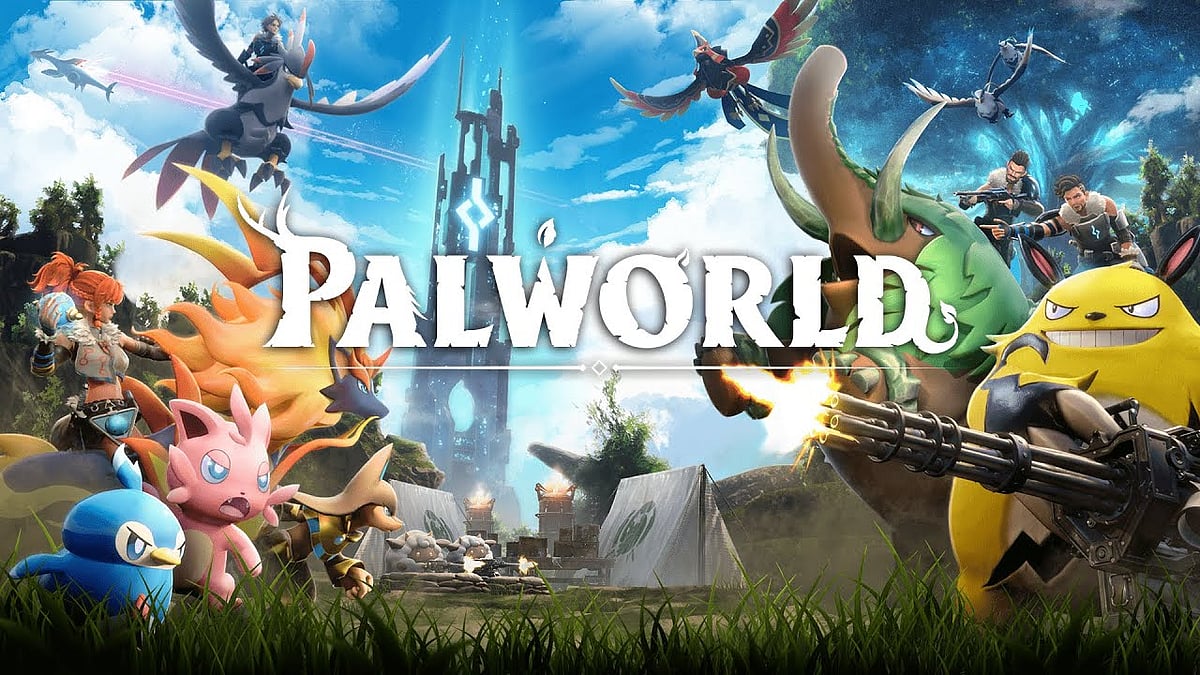
Highlights
- Palworld 1.0 launched July 10 with 40M lifetime players across platforms, then climbed to 961,867 concurrent Steam players by its second weekend.
- U.S. patent examiners rejected all 26 claims of Nintendo's key summoning patent in March; Japan's patent office dismissed a related capture filing as an ordinary rule set with no inventive step.
- Nintendo narrowed its Tokyo claims in November 2025 to superseded versions of the game.
On its launch weekend, Palworld 1.0 peaked at 855,525 concurrent players on Steam, the second time Pocketpair's creature survival game has entered the platform's all-time top 15. Every one of those players could throw a Pal Sphere at a wild creature and catch it. None of them could throw one to summon a creature they already owned.
That interaction, one of the most Pokémon-coded in the game, was cut in patch v0.3.11 in November 2024, two months after Nintendo and The Pokémon Company sued Pocketpair in Tokyo District Court. 20 months later, the full release arrived with 72 new Pals, two new regions, including the long-sealed World Tree. On the game's Discord, Pocketpair's head of publishing and communications John Buckley called it an update "bigger in scale than any update we have ever released." The throw-summon was not in it.
Nintendo's case has spent 2026 shrinking: claims narrowed to versions of the game that no longer exist, related patent applications dismissed in Japan as ordinary, and all 26 claims of its key American patent rejected as obvious. Palworld crossed 40M players two days before launch. The patch that removed the throw was the defence.
The Case That Narrowed Itself
Nintendo and The Pokémon Company filed in Tokyo District Court on Sep 18, 2024, asserting three Japanese patents covering creature capture and mount-switching mechanics. The plaintiffs sought ¥5M each, ¥10M total (~$65K), plus the thing that mattered: an injunction that could pull Palworld from sale.
In November 2025, Nintendo amended its case to target only older versions of the game, versions Pocketpair had already patched out of existence. Florian Mueller, the patent analyst who runs Games Fray, now caps Nintendo's realistic recovery at $30K, damages tied to a window of past infringement rather than a live product, and sees no path for the injunction against Palworld as it ships today. The court has an evidence presentation scheduled for October 1 and a preliminary view due November 9, which means nothing here is a verdict.
Patching as Legal Defence
Pocketpair's own account posted a statement on X in May 2025 explicitly calling v0.3.11 and v0.5.5 "compromises" made because of the "prolonged legal proceedings." Patch v0.3.11 removed the ability to summon a Pal by throwing its sphere; the creature now materializes beside the player instead of where the ball lands. Patch v0.5.5, in May 2025, ended Pal-assisted gliding, replacing living gliders with a crafted item.
Both were cuts to exactly the interactions Nintendo's patents describe, and both landed while the case was still exchanging paperwork. By the time Nintendo's claims were ready to argue, the accused implementations were archived, and the November amendment was the concession: the plaintiff now describes a game you cannot download.
The patents themselves have fared worse than the case. In October 2025, the Japan Patent Office rejected a Nintendo application in the capture-patent family for lacking an inventive step, after a third-party prior-art submission that, Mueller has written on Games Fray, plausibly came from Pocketpair's side.
A divisional application aimed at touchscreen capture, filed with Palworld Mobile in its likely sights, drew two preliminary rejections of its own, in February and again on April 24, 2026, with the examiner calling it "simply a general monster-catching rule set."
In the United States, the patent office granted Nintendo a summon-and-fight patent in September 2025. Two months later, USPTO Director John Squires ordered his own office to reexamine it, without a petition from Pocketpair or anyone else. It was the first director-initiated reexamination since 2012, described as extremely rare by Japanese patent attorneys who spoke to ip fray. It also cut against Squires' own record, since every other decision he had made since taking office had made patents harder to challenge rather than easier.
Nintendo let the response deadline slip. In March the examiner rejected all 26 claims as obvious over four earlier applications, two of them Nintendo's own, plus filings from Konami and Bandai Namco.
Nintendo's initial response deadline has passed, with extensions available on request, and there is no public record of a filing. Back in Japan, the touchscreen application met a harder wall on July 16, when the JPO issued a formal decision of refusal, a terminal stage beyond the earlier preliminary rejections. Nintendo had argued that a 2013 fan-made gameplay video documenting an unofficial Pokémon project shouldn't count as prior art, since the project itself allegedly infringed Pokémon's copyrights.
The examiner used the footage anyway, reasoning that a work's copyright status has no bearing on whether it demonstrates an idea already existed. Mueller's summary of where that leaves Nintendo: "the patent examiner is done with this." Nintendo has three months to appeal to a JPO board or refile narrower claims. The rejections across both countries are non-final or freshly final but still appealable, and the three Tokyo patents remain granted.
The Resemblance Was the Marketing
Palworld launched into early access on Jan 19, 2024, looking like the Pokémon game Game Freak would not make. The resemblance did the customer acquisition. Pocketpair counted 19M players in two weeks, 12M copies on Steam and 7M players on Xbox by its own split, and the discourse was carried almost entirely by how close the Pals sat to the designs they echoed.
Pocketpair Palworld/YouTube
When v0.3.11 cut the summon throw, the most visibly Pokemon-shaped verb in the game, the audience shrugged. Daily concurrents held around 35K through late early access, and about a fifth of its total audience arrived in the past year and a half. The second weekend after launch, July 19, hit 961,867 concurrents. The resemblance opened the door, and the gameplay kept people in the room. Nintendo was left litigating the doorway two years after everyone was already inside.
The demand was visible in Nintendo's own numbers first. Pokémon Legends: Arceus, the franchise's most structurally ambitious release, opened at 6.5M copies in its first week in January 2022. The follow-up, Legends: Z-A, pulled back into a single city, and still sold 5.8M in four days and 12.79M by March 31. The franchise is not bleeding, and that insulation is why nothing changed: by its own metrics, Game Freak never had a reason to build the open-ended creature sandbox players kept asking for.
Pocketpair counts 40M players, while the best-selling Pokémon releases ever, Red, Blue and Green, sold about 31.38M copies, with the caveat that players and copies are different units, and Palworld's figure includes Game Pass.
Nintendo's sandbox answer did eventually ship. Pokopia, a cosy life sim in which a Ditto rebuilds an island, arrived on Switch 2 on March 5 and promptly sold out at UK retail; Christopher Dring, editor of industry outlet The Game Business, reported launch physical sales at half of Z-A's, and attributed the gap to severe understocking. It went on to sell over 4M copies globally within five weeks of launch. Two years after Palworld's first month, demand for Pokémon in a sandbox still surprised the people whose job is forecasting it. Pocketpair, for its part, announced Palfarm, a farming sim, shortly after Pokopia's reveal.
What an Empty Space Costs
This is not the first franchise to treat an obvious request as optional and watch a competitor move in. Ubisoft heard "Assassin's Creed in Japan" for over a decade before building it. PlayStation studio Sucker Punch Productions got there first with Ghost of Tsushima in July 2020, which passed 13M copies sold.
When Assassin's Creed Shadows finally reached feudal Japan in March 2025, it arrived into an occupied space. Market intelligence firm Alinea Analytics found the four-year-old Tsushima PC port had outsold Shadows on Steam at launch, and Rhys Elliott, games analyst at MIDiA Research, wrote in a LinkedIn post that the figures did not reflect the "smash hit Ubisoft desperately needs."
By October, Ghost of Yotei had sold 2.5M copies on PlayStation 5 in under three weeks, against Shadows' 2.4M on the platform in seven months, per Alinea.
The comparison has limits. Shadows carried Ubisoft's wider troubles into that launch, and Palworld faced an incumbent still moving 12M copies a release.
What the Rejections Unlocked
Japanese examiners have now called ball-throw capture an ordinary rule set, on the record. A prior-art docket has been assembled across two jurisdictions, and any future defendant can cite it: ARK: Survival Evolved, Monster Hunter 4, Kantai Collection, Pocketpair's own Craftopia, and Pokémon GO. Nintendo's own November narrowing concedes that Palworld, as sold today, sits outside its claims. None of that erases the three granted Tokyo patents, and every rejection can be appealed. What it changes is the price of fear: an indie studio just benchmarked the cost of defending capture mechanics at a survivable number.
Krafton, the South Korean publisher behind PUBG and, in India, BGMI, is building Palworld Mobile for a worldwide 2026 release, after a demo in November and a closed alpha in December. That is the product most exposed to a touchscreen-capture patent, the one Japan's examiners have now rejected three times.
Pocketpair
According to ggcontent.com, between June 29 and July 20, India accounted for the third-largest share of Palworld's YouTube viewership at 7.5%, behind the US and Japan.
Pocketpair itself has widened rather than braced: a publishing arm, a Terraria crossover, Palfarm, and Palworld Online trademarks filed in the U.S. and South Korea in late April.
The genre pipeline around it is refilling. Capcom shipped Monster Hunter Stories 3 into the top of Japan's digital charts in March. Aniimo, a free-to-play open world creature catcher, is due in 2026 across Xbox, PC and mobile, and smaller entries like Tamer Town and Monster Lab Simulator are heading into early access. Nintendo's own paperwork and Konami's and Bandai Namco's filings are what examiners used against Nintendo, and everyone shipping a capture mechanic in 2026 does it in a world where the broadest claims failed in public.
The Mechanic That Stayed Gone
For all of it, the throw-summon is still not in Palworld 1.0. Players keep checking; Steam threads from June asked whether the full release restored it, and the answer remains no.
There is a version of this story where Pocketpair, vindicated at two patent offices, patches its game back to January 2024. It has chosen not to, with the Tokyo patents still granted and hearing dates still on the calendar. The patches only function as a defence if they are permanent. Pocketpair got the launch and the players. The version of Palworld that no longer exists is the one thing Nintendo gets to keep.