



Highlights
- Microsoft gave up roughly $300 million USD in Call of Duty sales in 2024 by putting the game on Game Pass day one, per Bloomberg.
- The July reset cuts about 3.2K Xbox roles through fiscal 2027, close to a fifth of the division, and sends four studios out of Microsoft's ownership.
- Call of Duty no longer arrives on Game Pass on day one, Ultimate's price has been cut back to $22.99, and the cloud tier Microsoft began testing on July 23 requires no subscription at all.
In 2024, Microsoft gave away roughly $300M of Call of Duty in sales it chose not to make, by putting the year's biggest game on Game Pass the day it launched, instead of charging $70 for it. That figure comes from a person familiar with the matter who spoke to Bloomberg, and it covers one game in one year on Microsoft's own consoles and PC. PlayStation, which sold the game the ordinary way, took 82% of Black Ops 6 sales. This was the strategy, executed deliberately, on the theory that enough new subscribers would arrive to cover what the giveaway cost. They did not.
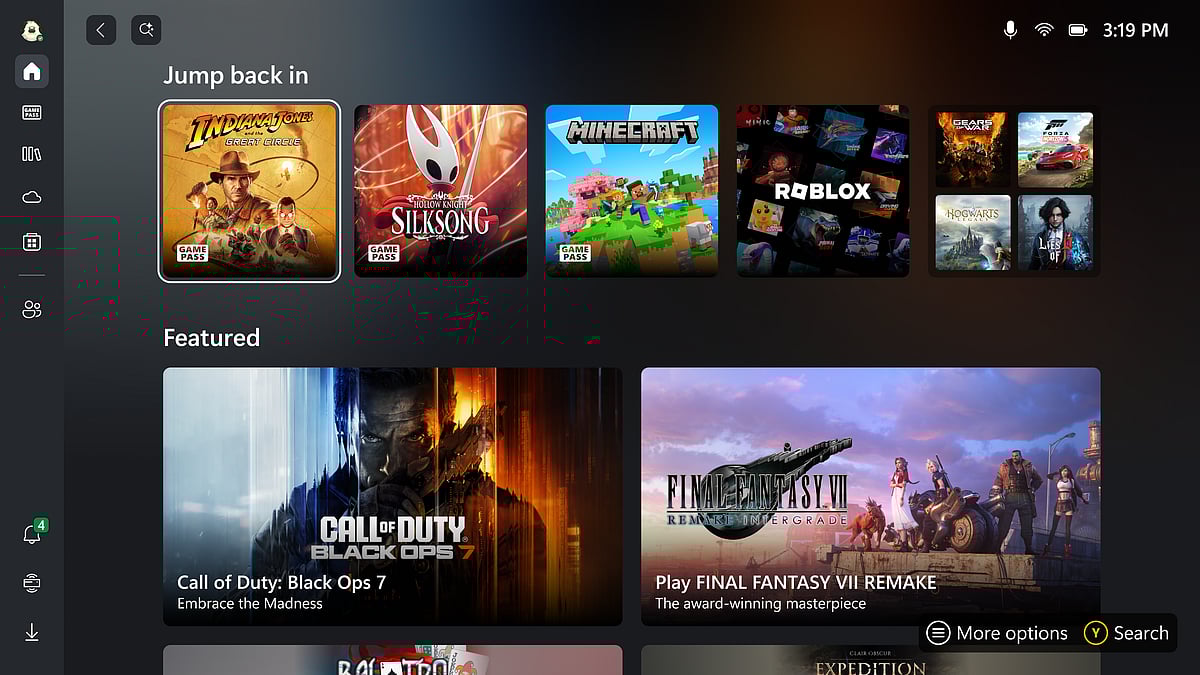
Two years later, Call of Duty is no longer on Game Pass on day one, and the promise that made the service famous has been retired.
What Game Pass Was Built to Do
Game Pass did not begin as a way to give away new games. When it launched in 2017, it was built to do something more specific and less glamorous: activate back-catalog titles that had no obvious path to an audience. Putting a $70 release into it on launch day was a later addition, and a fundamentally different proposition.
Call of Duty cost $70 on its own. On Game Pass, it came with hundreds of other games for less than half that. Day one was what turned a catalog service into a reason to buy the studios that would supply it, and the acquisitions in turn had to be justified by subscriber growth the day-one games were supposed to deliver. Five former Microsoft employees told Bloomberg the model drew internal criticism at the time. Former Bethesda communications head, Pete Hines, and former Xbox Game Studios vice president, Shannon Loftis, have both since said versions of the same thing publicly.
Steam
The Price of Day One
Microsoft put nearly $80B into games deals over roughly a decade, according to Bloomberg, almost all of it aimed at one outcome: making Game Pass the default way people play. ZeniMax, the parent of Bethesda, cost $7.5B in 2021. Activision Blizzard cost $68.7B in 2023, the largest acquisition the industry has seen.
Against that spend, executives set a target of 77M subscribers by the end of fiscal 2026 in a document filed during the Activision Blizzard litigation. The service is now reported at around 30M, down from the 34M Microsoft last confirmed in February 2024. Revenue reached a record near-$5 billion in fiscal 2025, real money that still leaves the gap unclosed.
In July 2025, The Game Business editor-in-chief Christopher Dring reported that Microsoft's internal claim of Game Pass profitability excluded first-party development costs, which sit on a separate ledger; his sources later added the service stayed profitable even counting the first-party revenue it cannibalized. Both can be true, and both sit alongside the new Xbox CEO Asha Sharma's own numbers from the July memo: in a typical year, Xbox lost 64 cents for every dollar it invested in studios and had margins 3-10x lower than comparable platform and publishing businesses.
The official earnings arrived on July 29. Microsoft closed its fiscal year with a record $90B quarter, revenue up 18%, and Azure past $100B for the year. Xbox went the other way. Content and services revenue fell 10% for the quarter. Across the full year Xbox revenue dropped $1.7B, or 7%, to $21.79 billion, with hardware sales down 29% on lower console volumes. The quarter also carried severance costs and impairment charges against Xbox, the accounting term for assets no longer worth what the balance sheet says they are.
Two details cut in the opposite direction. Microsoft's own April 2026 guidance had attributed part of the expected decline to the lowered price of Game Pass, which means some of the shortfall was a choice. And the annual filing attributes part of what held the content and services line up to growth in Game Pass itself.
What the Reset Actually Took
The reset is not a rounding error. On July 6, Microsoft cut about 1.6K Xbox roles immediately, with roughly 3.2K going through fiscal 2027. These numbers are close to a fifth of the division, inside a wider round of 4.8K across the company. Four studios left Microsoft's ownership outright, all four bought in the 2018 - 2019 wave that was meant to supply Game Pass.
Double Fine, the studio behind Psychonauts, and Compulsion Games are being returned to their own management with their IP and back catalogs intact. Ninja Theory and Undead Labs were sold to buyers Microsoft has not named, with financing attached to finish Senua and State of Decay 3. A fifth, Arkane Lyon, currently working on Marvel’s Blade, entered the French works council process that normally precedes a sale or a wind-down.
The memo also describes a company that had grown around the strategy rather than around the games. Some work at Xbox passed through 14 layers of management, which Sharma says she intends to reduce to no more than five, and where possible three.
Platform teams are 40% larger than they were at the start of this console generation; a generation in which Xbox hardware sold roughly 35M units against the PlayStation 5's 94M. The studios that stayed did not stay untouched: the memo describes shifting investment across Activision, Bethesda, Blizzard, King, Mojang and Xbox Game Studios toward higher-priority work, which has historically meant shelved projects at studios that were not divested.
Taking the Mandate Off
When Ultimate's price went to $30 a month in October 2025, millions of subscribers left. Sharma cut it back to $22.99 after taking over in February, and Call of Duty no longer arrives on Game Pass on day one. Day-one access had already been narrowed to the most expensive tier before that.
In a Bloomberg Live interview in June, Sharma disavowed the 30% profit target Microsoft's finance organization had imposed on Xbox in late 2023, a figure well above the 17-22% the industry averages and one widely blamed for two years of cancellations and closures. She dropped the target and made the cuts anyway. What none of it touches is the subscription. Nobody is being asked to give up Game Pass. They are being asked to accept a version that no longer hands over a $70 game on launch day, and to pay less for it.
What is Being Built Instead
Cloud streaming has been a Game Pass feature since it launched, bundled into the subscription and available on every tier that includes it. The test launched on July 23 unbundles it. Microsoft is now offering a cloud service that streams games you already bought, an hour at a time, with ads before each session and no subscription attached.
That is not a description of Game Pass. It is close to a description of GeForce NOW, Nvidia's rival service, which rents you a remote gaming PC to run the library you own elsewhere, and whose free tier has long run on short sessions and preroll ads. More than 1.8K titles in the Xbox store already support cloud streaming, which means the catalog for a subscription-free product already exists.
The hardware situation makes the logic harder to argue with. A memory shortage driven by AI data-centre demand has pushed console component costs to multiples of last year's levels, and Xbox console prices rose again on Aug 1. Sharma has described this as the most severe hardware crisis in Xbox's history, and the most recent earnings report backs this up.
A way to reach players that needs no console at all is not a side experiment in that context. Sharma has separately been reported exploring cheaper tiers and bundle partnerships, including talks with Netflix, and has set a goal of entertaining over a billion people a day. None of those numbers work through a $23 subscription. They work through distribution. India shows the same instinct in the pricing: Game Pass Ultimate runs INR 1,089 there against $22.99 in the United States, about half, in a market Microsoft is clearly buying reach in rather than revenue.
The day-one promise made Game Pass famous and cost Microsoft $300M in Call of Duty sales in a single year. What survives it is the part that was never the expensive bit.