




- K-pop album exports have hit a record $120M in Q1 2026, crossing the $100M mark for the first time.
- Growing “streaming fatigue” is pushing fans towards procurement of physical albums, however, not because of their music format but as collectible symbols of loyalty.
- Amidst this growth, the United States has become the top export market for K-pop, while demand surged across 131 countries worldwide.
The global music industry is currently experiencing an interesting paradox: in an era defined by the sublime nature of streaming, physical item sales have reclaimed its mantle. South Korea’s customs data released this Tuesday (April 28, 2026) has validated the fact that K-pop’s outbound shipments didn't just expand in the first quarter (Q1) of this year; they transitioned into a financial powerhouse, hitting a record-breaking $120 million USD.
The stats mark a first time for quarterly exports to have surpassed the $100M barrier, depicting a remarkable 159% surge compared to the same period last year. For those tracking the pulse of the Hallyu or the Korean wave, this isn’t a sudden change. The Korea Customs Service observes that the industry has been striking consecutive record highs since the third quarter (Q3) of 2025, indicating a sustained upward trajectory that resisted the usual instability plaguing the entertainment sector.
Streaming Fatigue Fuels K-pop Physical Album Boom
Two primary factors are driving this K-pop albums’ surge, according to the Korea Customs Service. Although the rapid market scaling of global fandoms offers the baseline, a growing “streaming fatigue” is pulling the fans back to the tangible appeal of physical K-pop albums. In the digital world, the possession of physical albums has become the ultimate badge of loyalty, and as seen through the metrics, the market is reacting accordingly.
US Overtakes Japan as Top Export Market of K-pop
In a significant industry pivot, the United States has officially displaced Japan as the key destination for such physical exports. Accounting for 28% of the overall market share, the US now spearheads the sector’s evolution, followed by the European Union at 16.5%. Popularity of the same is robust in its usual core geographical bases like China and Japan, although there has been a recent shift in hierarchy. And within this shift, China and Taiwan trailed behind the US and Japan at 14.4% and 6.9%, respectively.
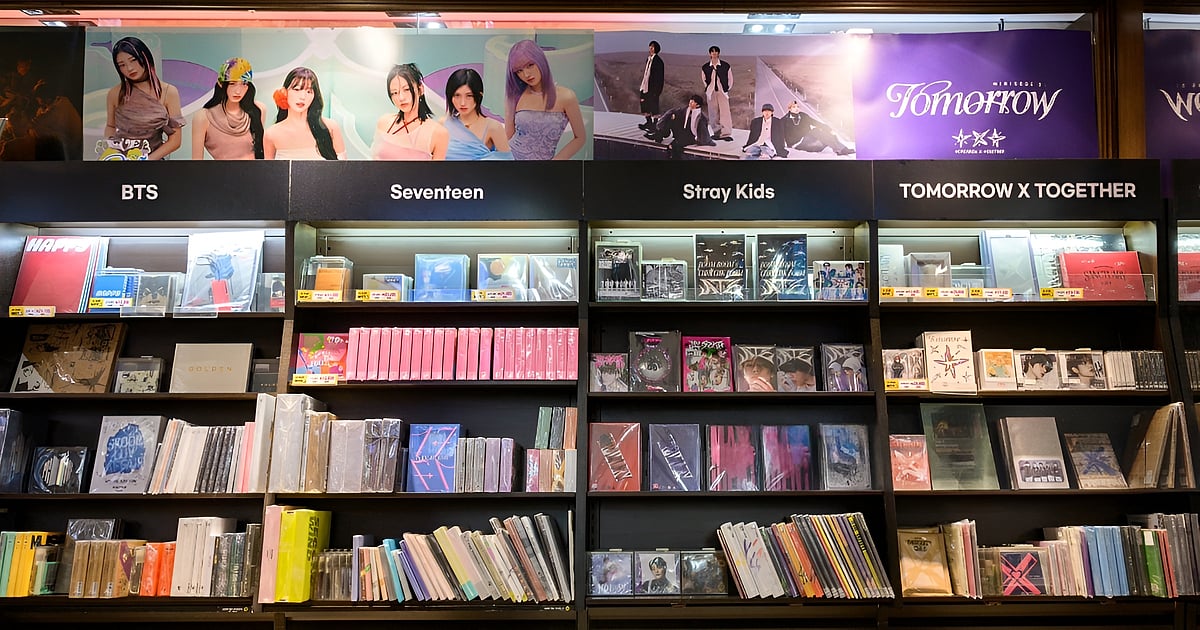
K-pop albums in a store (Image Credit: @stgn4mph at X)
However, the true success of the physical exports lies in their expansive reach. It isn't just concentrated in a few profitable hubs. Out of the 131 nations that imported K-pop albums this quarter, 94 logged their highest-ever quarterly figures. From the established transit arteries of Europe to emerging markets across the world, the appetite for Korean music depicts versatility and long-term grit. As the data suggests, K-pop has walked past the "trend" phase and cemented itself as a significant element of international trade, sequentially providing a physical media experience.