The Noodle Miracle: How an animated film with 325M views turned food into a $1.5B export surge.
KPop Demon Hunters Sparks $1.5 Billion Instant Noodle Export Surge
Netflix's biggest movie ever is reshaping South Korean tourism, food exports and a national debate over who owns the country's most valuable cultural franchises.

- KPop Demon Hunters became Netflix's most-watched movie ever, with over 325 million views in just 91 days.
- The movie boosted South Korean tourism and K-food exports, recording more than 18.5M tourists in 2025, and a staggering $1.5B revenue in overseas instant noodle sales.
- Despite a valuation of over $690M, licensing profits mostly benefit Sony Pictures Animation and Netflix, emphasizing South Korea's IP ownership gap.
Since its Netflix debut on June 20, 2025, KPop Demon Hunters has crossed from pop-culture hit into an economic event. The animated action-fantasy follows Huntr/x, a fictional all-girl K-pop trio who perform as pop idols by day and fight demons by night. Co-directed by Korean-Canadian filmmaker Maggie Kang, the film broke streaming records almost immediately and has since reshaped how Korean culture moves through global markets.
The numbers are hard to dismiss. KPop Demon Hunters accumulated over 325 million views in its first 91 days on Netflix, surpassing Red Notice and the original Squid Game to become the platform's most-watched film ever. It held steady in weekly consumption charts from late 2025 into early 2026. In the United States alone, Nielsen measured 20.5 billion minutes viewed.
KPop Demon Hunters received a Golden Globe for Best Animated Feature, and its breakout hit Golden became a global chart phenomenon. Notably, the song topped the Billboard Hot 100 and won the Grammys and is nominated for the Academy Awards (Oscar).
How KPop Demon Hunters fueled South Korea's record tourism year
South Korean tourism felt the impact quickly. The country recorded more than 18.5 million visitors in 2025, according to Korea Times, surpassing its pre-pandemic peak of 17.5 million set in 2019. Seoul saw an especially sharp spike in July, when foreign arrivals hit a record 1.36 million, a 23% year-on-year jump that the Seoul Metropolitan Government attributed partly to the film's global popularity. Between January and July, 8.28 million foreigners visited the capital, a new record for the period.
Tour operators rolled out themed trips built around the film's locations. Souvenir sales at the National Museum of Korea topped 35 billion won, buoyed by the popularity of the film's Korean folklore-inspired characters.
South Korea's instant noodle exports hit $1.5 billion record in 2025
The film's influence on food exports has been just as measurable. South Korea's instant noodle exports reached a record $1.52 billion in 2025, up 21.8% year-on-year, according to Korea Customs Service data reported by the Korea Herald. The animated movie features noodle dishes prominently, and that screen time translated into real-world consumer demand.
China accounted for the sharpest increase at 47.9%, with shipments reaching $385 million. Exports to the United States grew 18.1% to $255 million, though a 15% tariff weighed on that growth rate. President Lee Jae-myung responded by announcing a "K-Food" export brand strategy, designed to channel the momentum into longer-term support for Korean food businesses abroad.
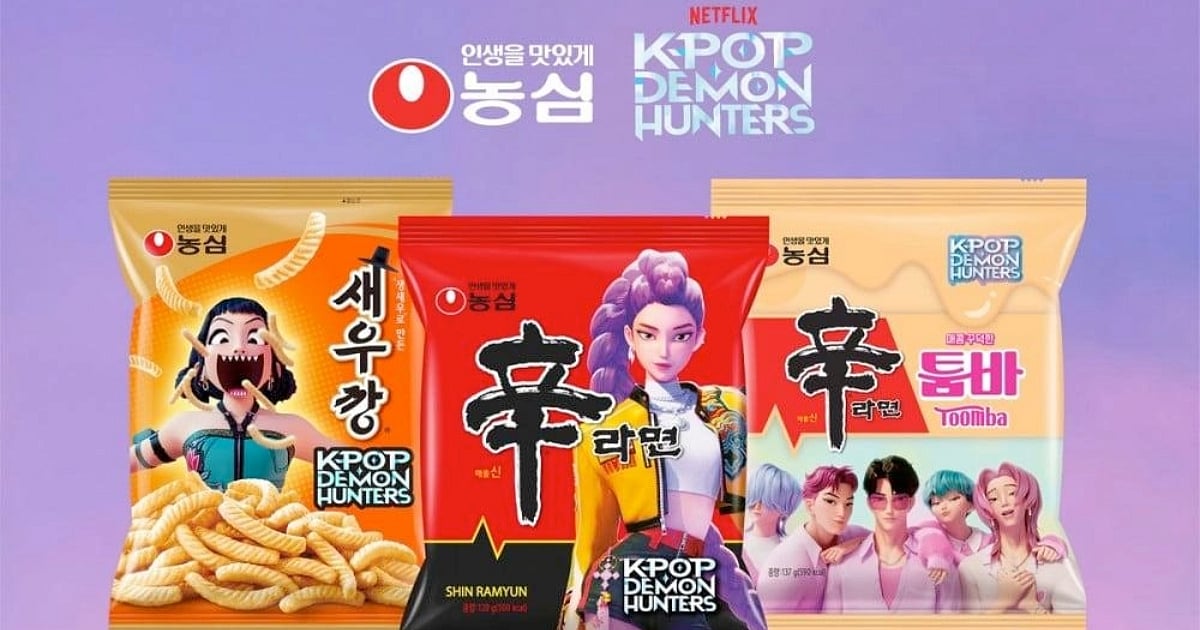
Nongshim, the maker of Shin Ramyun, moved fast. The company released character-themed packaging tied to the film and reported increased exports to the United States, Canada and Australia.
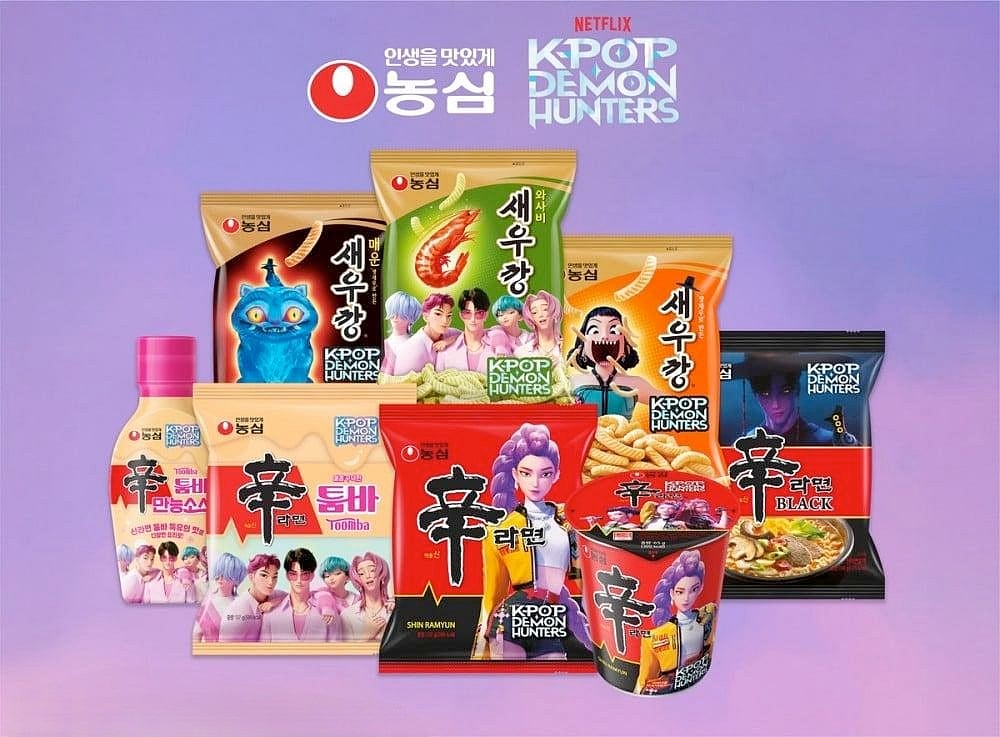
KPop Demon Hunters x Nongshim
Who owns K-content? South Korea's IP ownership gap widens
For all the economic tailwinds, the film has also reopened an uncomfortable question for South Korean industry leaders: who profits when Korean culture goes global?
KPop Demon Hunters was produced by Sony Pictures Animation under a deal in which Netflix paid $125 million covering both the budget and a premium, retaining all film rights. That means domestic Korean companies pay licensing fees to use the franchise even within their own market. Entertainment industry estimates, cited in Korean media, put the franchise's IP value at over 1 trillion won (roughly $722 million). Yet the bulk of that commercial upside flows offshore.
The Korea Chamber of Commerce and Industry (KCCI) has seized on this gap. In an August 2025 report on IP industrialization, the chamber noted that no Korean company ranks among the world's top 50 IP licensors and called for Korea to develop a global hit franchise on home-grown terms. Meanwhile, Naver's Webtoon Entertainment is expanding co-production deals with Disney and Warner Bros. Animation, aiming to build an IP portfolio that can generate sustained franchise revenue.
Whether Korean companies can close that gap will depend on whether the current boom in cultural exports translates into lasting ownership stakes or remains, as it has in the past, a story where the creative labor originates in Seoul but the returns land elsewhere.

Author
Diya Mukherjee is a Content Writer at Outlook Respawn with a postgraduate background in media. She has a passion for writing content and is enthusiastic about exploring cultures, literature, global affairs, and pop culture.