
A stark divide between domestic and global chart data exposes a different K-pop reality.
Are Domestic Charts Not Reflecting K-pop’s Current Global Reality?
Behind K-pop's global rise lies a challenge that South Korea's music industry can not ignore anymore.

Highlights
- South Korea's biggest K-pop companies are thriving globally, but the country's domestic music platforms are struggling to keep pace.
- Aging user bases and local barriers are shaping the domestic charts, creating a growing gap from the recent global K-pop trends.
- Industry experts argue that local streaming services need to reinvent their role within the current wider ecosystem of K-pop to stay relevant.
As South Korea’s major entertainment giants successfully shape their business models around global demand, the nation's local music streaming platforms remain fundamentally landlocked, creating a widening gap between international K-pop consumption and domestic market realities.
Financial reports from 2025 revealed that 60% of the total revenue of South Korea's “Big Four” music agencies, HYBE, SM Entertainment, JYP Entertainment, and YG Entertainment, came from markets abroad. However, the international revenue share of South Korea's native streaming providers remains nominal. According to the music service revenue last year, Genie Music’s overseas revenue share accounts for 18%, while FLO’s stands at 2%, with Bugs at 0%. Nevertheless, market leader Melon, as of now, has not separately disclosed its international earnings.
Technical Isolation and Regional Borders
The failure of domestic applications to encapsulate global fandom originates primarily from inflexible infrastructure and localized user barriers. Major music platforms like Melon, Genie, FLO, and Bugs operate only with Korean-language interfaces alongside strict identity verification protocols. Registration and payment also usually require a South Korean mobile phone number or a domestic credit card. Additionally, geographical restrictions block many international users from downloading the applications via foreign app stores.
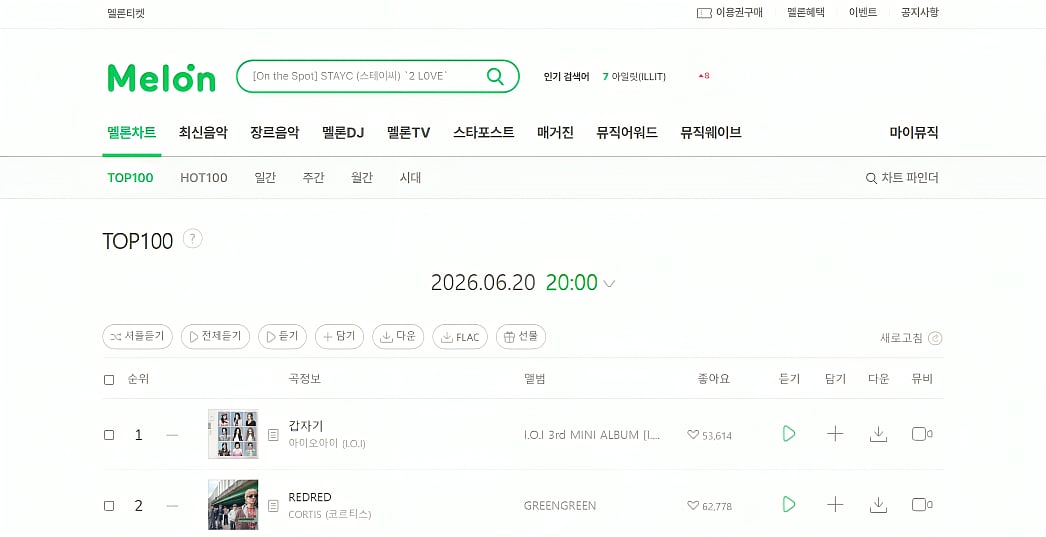
SCREEN CAPTURE: WEBSITE INTERFACE OF K-POP CHART MELON
Although Melon has tried to expand into parts of East Asia via a music supply partnership with Tencent Music, the initiative acted as a domestic distribution deal rather than a direct pipeline for users around the world to enter the ecosystem of Melon. Because global platforms like Spotify and Apple Music maintain comprehensive catalogs of K-pop music, overseas consumers face zero incentive to bypass the administrative friction required to use South Korean applications.
The Demographic Divide and "Concretized" Charts
This international isolation has changed the internal user bases of domestic services, thereby creating a radical crisis for South Korea’s music charts. Data from the 2025 Music Industry White Paper and the Korea Information Society Development Institute (KISDI) show that younger listeners, primarily in their teens and 20s, are using more of the overseas platforms, like YouTube Music, Spotify, Apple Music, and SoundCloud. On the other hand, legacy domestic platforms like Melon depend increasingly on users aged 50 and older.
This generational imbalance heavily tilts local chart data towards locally preferred genres instead of global trends. As per industry preference surveys cited by the Seoul Economic Daily, ballads have a 39.5% preference amongst all age groups, peaking massively among older demographics. Interestingly, 47.8% of the individuals in their 40s listen to the genre alongside 57.1% and 43.6% of people in their 50s and 60s, respectively. Meanwhile, traditional trot music marks a preference percentage of 28.5% amongst the users in their 60s.
Due to such trends, the domestic charts suffer from a “concretization” effect, where legacy mega-hits released years ago remain at the top owing to the repetitive listening by older listeners. This pattern reportedly creates a slow, “lagging chart” environment that is unable to capture the momentum of the new, globally relevant releases.
An example of such an issue is clearly depicted by the performance of the song Red Red by the artist CORTIS. On Spotify’s Daily Top Songs Korea chart, the track entered at No. 65 and climbed to No. 1 within a week of its release, depicting a near-identical path on Apple Music’s Top 100 Korea. It entered the latter chart at No. 72 and reached the top spot just six days later. However, when its position was compared on Melon's daily charts, the song debuted at a distant No. 332, taking a full week just to get into the top 100. Consequently, it required an entire month to achieve the number-one position on Melon.
Industry insiders warn that these data discrepancies undermine the value of South Korean charts. Because charts serve as the foundational tool for international consumers and music stakeholders to identify current trends, platforms that fail to accurately mirror real-time global consumption risk losing institutional credibility.
Specialized Utility and Ecosystem Integration
Media and communication experts suggest that for South Korean platforms to remain competitive, they must move away from baseline audio delivery and build functional specializations that are specifically curated to the wider K-pop framework.
As noted by the Seoul Economic Daily, Kim Jung-hwan, a professor in the School of Media and Communication at Korea University, highlighted that global music consumption has been broken down into distinct, platform-specific roles. And within this landscape, Spotify has optimized its model for playlist curation and global discovery, while Apple Music has focused on high-engagement, high-fidelity listening. Alternatively, TikTok acts as the determinative trend ignition point for Gen Z and millennial audiences, as emphasized by the global breakout of FIFTY FIFTY’s hit song Cupid, released three years ago.
"K-pop is an ecosystem in which music, music videos, shorts, performances, and fan communities operate in a complex way," said Kim in a statement to the Seoul Economic Daily. "Domestic music platforms, too, must have specialized functions tailored to this ecosystem if they hope to attract global consumers," the professor added further.

Author
Diya Mukherjee is a Content Writer at Outlook Respawn with a postgraduate background in media. She has a passion for writing content and is enthusiastic about exploring cultures, literature, global affairs, and pop culture.




Related Articles