




Highlights
- Indofuturism Studios and Dasein Lab are building a structured approach to worldbuilding that combines research, design, and interdisciplinary collaboration.
- Indian game development often mirrors Western ideas, limiting originality and preventing culturally rooted storytelling.
- Their initiatives aim to shift India from execution-focused work to creating original intellectual property that shines globally.
There’s a pattern many are noticing in Indian video games. They play well and look polished, but they frequently draw from ideas that have already succeeded in other markets. The worlds don’t quite feel rooted in a specific place and end up conforming to tropes in the industry.
When we sat down with the founders of Indofuturism Studios Pvt. Ltd and Dasein Lab, this gap started to look less like a creative shortfall and more like a structural one. The studio positions itself as a production house dedicated to raising creative standards across South Asia. Their goal is to create a global environment where people from the industry can come together and share ideas.
At the heart of what they’re doing is a bigger ambition. They want to craft interactive stories that draw from South Asian heritage, creating real cultural resonance. For these founders, the real issue with Indian games isn’t a lack of technical skill or polish. It’s the absence of proper systems and environments that let truly original ideas surface, breathe, and take shape.
India’s Originality Problem Begins With How it Sees Itself
When Srijandeep Kumar Das, co-founder of Indofuturism Studios Pvt. Ltd., speaks about Indian games, he feels that the country’s developers need to delve deep into their roots. He said, “The fact that we keep looking at ourselves from the colonial lens, or let’s say the Western lens altogether, means that we haven’t really taken a chance to imagine what a version of Indian sci-fi would look like, or a version of Indian noir would look like… we end up replicating Western tropes and Western systems of storytelling instead of diving deeper into who we are and where we come from.”
Teams tend to lean toward familiar themes and gameplay loops because they are easier to execute and simpler to justify, especially in an industry where risk is already high. Over time, this leads to a cycle where ideas are shaped by what has worked elsewhere, rather than what could emerge from within the local context, resulting in games that feel derivative even when they are well-made.
The problem, he suggests, goes beyond imitation. It also affects how culture is interpreted and presented. Many projects return to the same visual cues and mythological references, while large parts of India’s cultural and regional diversity remain absent from these worlds. What ends up being portrayed as Indian identity begins to feel limited and repetitive.
Worldbuilding Becomes the Starting Point
The approach at Indofuturism Studios and Dasein Lab begins from a different place. Instead of treating worldbuilding as a layer added later, it becomes the foundation on which everything else is built. Das describes video games as a medium that naturally supports this way of thinking. Video games are an all-encompassing platform that combines several disciplines like character design, UI, UX, architecture, graphic design, and more.
Within this framework, the world comes first. Its logic, its ecology, and its systems are defined before characters and narratives begin to take shape. This process draws from methods that emphasize environments as carriers of meaning.
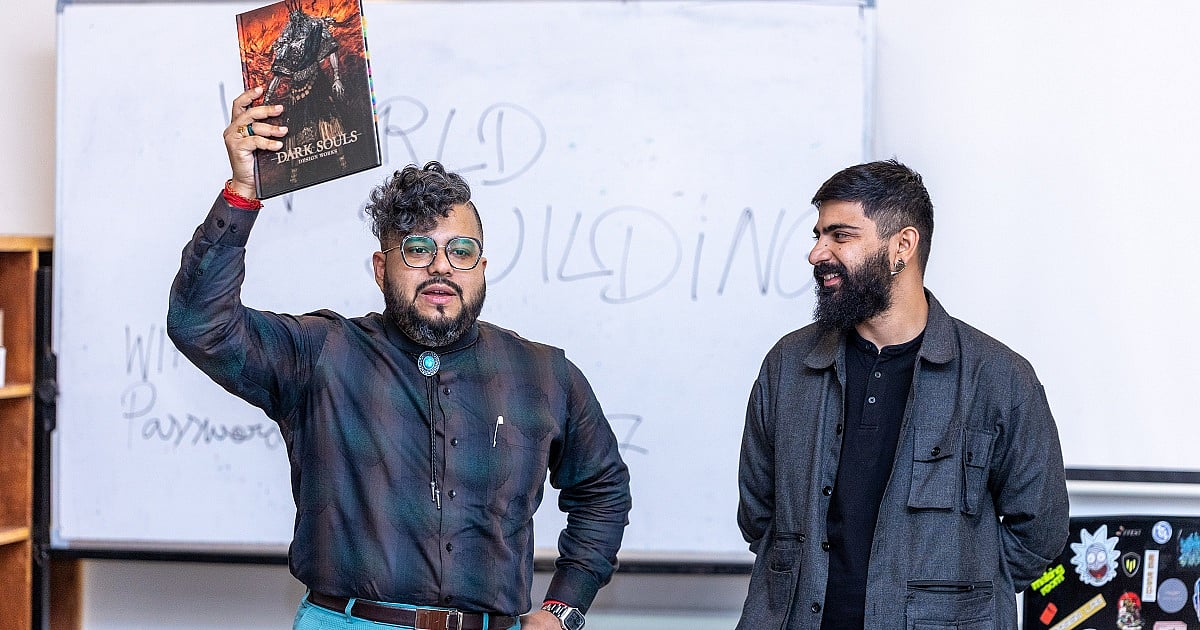
Indofuturism and Dasein Lab often refer to Dark Souls as a reference point for this thinking. In that game, the environment itself communicates history, conflict, and emotion without relying on direct explanation. Das said, “They start by building the world first, and being inspired by the world, they start building the characters that inhabit it. The world itself can be a storyteller.”
This method extends into research as well. Ecological systems, climate narratives, and urban design become part of the creative process. Ideas are tested not only for how they function in a game, but also for how they connect to real-world contexts. Through this lens, a game stops being just a product. It becomes a system that can generate stories, ideas, and possibilities over time.
Building India’s First Worldbuilding Hackathon
The ideas behind Indofuturism and Dasein Lab's philosophy are not limited to theory. They are already being tested in practice through what the founders describe as India’s first worldbuilding hackathon.
Hosted in Kolkata during early March 2026, the event brought together a small but carefully selected group of participants, including students and working professionals, and placed them in interdisciplinary teams. The structure itself was intentional. Designers, programmers, architects, and artists were asked to work within the same space, forcing a kind of collaboration that rarely happens in traditional academic settings. Das revealed that there were a total of 36 participants. A panel handpicked those participants through a rigorous screening process and helped create the hackathon.
Bharat Raj Thukral, who collaborates with Indofuturism and founded multi-discipline studio Dasein Lab, revealed that one of the most important outcomes of the event was not the final output, but the shift in how participants approached creation. Many were experiencing this kind of cross-disciplinary work for the first time. He said, “It was very new for them to be working in an interdisciplinary team, but we could actually see that they can thrive in those environments.”
He believes that everything you experience, inhabit, or interact with in your surroundings contributes to worldbuilding.
The hackathon itself moved away from conventional design exercises. Instead of starting with characters or gameplay loops, participants were encouraged to observe their surroundings and translate real-world systems into playable mechanics. Urban spaces, ecological patterns, and everyday objects became the starting point for ideas.
This approach reflects the studio’s larger philosophy. Worldbuilding is not treated as an aesthetic layer but as a process grounded in observation, research, and systems thinking. The goal is to train creators to look beyond references and begin constructing original worlds from lived experiences. In that sense, the Indofuturism and Dasein Lab hackathon functions less as an event and more as a prototype for a different kind of creative pipeline.
Bringing Fresh Ideas to Life
Indofuturism and Dasein Lab want to continue bringing its ideas to life and build platforms where gaming industry members can share efforts. One part of this effort is an Indo-futurism design game lab, inspired by global research institutions and adapted for the local market. Das revealed, “We are building our own version of the MIT Media Lab, known as the Indofuturism Dasein Game Lab where we create original IPs each year to reposition India from being a service nation to an IP creation nation.”
Alongside this, the team is organizing worldbuilding hackathons that bring together students and professionals across disciplines. Designers, architects, programmers, and artists can work within the same space, learning to build shared vocabularies and collaborative processes.
There is also a focus on mentorship. Indofuturism and Dasein Lab are looking to host more events in India and abroad. Their aim is to move away from an ecosystem where talent is trained primarily for execution and toward one where creators are equipped to work on new ideas.
Over time, that change could redefine how Indian games are perceived. Instead of building iterations of familiar formats, Indofuturism and Dasein Lab want to build worlds that feel distinct, grounded, and fully their own.