



- South Korea is combining K-pop with traditional heritage to uplift its history into a modern, revenue-producing “experience economy.”
- The demand for palace tours and cultural programs has now reached a scale that matches the intensity of popular K-pop events led by acts like BTS.
- Fast-paced commercialization, bolstered by K-pop collabs with groups like BLACKPINK, is amplifying K-heritage’s global influence.
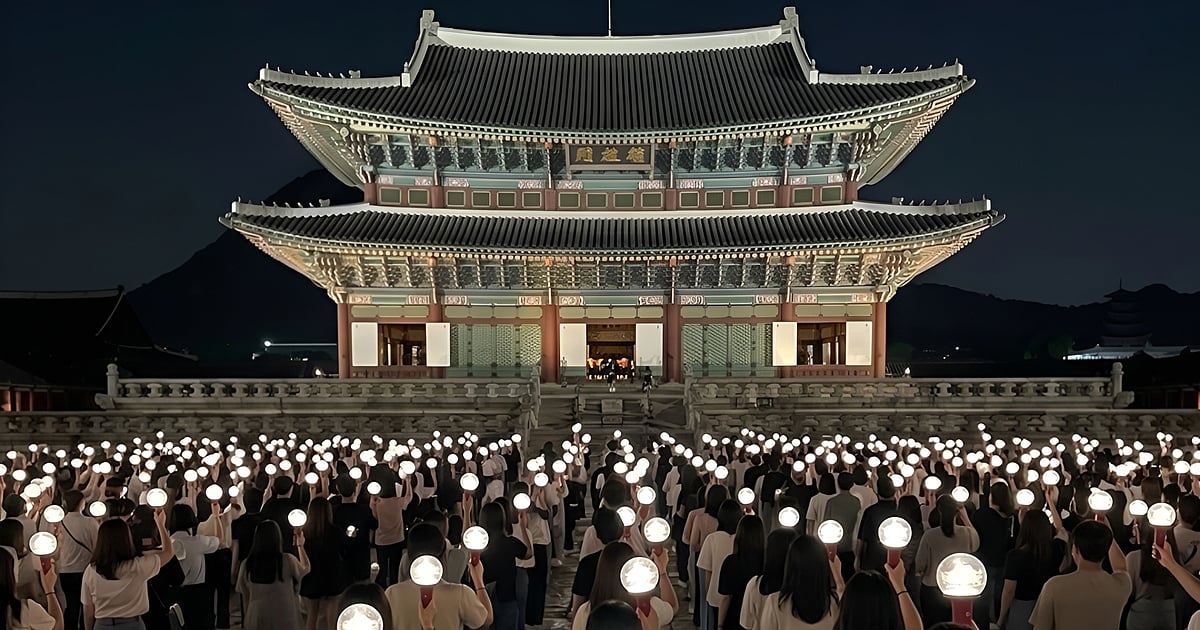
The K-pop lightsticks, a fandom identity, has now outdone itself. What started as a fun cheering activity has now been imbued within the aesthetic of its home country’s heritage. A new set of lightsticks, with a thousand years of Joseon-era heritage, is now available for purchase till May 3.
This limited-edition Palace Light Stick by the K-Heritage Agency is specially made for the 2026 Spring Royal Culture Festival, set to end on the same day. With such items, which are usually associated with pop culture, marks a startling structural pivot in Korean soft power. It is a moment where South Korea’s past and its high-speed present are blending.
K-pop Inspired Royal Palace Lightstick and Other Merchandise of Statecraft
This K-pop lightstick inspired item is not just a festival souvenir; rather, a strategic “experience economy” at play. Influenced by the Gyeonghoeru banquet pavilion of Gyeongbokgung Palace, the lightstick is created in a partnership with Kream, an online shopping and reselling platform.
As per Seoul Economic Daily, the merch collection sale began on Kream from April 24, and is created to build traditional symbolism within contemporary life. The merch lineup includes:
- Whiskey glasses featuring Joseon-era tiger motifs.
- Safety key rings inspired by the chimney patterns of Jagyeongjeon Hall.
- Stickers drawn from traditional genre paintings.
"This collection was designed so that people can enjoy the symbolism of traditional culture in their daily lives," a Kream official told Seoul Economic Daily.
K-Heritage x KREAM Products Including Palace Lightstick (Image Credit: KREAM)
Sold Out: Korean Heritage Tours Now Rival K-Pop’s Biggest Shows
The demand for K-culture tours exploring the country’s history has reached a new high. According to the Korea JoongAng Daily, securing tickets for such tours (the K-Royal Culture Festival) has attained a market demand that matches any grand K-pop arena tour, like that of BTS. The Korea Heritage Service notes that visitors to royal palaces, tombs, and the Jongmyo Shrine hit a record 17.8 million last year. Interestingly, that momentum has increased by 13.1% in mid-April 2026.
The competition for access is startling:
- Seokjojeon Hall (Deoksu Palace): Gaining a ticket for its night tour, where visitors dine on royal desserts for ₩35,000 (~ $24 USD), is now a 137 to 1 gamble.
- Gyeongbok Palace Restoration: The site has grown from 36 buildings to 148 since the 1990s, permitting new programs like the saenggwabang experience.
- Cinema Synergy: This spring’s saenggwabang experience includes a special edition inspired by King Danjong. Notably, this historical figure captured the attention of 16.5 million people via the February release of the film The King's Warden.
Gyeongbokgung Palace, Gwanghwamun Square (Image Credit: istock)
The Global K-pop Synergy: BTS and its Netflix Effect & BLACKPINK
The gravitational pull of these landmarks had been further amplified by a systematic cultural push between the Ministry of Culture and entertainment titans like BTS and BLACKPINK.
On March 21, BTS converted Gwanghwamun Square into a global stage for their fifth album, Arirang. They also named their album after Korea’s iconic folk song. Notably, their Gwanghwamun Square performance came through the gates of Gyeongbok Palace and the ceremonial woldae stage, a pathway that was only reserved for the historical figures in ancient times. People in 190 countries witnessed this iconic moment live via Netflix streaming, which drew in more than 18 million viewers.
BTS (Image Credit: Netflix X Twitter Account)
To capitalize on the period before BTS’ return, the Ministry of Culture opened guided programs across five national institutions: the National Museum of Korea (NMK), the National Museum of Modern and Contemporary Art (MMCA), the National Folk Museum, the National Museum of Korean Contemporary History, and the National Library. They provided foreign visitors with knowledge about Korean artifacts, many of which directly inspired BTS members and their exclusive Arirang merch line, such as the gilt-bronze pensive bodhisattva.
Simultaneously, BLACKPINK also initiated their Deadline EP promotion by tapping into the National Museum of Korea. The group, notably, illuminated the NMK in their signature pink color and became the first K-pop act to have a large-scale collaboration with the institution. Interestingly, the members of the band also provided voice commentary for eight signature artifacts in various languages apart from Korean, like Japanese and English.
K-Heritage and History: Part of an Innovative Pop Culture?
The results from the collaborative efforts with the K-pop industry and individual government push are showcased in the global rankings. As reported by Korea Times, National Museum of Korea Director You Hong-june noted in “The Korea Forum 2026,” that the National Museum of Korea now ranks third globally owing to its 6.5M visitorship. The museum notably trails only behind remarkable landmark sites like the Louvre and the Vatican.
To potentially maintain this solid trajectory, a “2026 Museum Week” will run through May 31. It will involve 310 institutions under the theme "Museums uniting a divided world” and will coincide with International Museum Day (May 18), and will include the following:
- Lectures, special exhibitions, and hands-on activities.
- A “Museum X Stroll” to boost engagement beyond Seoul into Gongju, Gyeongju, and Jeju Island.
"We hope this will offer a chance to rediscover the value of culture and arts in daily lives," said Jung Hyang-mi, director general of the Culture Policy Bureau, to Korea JoongAng Daily.
K-Heritage’s Preservation Crisis: Walking the Razor’s Edge
However, this “living history” model does come with risks. Hanyang University Professor Lee Hoon, recently told Korea JoongAng Daily that additional programs prevent palaces from becoming “static relics,” the footfall increase is testing the “realistic limits” of preservation.
The fear previously turned out to be true on March 28, when a fire broke out at Gyeongbok Palace. This served as a grim reminder of the fact that such assets are indeed very delicate. In a conversation with the same media outlet, Ahn Ho of the Korea Heritage Service's Palace and Tombs Center noted that while there are persistent requests to increase programs, they are working within strict management limits.
Additionally, Kim Hyeong-woo of the Korean Peninsula Culture and Tourism Institute further added, “As performances by BTS have shown, palaces are expanding from historical assets into hubs of contemporary K-culture,” and such sites “should serve as focal points for tourism by offering more diverse events within a virtuous cycle in which utilization supports preservation.”
The Bottom Line of K-Heritage Tourism
From the meeting rooms of Sulwhasoo, Terarosa, Nongshim, and Millie’s Library, all of whom have partnered with a notable K-heritage celebration named K-Royal Culture Festival, showcase that corporate South Korea is betting big on the country’s history.
As the traditional tunes of Arirang stir a deep cultural resonance within BTS’ Body to Body, the palace light stick stands as the real manifestation of a clear state strategy: South Korea has stopped treating its heritage as only historic relics and has begun treating it as an element of the dynamic global pop culture. This fragile equilibrium that connects commercial utility and historical preservation might be risky, but for now, the past could provide South Korea with a profitable future.