




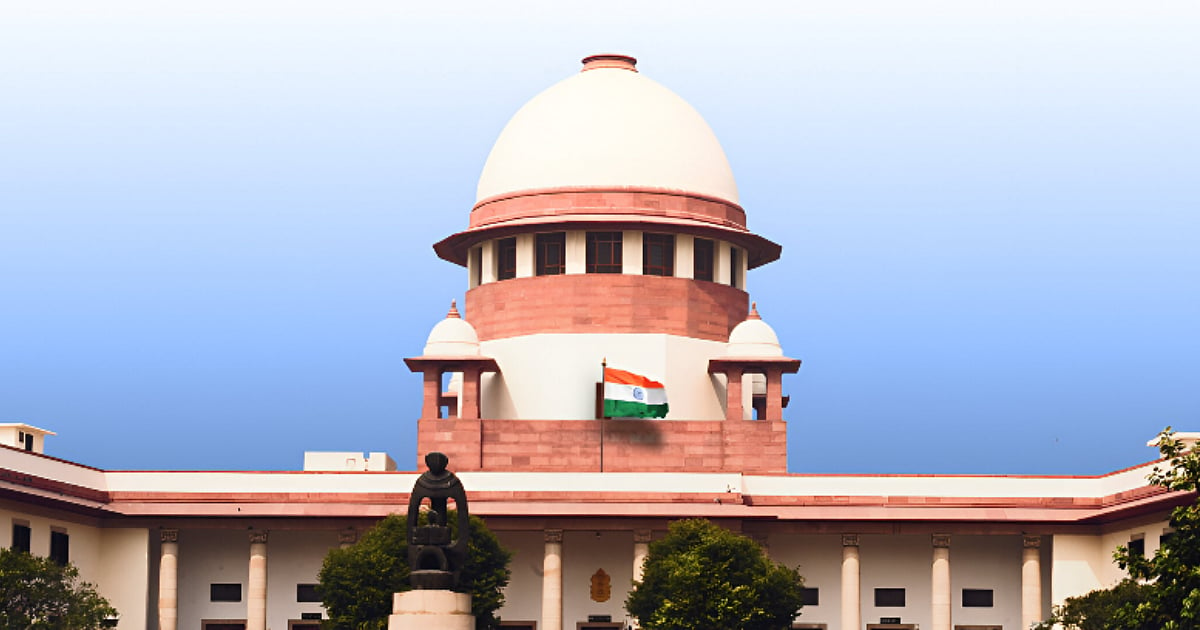
Supreme Court Upholds 28% GST on Real Money Gaming (Image Credit: sci.gov.in)
SC Upholds 28% GST on Online Money Gaming, Fantasy, Casinos
The Supreme Court upheld the levy on real-money games with pooled stakes as constitutionally valid and rejected challenges to retrospective tax demands, dismissing petitions from operators

Highlights
- The Supreme Court upheld the 28% GST on online money gaming, fantasy sports and casinos as constitutionally valid and rejected challenges to retrospective tax demands.
- The court held that a game becomes betting for GST purposes the moment money is staked on an uncertain outcome, regardless of whether skill or chance decides the result.
- GST applies to the full amount staked by users, not just the platform fee, in a dispute estimated at ₹2.5 lakh crore.
The Supreme Court on Wednesday upheld the 28% goods and services tax on online money gaming and rejected challenges to retrospective tax demands, ruling against the industry in a dispute that had run for more than two years.
A bench of Justice J.B. Pardiwala and Justice R. Mahadevan held that organized online money gaming, including fantasy games built on pooled stakes and contingent prize structures, gives rise to "actionable claims" that are taxable under GST as betting and gambling. The ruling came in the Directorate General of GST Intelligence's appeal against Gameskraft Technologies, alongside related petitions filed by gaming operators including Delta Corp and industry bodies such as the All India Gaming Federation, the E-Gaming Federation and the Federation of Indian Fantasy Sports.
The ruling applies to online money gaming, fantasy sports and casinos, the formats the petitioners operated. The court's reasoning turns on the "actionable claims" that arise when players stake money into a common pool and winnings depend on an uncertain outcome. Games sold for a one-time price, or played without staking money, do not involve the pooled-stake structure the bench described.
The petitioners had argued that the 28% rate should apply only from 1 October 2023, the date the GST Council's amendments took effect. The government countered that the amendments clarified the existing legal position rather than creating a new levy, which kept the earlier demands valid. The court accepted that view.
Why the court said skill-based games still count as betting
The industry's defence has long rested on the distinction between games of skill and games of chance, with operators arguing that skill-based formats sit outside betting and gambling. The court rejected that argument.
It held that the character of betting does not depend on whether skill or chance decides the outcome, but on whether money is staked on an uncertain result. Once participation requires staking money on an uncertain outcome, the bench ruled, the transaction becomes betting and gambling for GST purposes, even where the game involves substantial skill.
The ruling also overturns a 2023 Karnataka High Court order that had quashed a show-cause notice against Gameskraft involving tax demands of over ₹21,000 crore. The Supreme Court restored those notices and directed adjudicating authorities to proceed in line with the principles laid down in the judgment.
The court further held that operators are not merely intermediaries connecting users but are themselves suppliers of actionable claims. Amounts staked by users count as consideration under the GST Act, it found, and there is no statutory basis for excluding prize pools, winnings or payouts when computing taxable value. That means GST applies to the full value of bets rather than to platform fees or gross gaming revenue alone. On a ₹100 deposit, the tax rises from about ₹1.8 under the platform-fee model to ₹28 on the full face value.
On the constitutional question, the bench rejected challenges under Articles 14, 19, 20, 21 and 265 of the Constitution. It held that commercial hardship, lower profitability or a heavier tax burden cannot by themselves make a fiscal measure unconstitutional.
The verdict lands on an industry already reshaped by regulation. Parliament passed the Promotion and Regulation of Online Gaming Act in August 2025, banning online money gaming. The law came into force in May 2026 and hit platforms including Dream11, Gameskraft and Games24x7. Most real-money ventures have since shut down or moved into new businesses that have yet to bring in meaningful revenue.

Author
Vignesh Raghuram is the Editor of Outlook Respawn, where he leads editorial strategy across gaming, esports, and pop culture. With a decade of experience in gaming journalism, he has established himself as a trusted voice in the industry.