






Fans criticize the Recording Academy's new Asian Pop category for the 2027 Grammy Awards as institutional gatekeeping.
New Grammys 2027 Rules Gatekeep BTS and Other Global Acts?
Grammys 2027 overhaul makes fans question what true global recognition should look like.

Highlights
- The Grammys' new Asian Pop category has ignited a debate, with people questioning if the institution is creating a separate lane for Asian stars.
- Beyond the controversy, the Recording Academy has also rolled out major voting and eligibility changes that could redefine the awards race.
- The fiery discussions online about the overhaul have people recalling older controversial award categories.
The Recording Academy has revealed a major structural overhaul for the 2027 Grammy Awards by introducing five new categories and a revamped voting system. Headlined by the debut of Best Asian Pop Music Performance, the new categories announced are Best R&B Collaboration and Best Latin Song.
Notably, Recording Academy CEO Harvey Mason Jr. framed the updates as an effort to reflect "the breadth of today's music industry." However, the expansion has sparked a bitter, long-standing debate over how Western institutions acknowledge non-Western commercial juggernauts. The debate arrives particularly with the newly minted Asian Pop category, which explicitly recognizes K-pop, J-pop, C-pop, and associated Asian-language tracks.
BTS and Asian Music Fans Speak Up Against Grammy Awards’ Asian Pop category
Global audiences and K-pop fans, particularly supporters of Asian powerhouses like BTS, have labeled the new Grammy Asian Pop category as a containment strategy, a method of gatekeeping Asian acts institutionally. Critics argue the Academy is separating these chart-dominating global forces to safeguard mainstream domestic pop stars from direct competition in key fields like Record and Album of the Year.
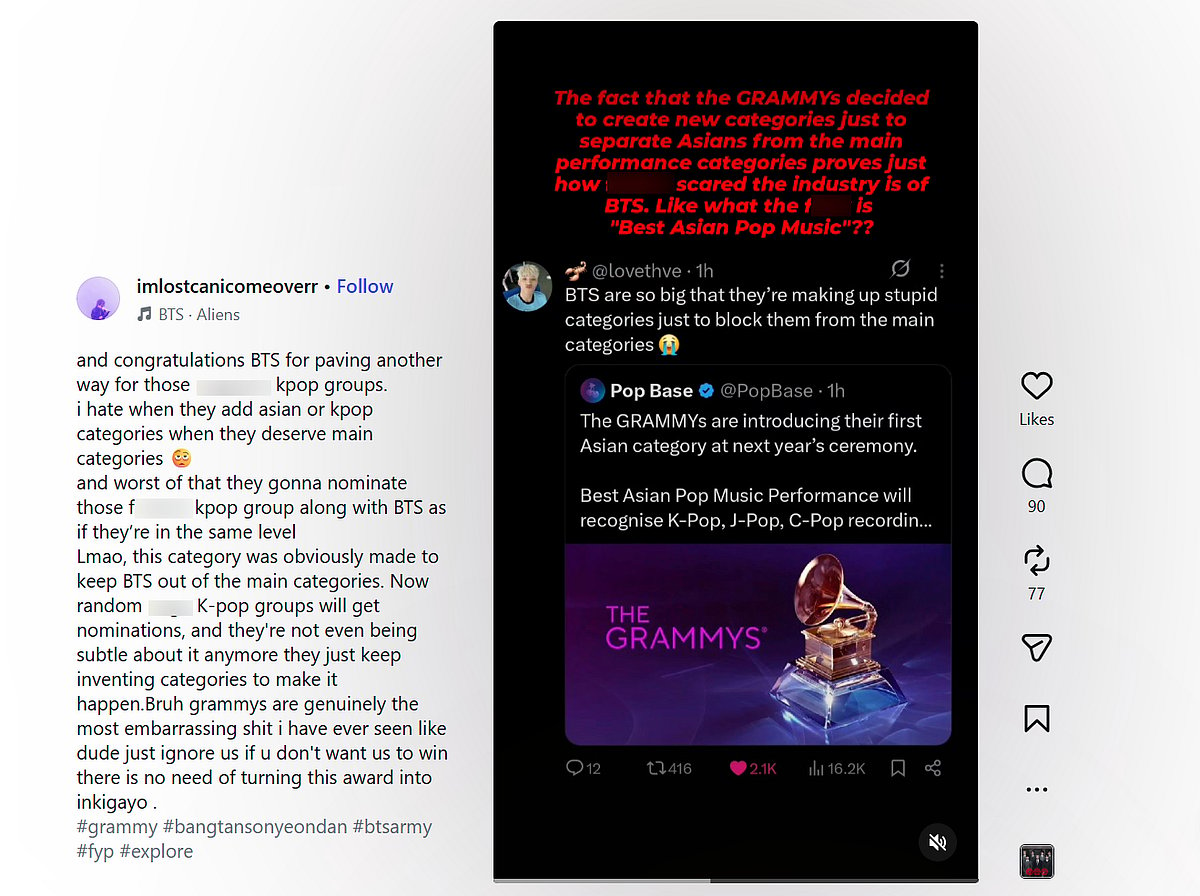
SCREEN CAPTURE FROM INSTAGRAM
Many pop culture and music fans have found the move to be closely echoing the controversial legacies of the World Music and the Urban Contemporary labels. These two labels reportedly acted as silos in the past that quarantined international and Black artists away from mainstream integration.
The Academy originally introduced the Best World Music Album category in 1992. However, it was renamed to Best Global Music Album in 2020 after many pointed out that the term “world music” effectively “othered” non-Western artists.
On a similar note, the “Best Urban Contemporary Album” was also rebranded in 2020 as “Best Progressive R&B Album” after a big public pushback that “urban contemporary” acted as a reductive, selective catch-all for Black music. Critics online are arguing that, much like these past categories, the latest updates risk repeating history by isolating dominant international acts from the major award categories.
K-pop at the Grammys
BTS was the first K-pop artist to represent the genre at the biggest music awards night. As per BTS' Grammy history, in 2019, the group presented an award during the ceremony, marking the genre's first major on-stage role. Additionally, BTS had earned five nominations across categories, including Best Pop Duo/Group Performance and Best Music Video throughout 2021-2023; however, they did not take any trophies home.
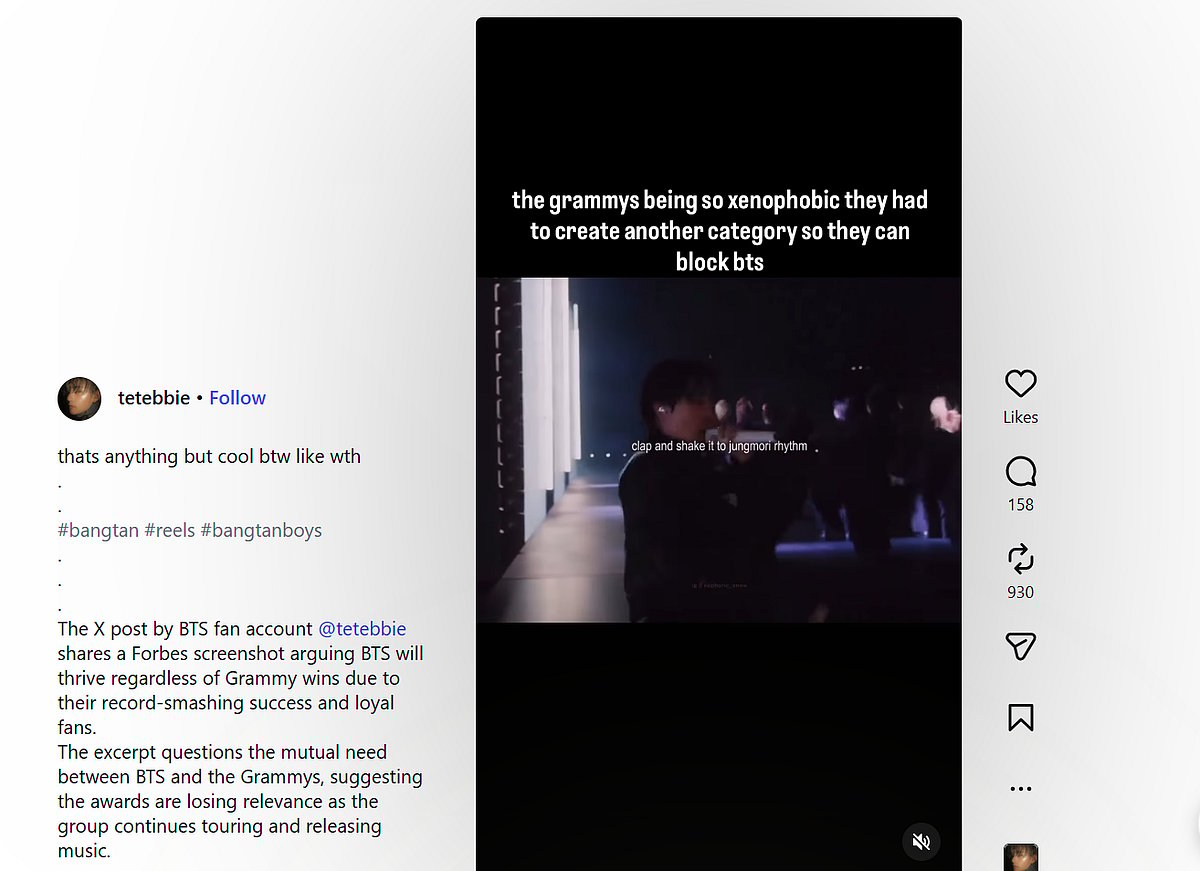
SCREEN CAPTURED FROM INSTAGRAM
Meanwhile, in 2026, BLACKPINK's Rosé also earned a Grammy nomination for Record of the Year with APT. alongside Bruno Mars. Recognizing Asian music in major categories showcases its presence on the global stage, rather than the current complicated relationship K-pop has with the Grammys. The new rules have challenged whether Asian music belongs in mainstream competition or separate recognition.
Grammy Awards 2027: Shift to "Ballot Plus" and Operational Tweaks
Apart from the cultural flashpoint, the 69th Grammys will introduce significant operational adjustments, including the introduction of the new "Ballot Plus" initiative. This new method will allow qualified voting members to opt into voting for up to 15 peer-related categories based on verified credits, providing a flexible alternative to the usual 10/3 voting framework. Additionally, the Academy has lowered the threshold of new recordings needed for album eligibility from 75% to 66%, while also offering direct statuette eligibility to songwriters and composers across most genre album categories.
Yet, as the music world gears up for the February 2027 awards night, this technical overhaul is mostly getting overshadowed by the bigger cultural debate. Although the new rules may be an attempt to democratize music’s highest honor, many are anxious about whether the institution runs the risk of transforming a gesture of global inclusion into another modern glass ceiling.

Author
Diya Mukherjee is a Content Writer at Outlook Respawn with a postgraduate background in media. She has a passion for writing content and is enthusiastic about exploring cultures, literature, global affairs, and pop culture.




Related Articles