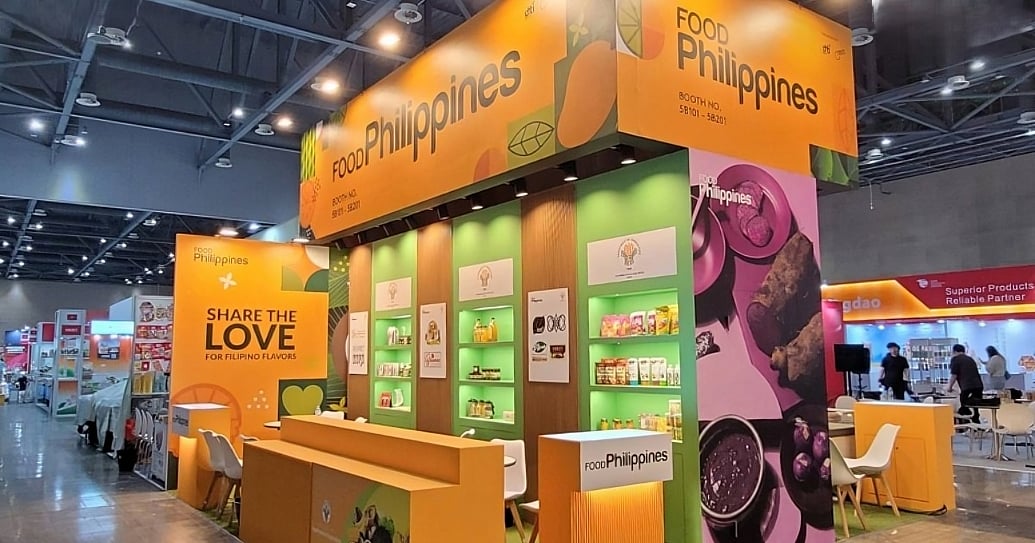
The new FOODPhilippines country pavilion debuts at the Seoul Food 2026 exhibition.
Philippines Targets South Korea’s $37B Food Import Market
Tariff-free trade windows and changing consumer demand are allowing Philippine exporters to deepen their foothold in South Korea’s evolving food market.

Highlights
- South Korea’s growing dependence on imported food is generating a rare opening that may soon be captured by the Philippines.
- A new trade framework is offering Filipino exporters an advantage as they push beyond traditional product sales.
- Behind the showcase is a bigger strategy to secure long-term shelf space and stronger commercial ties in one of Asia’s most lucrative food markets.
The Philippines has opened its first formal country pavilion at Seoul Food 2026, which brings together 24 Filipino companies at the KINTEX convention center in Seoul. The four-day event, which kicked off on Tuesday (June 9, 2026), is the Philippines’ biggest institutional push into the Korean market since its Free Trade Agreement (FTA) materialized in December 2024.
Philippine Food Brands Seek Korean Market Share
The bilateral trade pact avoids tariffs on 94.8% of Philippine exports, providing a quick edge to beat the local competition. The move comes at a significant time, when limited domestic arable land and a rapidly aging rural workforce are forcing South Korea to rely on imported food. The acceleration has reached such a pace that the country brought in massive agricultural acquisitions last year, amounting to almost $37.4 billion USD, according to The Korea Times. Although the Philippines exported over $3.5B in overall goods to South Korea in 2024, agricultural and food products accounted for a modest $300M to $350M.
To meet this macroeconomic gap, Manila’s trade tool has structured the exhibition into two unique commercial gateways under the “FOODPhilippines” banner. The Center for International Trade Expositions and Missions (CITEM), which is the export promotion arm of the Philippine Department of Trade and Industry, is handling 16 companies focused on processed goods, including integrated food conglomerates like Oleo-Fats and Phil-Union Frozen Foods. Simultaneously, the Philippine Department of Agriculture is also sponsoring eight midtier enterprises aiming at niche confectioneries and high-end fresh crops.
The approach indicates a wider industrial change that shifts away from low-margin raw commodity shipments toward higher-value, finished consumer goods. Philippine trade officials expect that the tariff exemptions could secure the country's food exports premium shelf space across South Korea’s highly competitive retail and convenience sectors. These export items include processed tropical goods like coconut oil and banana chips, as well as purple yam and calamansi concentrates.
Free Trade Agreement Benefits Drive Filipino Food Exports to Korea
Bilateral momentum between the two countries has been solidifying since earlier this year, when South Korean buyers ranked among the top 10 international delegations at Manila’s flagship domestic trade show, IFEX Philippines. To sustain this momentum, commercial data and digital storefronts for the exhibiting firms have been consolidated on the country’s trade portal, ifexconnect.com.
"International trade exhibitions represent the precise touchpoints where diplomatic relations and commercial strategies intersect," said CITEM Executive Director Leah Pulido Ocampo, as noted by The Korea Times. As KINTEX puts the spotlight on emerging trends, Manila is betting on that very opportunity to shift the trade balance in its favor with Seoul permanently.

Author
Diya Mukherjee is a Content Writer at Outlook Respawn with a postgraduate background in media. She has a passion for writing content and is enthusiastic about exploring cultures, literature, global affairs, and pop culture.



Related Articles