




Highlights
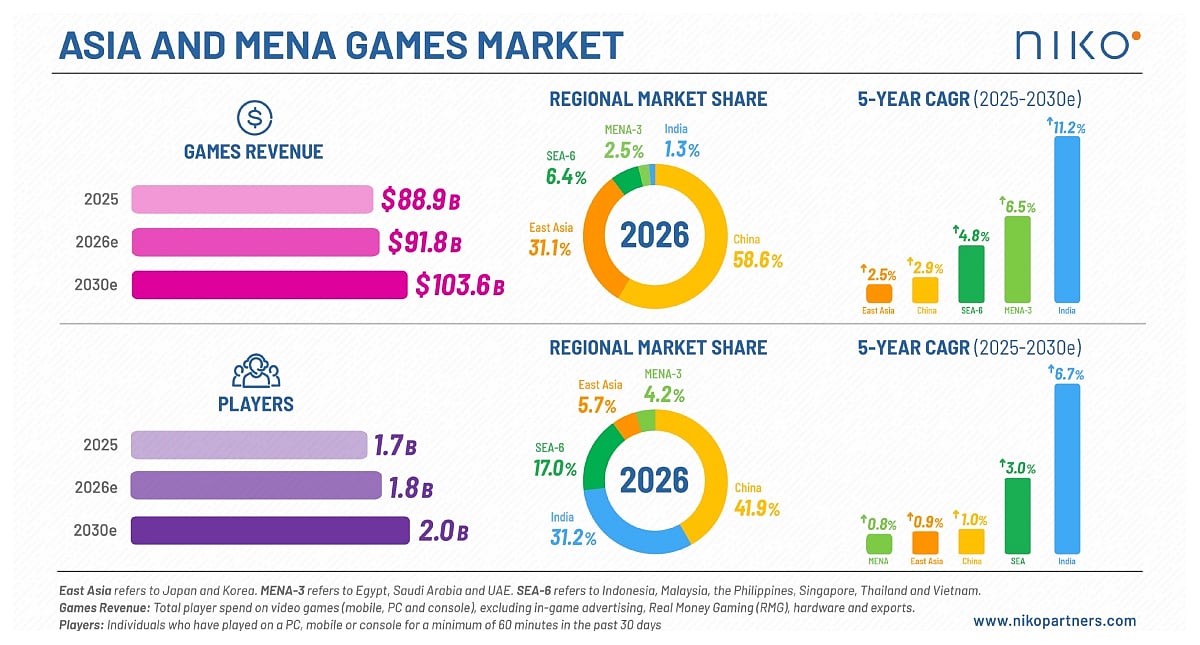
- Asia and MENA gaming revenue is set to hit $103.6 billion by 2030, led by a 3% CAGR.
- Mobile gaming drives the region, bolstered by a growing demographic of female players.
- India and the MENA-3 cluster show the fastest growth, while China remains the primary revenue powerhouse.
The video game landscape across Asia and the Middle East and North Africa (MENA) is booming, fueled by an ever-growing community of passionate players. According to the 2026 Market Model report from gaming research firm Niko Partners, the combined region is on track to cross the historic $100 billion USD revenue mark within the next five years. After generating $88.9B in 2025, an increase of nearly 3% year-over-year, the market is projected to reach a staggering $103.6B by 2030.
This steady climb, operating at a 3% five-year compound annual growth rate (CAGR), is driven by multi-dimensional growth and explosive player expansion across emerging markets. By the end of the decade, the total number of players across the regions is expected to climb from roughly 1.8B in 2026 to just shy of 2B, as per Niko.
While the entire region is thriving, India has firmly established itself as the fastest-growing gaming market tracked in the report. Already home to over 500M players, the country is expanding at an impressive 11% five-year CAGR and is projected to become a nearly $2B market by 2030. Much of this momentum is in the palm of players' hands, with Indian mobile player spending alone expected to cross the $1B milestone in 2027 as local audiences diversify into genres well beyond traditional battle royale titles.
MENA-3 Cluster Ranks Second in Revenue Growth
Following closely behind India's explosive growth is the MENA-3 cluster, comprising Saudi Arabia, the United Arab Emirates, and Egypt. Ranking second in revenue growth, this trio is slated to reach a combined $3B in player spending by 2030, with average annual revenue per user rising by $10 over the forecast period.
The industry's center of gravity is also making notable shifts toward Southeast Asia, where major financial milestones are rapidly approaching. Thailand is on track to hit the $2B revenue mark as early as 2026. Meanwhile, Indonesia is forecasted to reach $1.5B alongside a massive player base of 144M by 2030, and Vietnam is seeing a similar surge, with its gaming community expected to reach 68M players by the end of the decade.
Despite the rapid expansion in these emerging territories, legacy gaming capitals continue to command the lion's share of the cash. Even as their growth rates begin to stabilize, the mature markets of China, Japan, and South Korea are projected to account for 89% of total regional revenue by 2030, translating to a massive $91.7B in player spending, as per Pocketgamer.biz.
Photo by Pandhuya Niking on Unsplash
Mobile Mini-Games and Female Players
Behind these massive financial figures is a rapidly evolving player demographic and shifting consumer habits. Mobile gaming remains the primary anchor for regional revenue, a trend clearly highlighted in China, where easily accessible mobile mini-games now account for nearly 20% of all mobile game spending in the country.
Simultaneously, the gaming community is becoming far more inclusive. Female players now represent 42% of the total player base across Asia and MENA, up from about 40% the prior year. This marks a massive cultural shift from just five years ago, when markets like India and the MENA-3 cluster skewed 80% male, opening up major new opportunities for publishers targeting casual and mid-core audiences.
The region's future is further supported by an open-minded approach to new technology and a stabilizing regulatory landscape. Unlike Western markets, player sentiment toward generative artificial intelligence is materially more positive in Asia. While gamers still strongly prefer AI to assist behind-the-scenes workflows rather than replace core art or marketing assets, local studios are already reporting notable development efficiencies.
Paired with improving local regulations, such as China increasing its game license issuances and India fostering a healthier ecosystem by banning real-money gaming, a massive cohort of paying gamers ensures that Asia and MENA will continue to lead the global games industry well beyond 2030.