



Highlights
- Over 30,000 redundancies are driving a global talent drain and widespread job insecurity.
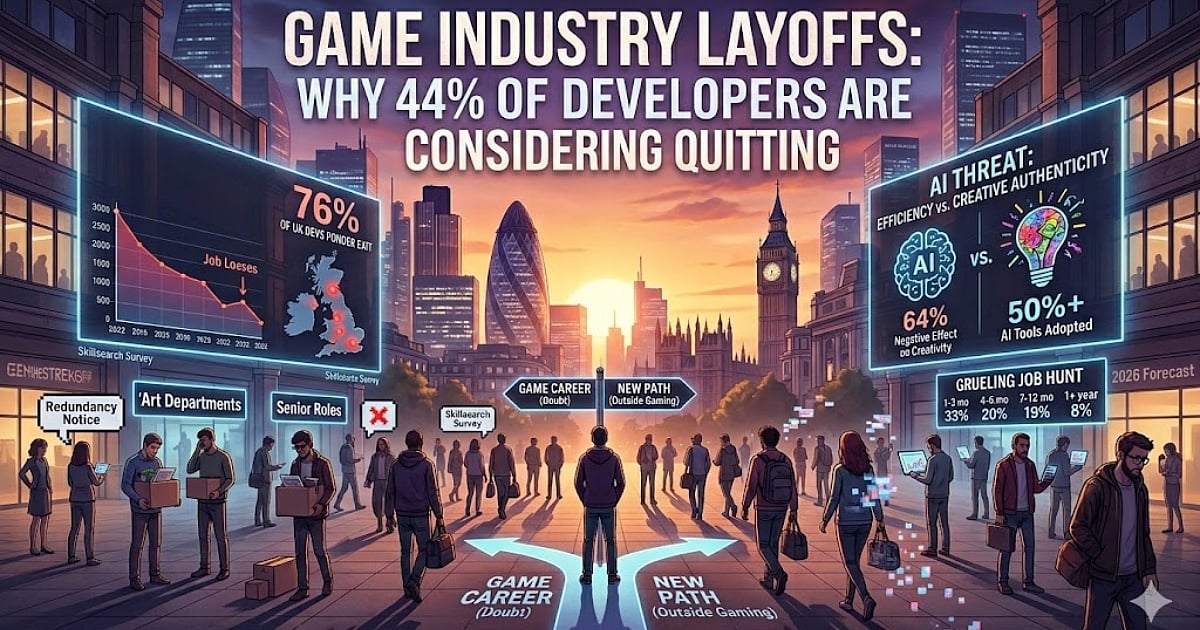
- The UK faces the steepest decline, with 76% of developers considering abandoning the sector.
- Rapid AI integration fuels deep concerns regarding creative authenticity and ethical job displacement.
The video game industry is bleeding its most valuable asset: its people. Following years of devastating studio closures and massive layoffs that have erased over 30,000 jobs since 2022, a staggering 44% of industry professionals are considering abandoning the sector entirely due to redundancies. The crisis is hitting the United Kingdom the hardest, listed as the most impacted country overall. There, an overwhelming 76% of developers state they are either actively planning or considering a career switch outside of gaming by the end of 2026.
These grim figures come from the latest annual Salary & Satisfaction survey by games recruitment firm Skillsearch. The study, conducted between November 12, 2025, and February 24, 2026, gathered insights from 1,000 professionals across the UK, Europe, North America, the Asia-Pacific (APAC), and the Middle East and North Africa (MENA) regions. The data paints a picture of a workforce pushed to the brink. In the past year alone, 22% of respondents were handed redundancy notices, while another 12% lost their jobs more than 12 months ago.
A rare 35% of professionals reported that they or their studios were completely unaffected by the cuts, and another 28% witnessed layoffs at their companies but miraculously managed to keep their own roles. The primary culprits driving these mass redundancies remain reduced investor funding, severe budget cuts, and a complete lack of greenlit projects.
The Grueling Job Hunt and Hardest-Hit Departments
The damage isn't spread evenly. The cuts have disproportionately devastated art departments, which were listed as one of the most impacted areas of redundancy. Also bearing the brunt of the storm are senior-level roles, veterans with over ten years of experience, and developers at large studios with more than 250 employees. For those forced out, the road to recovery is long and exhausting. While 45% of laid-off workers have managed to secure new employment, the trauma of the industry's instability lingers, with only 27% feeling genuinely secure in their new positions.
The job hunt itself is a grueling test of endurance. While 21% found work in less than a month, the majority faced longer waits. 33% took one to three months, 20% took four to six months, and 19% took seven to 12 months. For a deeply unfortunate 8%, the search dragged on for more than a year, as per Gamesindustry.biz.
With survival on the line, developers are shifting their priorities for 2026, citing job security, compensation, and opportunities for more challenging projects as their main drivers. While 53% of professionals expressed a willingness to uproot their lives and relocate for a new job if it offered a higher salary and relocation package, job security and the cost of living remain massive hurdles. In fact, 38% of workers have had to decline job offers entirely because the relocation assistance provided was inadequate.
The AI Threat: Efficiency vs. Creative Authenticity
Adding to the stress of financial insecurity is the rapid, aggressive push of artificial intelligence. Nearly half of the game professionals surveyed are deeply concerned about the increased use of AI tools. For 64% of developers, the technology is seen as having a negative effect on the industry's creative authenticity. Their top fears revolve around job security, the loss of creative authenticity, and ethical use.
However, respondents did highlight some benefits to the technology, such as increased efficiency, cost savings, and greater output from smaller teams. Despite the pushback, the integration is already happening; more than half of respondents reported that they or their company have adopted AI tools, though only 29% said their company actually has ethical AI policies or guidelines in place.
A look at the broader workforce reveals an industry that remains heavily male-dominated at 74%. The majority of the talent pool falls into the 25 to 34 and 35 to 44 age brackets, representing 39% and 37% of the workforce, respectively. Most professionals, about 66%, are in permanent employment, and almost half carry the weight of over ten years of industry experience.
Financially, compensation varies wildly depending on the role. Looking specifically at the UK—which accounted for 43% of all survey responses—salaries translate to roughly $269,775 (£199,833) for C-suite executives, $149,097 (£110,442) for directors, and $40,982 (£30,357) for junior positions. Specialized leadership naturally commands a premium, with director-level roles in programming pulling in about $176,800 (£130,963) and business operations directors earning around $151,868 (£112,495).
Ultimately, as developers weigh these salaries against the looming threat of layoffs and the rise of AI, the games industry faces a critical reckoning on how it protects, values, and retains the human creators behind its biggest titles.