



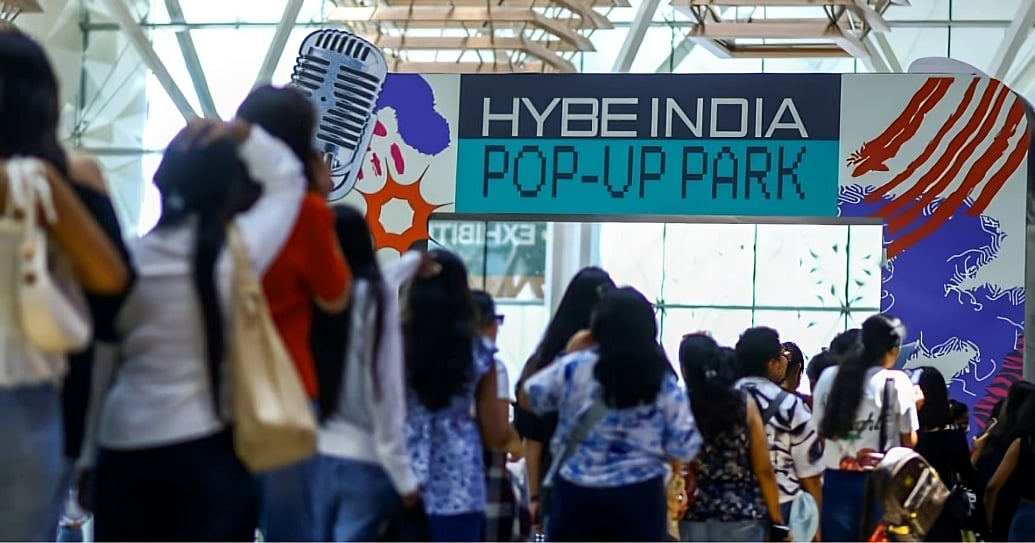
- The sold-out HYBE India Pop-up Park became one of the clearest indicators that K-pop's audience in India has evolved beyond its early adopters.
- The crowd inside showcased why global and Indian brands increasingly see K-pop as a gateway to the country's next generation of consumers.
- What looked like a fan festival quietly became a test of India's entertainment economy and how effective the K-pop ecosystem could be here.
The tickets sold out once. Then HYBE India restocked them, and those sold out too. By the time the gates to the HYBE India Pop Up Park opened in New Delhi, the uncertainty about whether K-pop had a real, paying audience in India was already answered by the audience. Although the entry to the event was free, inside, fans were busy buying exclusive merchandise that was priced at a mid-premium range.
As the event unfolded, it was gradually revealed that the HYBE India Pop-up Park was not just about performances or traditional brand activations but turned out to be the proof of concept for an entire culture industry. The people who visited the event were as young as eight to twelve years old, alongside pop culture (including K-pop) enthusiasts in their late twenties, who were also present.
The Audience at the HYBE Pop-up Park Delhi
The demographic spread was the event's most significant data point. K-pop's Indian fanbase is most densely concentrated among those who are currently teenagers or were of the same age during the 2020–2021 pandemic period. During that time, Korean content like K-Dramas and variety shows with K-pop idols were the key anchor for social connection during lockdowns. When asked during the event about their fandom stay, the majority of the people present traced their stories of being a fan to those two years. For them, BTS remained the lead entry point, followed by newer acts in recent times like Le Sserafim, KATSEYE, and ENHYPEN.
Alongside devoted fans, people who are not the usual “K-pop stans” were present too, some curious about the phenomenon, others there to support friends and family who were either performing on stage or simply enjoying the experience. The social pull was as visible as the fandom itself.
HYBE INDIA POP UP PARK DELHI AT YASHOBHOOMI
Brand installations in the pop-up park drew everyone into the same queues regardless of their interests: the photobooths by HYBE India and H&M, Samsung's 360-degree reel bay, and notably the Nongshim food zone, where visitors got the taste of Korean flavors via instant noodles, all ran lines long enough to test anyone's patience. That reach and the extent of engagement were precisely the point that indicated that K-pop in India is no longer a subculture requiring initiation, but is materializing to a general mainstream audience.
HYBE INDIA POP UP PARK DELHI: NONGSHIM NOODLE STAND
The clearest depiction of that shift was visible when parents were seen accompanying fans of a much lower age. These young fans are not just turning their parents to K-pop, but are normalizing it in the household, thereby lowering the threshold of strangeness until a parent's initial response to a child wanting to audition turns supportive.
One such mother at the event, watching a cover dance showcase, said that she wanted her daughter to audition for the same. When asked about thoughts regarding K-pop and how common it is in her surroundings, she said, “My daughter is a big fan, so we have also become very accustomed to the thing. It is good to keep up with the times. I love the dance regimes these K-pop groups have; it is not only beautiful but also keeps you fit.”
What Corporate Play Did the K-pop Event Reveal?
A closer look at the brand partners who put up the experience hubs revealed that there was a deeper corporate play. H&M, Samsung, Shoppers Stop and KIA, each brand competed for the same Gen Z demographic, whose identity and lifestyle choices are now entangled within the digital culture. And, K-pop, as a genre and an aesthetic system, is among the most powerful lifestyle signals available to reach that section of consumers. And with this HYBE India event, these brands drew in something rare: a self-selected, high-engagement audience that had literally overcome a ticket war to be in the room.
For instance, Samsung's 360-degree reel zone, or the photobooths in particular, highlight that for K-pop fans, creating content isn't just a souvenir but serves as a novelty item to draw in new fans. By providing high-quality setups for this, Samsung seems to be moving past a usual sponsorship deal into a strategy for organic distribution.
HYBE INDIA POP UP PARK DELHI PHOTOBOOTH
Shoppers Stop and H&M's alignment was also legible on similar terms. Gen Z's relationship with fashion and beauty is inseparable from its relationship with K-pop aesthetics, which ranges from stage outfits, styling references, and idol fashion & beauty choices. These have driven mainstream streetwear trends alongside certain beauty products to become the better part of today’s lifestyle.
The Experience Economy
HYBE India issued physical “fandom passports” at registration for fans to collect stamps across various venue experience hubs. Notably, the number of stamps determined which free giveaway items a fan took home: sticker pads, branded fans, or other items. Customizable tote bags and exclusive HYBE India T-shirts were also available for purchase, showcasing that the event aimed at the fan obsession with collecting, a factor that K-pop has mastered with near-unrivaled success in modern pop culture.
The audition pipeline embedded in the event was, perhaps, one of the biggest structural choices. A small team associated with Panchami Ghavri, a prominent OTT and film casting director, was also present on-site. The team was accepting registrations via Google Form with photographs taken in real time. Notably, the Google Form registration needs to mandatorily have the photos taken by the team at the event. Additionally, the random play dance segment offered the top three performers the possibility, if not the guarantee, of an audition pathway. The message the event sent to all was direct that this is not a passive fandom. There is a door here, and it opens quite widely.
Although fans were happy that finally a “first-of-its-kind” K-pop event took place in India, they were hungry for something bigger. “We want to see our favorite groups performing here next,” said a fan, a feeling that resonated with many in the Yashobhoomi hall. With an event like this, fans believe that the Indian K-pop scene is moving somewhere.
What Does it Mean for K-pop Fans in India?
The HYBE India Pop Up Park was, from one perspective, a ticketed, yet free, brand experience that created social content, moved merchandise, and provided corporate partners access to an enthusiastic young demographic. From another, it was a bigger field test to determine if K-pop in India had become mainstream from a niche. Notably, the infrastructure of the fandom, along with the spending capacity and the parental tolerance, including the cross-generational curiosity, is now substantial enough to support a much wider phenomenon. The sold-out tickets to the pop-up event suggest that HYBE already knows the answer. Beyond their plans for a new Indian girl group, the real question is how soon HYBE will bring its established artists to India for global concerts.