



Highlights
- South Korea is positioning K-content less like an entertainment export and more like a strategic industry worth millions in future economic value.
- Government-backed funds are pushing for a greater global expansion of Korean IP, while also keeping the door for foreign investment open.
- The ripple effect extends far beyond the popularization of music and dramas, fueling tourism, consumer spending, and growth across many sectors.
South Korea's content industry has surpassed an important economic threshold, positioning itself as something that is more than a cultural phenomenon. According to Yonhap, K-content exports reached a solid $14.9 billion USD in 2025, thereby making this sector a primary pillar of the country’s macroeconomic strategy, moving side by side with legacy industries like manufacturing and technology, as a core growth engine.
South Korea Bets Big on K-Content
To clear the runway for this expansion, Seoul is implementing active fiscal levers. For instance, Culture Minister Chae Hwi-young increased the government’s 2030 K-culture market target to ₩400 trillion (~ $265B), up from its earlier ₩300T (~ $199B) benchmark. Furthermore, in January, the Ministry of Culture, Sports and Tourism of the country announced that it would launch a ₩731.8B (~ $477.44M) content policy fund this year in partnership with Korea Venture Investment Corp. The amount, according to Seoul Economic Daily, marks a 22% increase from last year, thereby making this fund target the largest one in South Korea’s history. Within this framework lies a ₩200B (~ $130M) Export Fund, structured to scale Korean content firms overseas, while also attracting greater private-sector investment in the process.
BTS THE COMEBACK LIVE | ARIRANG
This state-backed initiative pushes K-content to mature from an isolated entertainment export into a high-yield commercial ecosystem. The usual Korean Wave of music and television dramas has anchored a wider network of gaming, webtoons, fashion, and food over the years. The most tangible outcome of this cross-sector leverage is best visible in the sector of hospitality and physical tourism. According to official data, in 2025, overseas visitor arrivals hit an all-time high of 18.9M, which resulted in a record $14.1B in domestic credit-card purchases made by foreigners.
K-Content Including K-pop is Driving Massive Tourism Demand
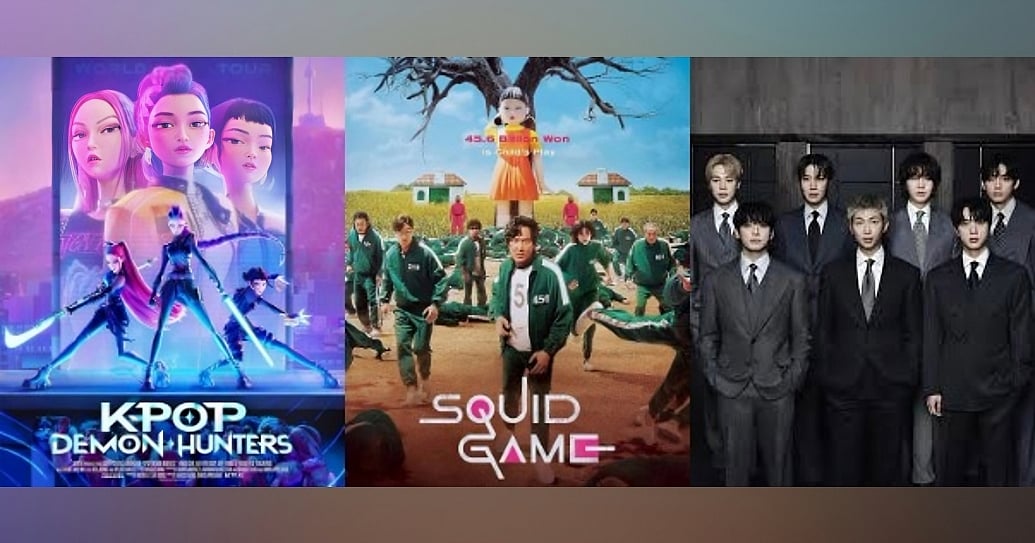
The underlying mechanics of such a financial boost depend highly on the transactional intellectual property. Although K-pop acts like BTS continue to create a massive global profile as well as long-tail tourism demand, other kinds of global content like KPop Demon Hunters is also proving itself to be equally potent at driving concurrent revenue streams. These K-content assets have showcased an immediately international demand for heritage-themed merchandise, travel, and cultural consumption via streaming popularity.
KPop Demon Hunters
Additional 2026 data revealed that after South Korea’s visa liberalization effort, foreign arrivals climbed 21% year-over-year to 6.77M during the first four months of the year. Simultaneously, the domestic film market staged a sharp first-quarter recovery, backed by extensive government production funding. Additionally, theater revenue jumped nearly 59%, with ticket sales rising over 53%, showcasing a significant rebound, as reported by The Korea Times.
South Korea to Use Stronger Policies to Protect Growth?
To support and protect these national cultural assets, designated authorities are strengthening regulatory moats, implementing anti-piracy measures while aiming to maintain stricter copyright enforcement protocols. With all such efforts in play, it is needless to say that K-content is no longer just a diplomatic tool of soft power but operates as one of South Korea's most formidable, resilient economic ecosystems.