






BTS effect pushes South Korean tourism to record highs
BTS Effect Hits Hard: South Korea Smashes Tourism Records in 2026
With over 4 million overseas visitors entering South Korea in the first quarter of 2026, mostly owing to BTS homecoming, the country expects to widen its horizon.

- BTS’ homecoming drove a record 4.76M overseas arrivals in Q1 2026, showcasing a 23% year-on-year rise in tourism.
- The recent concert tourism in South Korea pushed a staggering amount of over ₩55.5B in local spending, with retail and food bills rising more than 1,000%.
- The tourism boom has grown beyond Seoul, with 34.5% of visitors exploring regional spots while also indicating sharp rises in regional air and sea-bound travel.
South Korea’s tourism scenario just rewrote its record books, bolstered by a cultural pull that even a four-year hiatus could not falter. In the first quarter of this year, 2026, a remarkable 4.76 million foreign visitors arrived in the country, marking a 23% jump from the year before in 2025, which is the highest first-quarter figure ever achieved by the country.
The data depicts a widespread recovery, with the drive getting more intensified in March, experiencing a monthly record of 2.06M arrivals. The catalyst, however, was unmistakable: the comeback of BTS.
BTS Concerts Spark Tourism Surge in Q1 2026, Drives Local Spending Boom
BTS’ free concert at Gwanghwamun Square on March 21 drew over 100,000 fans to the heart of Seoul, according to the Korea Times, but the economic effects were felt far beyond the capital's center. Data from Hana Card depict that three subsequent ARIRANG world tour performances at Goyang Stadium boosted the country’s localized economic engine.
Within this paradigm, about 30,000 visitors from abroad contributed a minimum of ₩55.5B (~ $37.6M USD) into the vicinity. Notably, in the week of the Goyang shows, local transaction volume increased by 807%, with convenience stores and cafes experiencing surreal surges of 1,069% and 1,109%, respectively.
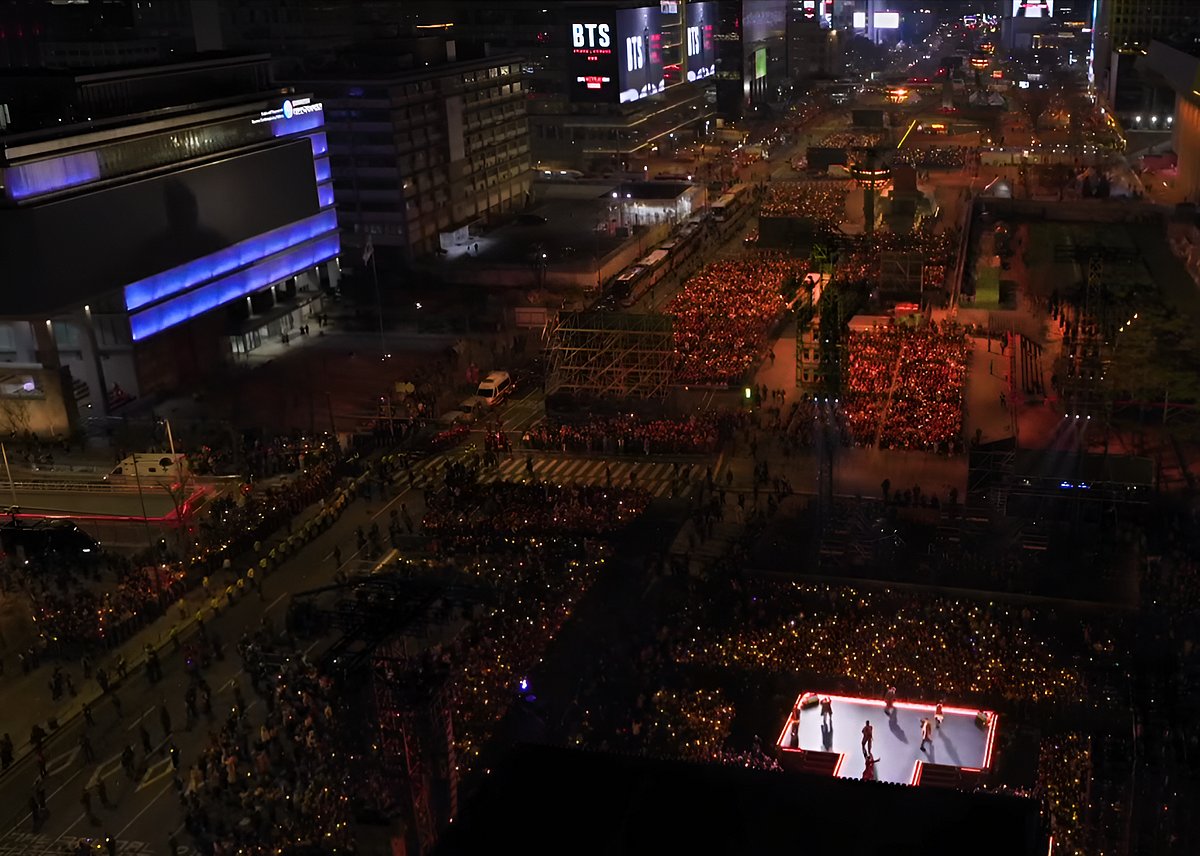
Audience hauling around BTS Gwanghwamun concert stage (on right). Screen Captured from BTS Netflix Live.
These "ARMY" travelers spent less on conventional retail, averaging ₩314,000 (~ $212), while shelling out significantly more for logistics, with per-person expenditure amounting to ₩616,000 (~ $416) for airfare and ₩480,000 (~ $324) for lodging. It is quantified by a 2.1-ticket purchase average, indicating a pattern of repeat attendance whilst the concert runs, as showcased in the same report.
Asia Leads Inbound Growth as Regional Travel Expands Beyond Seoul
This tourist influx is led by Asia, which accounts for 75% of the total. Notably, China dominated with 1.45M visitors, and Japan came next with 940,000 visitors. Nevertheless, Taiwan also showcased some staggering numbers, as one of the fastest-growing markets, indicating a 37.7% rise with 540,000 arrivals. According to industry experts, long-haul interest is also broadening out, as 690,000 tourists arrived in South Korea from America and Europe, indicating double-digit growth from both regions.
The report confirmed that the "K-effect" is finally leaking out of Seoul’s city limits. A significant share of tourists, 34.5%, also visited local provinces. Interestingly, regional airport arrivals rose nearly by 50% to 850,000, with the maritime sector mirroring this vitality. Authorities recorded 338 cruise ships docked at ports in Jeju, Busan, and Incheon. This marked a 52.9% surge for sea-bound travel, signaling a robust rebound as reported by Korea Times and Korea JoongAng Daily.
Altogether, these visitors reportedly spent ₩3.2128T (~ $2.2B) on foreign cards during the quarter, and are leaving contented, with re-travel sentiment hitting a high of 90.8 points. Kang Jeong-won, the Director General of the Ministry of Culture, Sports and Tourism, observed that while K-culture has solidified South Korea as a top-tier destination, the spectrum needs to be wider. Owing to the geopolitical instability in Central Asia, authorities are closely looking at the dual pressures of rising airfares and associated issues, which have the potential of tempering the record growth momentum of this year.

Author
Diya Mukherjee is a Content Writer at Outlook Respawn with a postgraduate background in media. She has a passion for writing content and is enthusiastic about exploring cultures, literature, global affairs, and pop culture.




Related Articles