





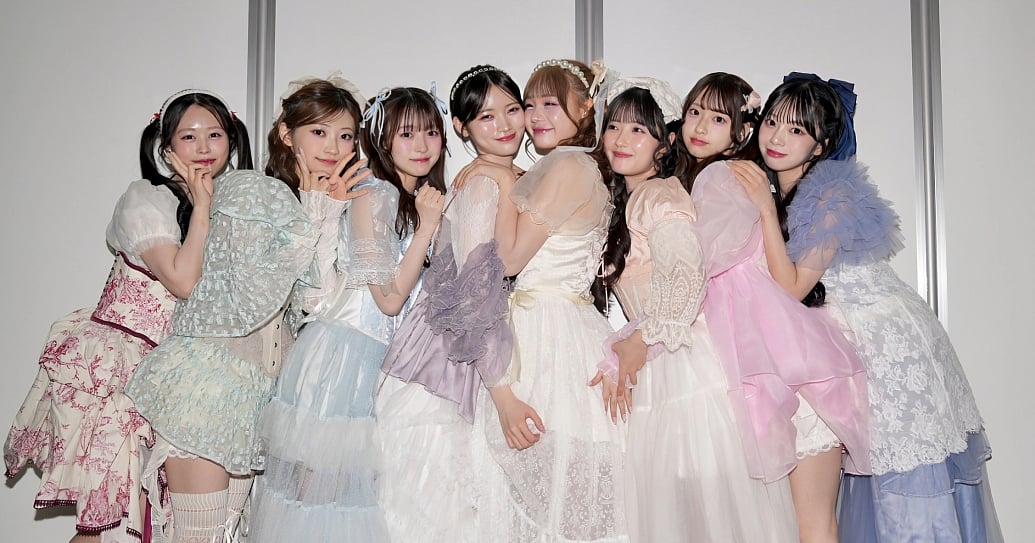
Cutie Street’s viral M Countdown performance marks a turning point as Japanese idol culture gains mainstream momentum in South Korea.
Japanese-pop Finds a New Home in South Korea
As South Korea’s audiences embrace Japanese idol aesthetics more, the once-niche genre has become a rapidly growing concert draw.

- Cutie Street’s popularity in South Korea depicts an expanding mainstream acceptance of J-pop’s “cute” idol culture.
- Social media and streaming algorithms have boosted J-pop’s presence in South Korea, prompting sold-out concerts for Japanese acts.
- Japanese artists are steadily using K-pop-style localization tactics, including Korean-language songs and fan-targeted content, to grow more in South Korea.
When Japanese girl group Cutie Street performed their Can’t We Just be Cute? on Mnet's M Countdown in March, no one had thought that their performance video would cross 11 million views. With pastel dresses and bubbly choreography, the eight-member group’s “cuteness” did not feel exaggerated, and was rather well-received by the Korean audience, with most of them calling the girls "happy shower balls" and "dancing cupcakes." The demand for Cutie Street became so strong that they are slated to visit South Korea in July 2026 for a second appearance. Once dismissed as “childish,” the J-pop style has re-found its popularity in the Korean crowd, indicating something larger.
J-pop’s Quiet Rise in South Korea
Japanese pop had been a niche interest in South Korea for a long period of time. However, the building of its mainstream audience was rather quiet. It received a boost during the time period of 2022-23, further accelerated by social media and short-form content. The turning point in today’s time arrived when singer-songwriter Imase’s Night Dancer became the first J-pop song to get into Melon’s Top 100 in 2023, followed by Yoasobi and Aimyon. Interestingly, social media and streaming algorithms pushed 1980s and 90s Japanese city pop songs to people’s feeds, owing to the growing popularity of the genre in the country. And since then, the wave kept building.
Interestingly, live numbers reveal a more telling story. South Korea's first large-scale J-pop festival, Wonderlivet, climbed from 25,000 attendees in 2024 to more than 40,000 in 2025. J-pop artist Kenshi Yonezu also sold out 22,000 seats across two days on his inaugural South Korea concert leg last year. Additionally, according to K-media reports, upcoming shows by Japanese acts like Back Number and Vaundy are already sold out.
Japanese Acts Borrow K-pop’s Localization Playbook?
The new wave of J-pop in South Korea is distinct from its earlier ones. Japanese artists are now strategically trying to implement what Korean acts have been doing for a long time in Japan, that is, localizing. Many K-pop artists like BTS, BigBang, Twice, and Red Velvet have released Japan-special albums and songs, bolstering the popularity of K-pop in the country. Following a similar path, Cutie Street has also reportedly released a Korean-language version of its song Can’t We Just be Cute? And has also been producing vlogs and short-form content especially for Korean fans, while also speaking sometimes in Korean.
“It is similar to how Korean artists promote themselves in Japan,” said culture critic Kim Sung-soo to The Korea Herald. “Now, it seems that Japanese artists are using localized strategies to enter the Korean market and appeal to a broader audience, including those that weren’t avid listeners of Japanese music,” Kim added, further highlighting the acknowledgement of the efforts’ sincerity.
The Korea Herald also observed the diversification of the genre from Japan. “Until now, J-pop in Korea was mainly associated with bands and rock,” critic Lee Moon-won said to the publication. “But idol music and dance pop are beginning to enter as well.” With Japanese animation also receiving unexpected traction in South Korea, Lee's outlook is clear: that the Japanese trend has room to grow in the country.
Author
Diya Mukherjee is a Content Writer at Outlook Respawn with a postgraduate background in media. She has a passion for writing content and is enthusiastic about exploring cultures, literature, global affairs, and pop culture.



Related Articles