




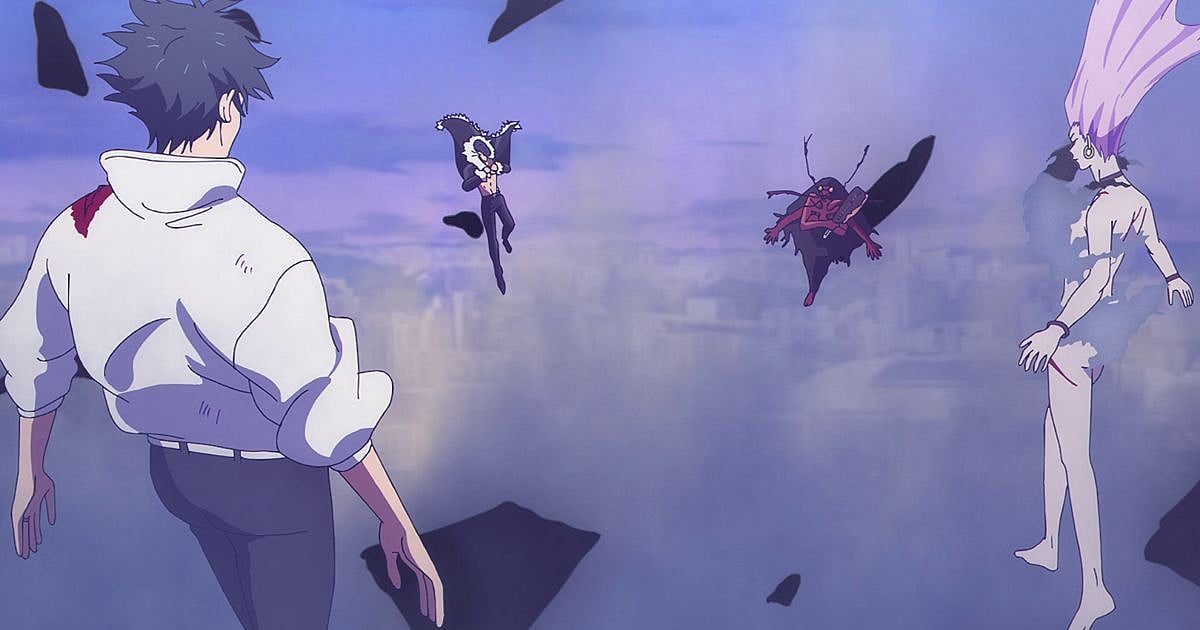
Three domain expansions open simultaneously. Then a fourth party walks in. | Credit: MAPPA
Jujutsu Kaisen Season 3 Episode 12 Review & Recap: Yuta vs All
The Sendai Colony delivers with an epic 28-minute finale. Yuta fights three special-grade opponents at once, and closes out this cour with one of the best episodes of shonen anime in this decade.

Highlights
- Jujutsu Kaisen Season 3 Episode 12 adapts Chapters 174 to 181 in 28 minutes, covering Yuta Okkotsu's full Sendai Colony run against Kurourushi, Takako Uro, and Ryu Ishigori.
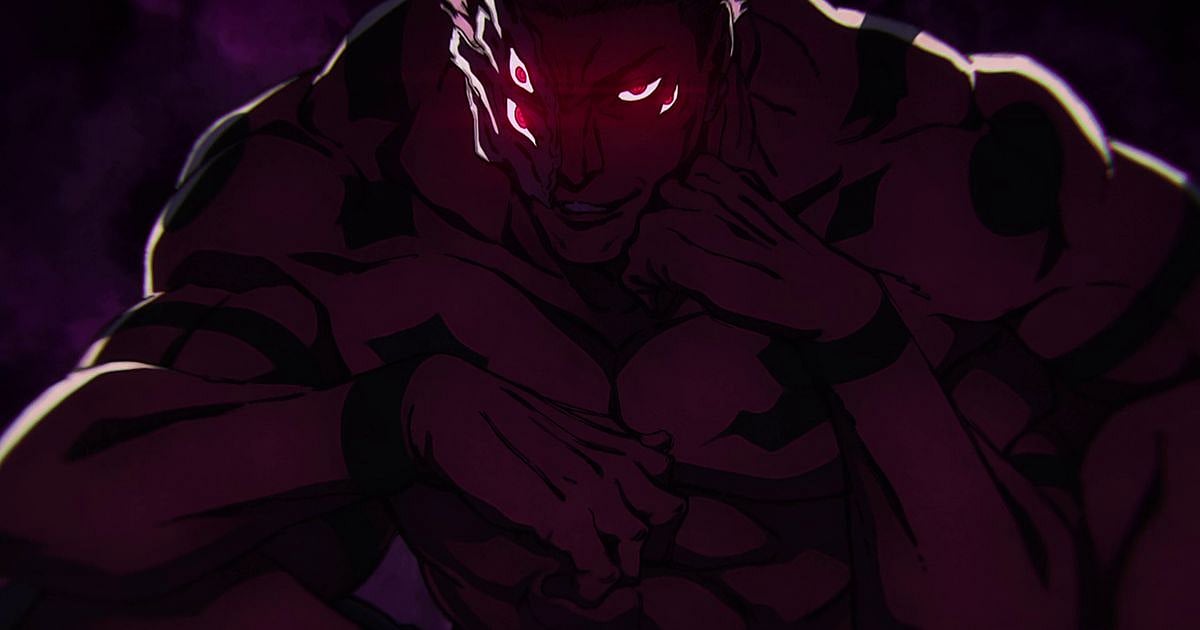
- The episode features the anime's first look at Sukuna's true form, the first three-way simultaneous domain expansion in the series, and Yuta's full manifestation of Rika.
- Director Gosso closes out JJK Season 3 Part 1 on his best episode, with MAPPA's animation and the Aizo full version ending delivering a mid-season finale that raises the bar for battle shonen adaptations.
Jujutsu Kaisen Season 3 Episode 12, titled "Sendai Colony," is the mid-season finale of Culling Game Part 1 and the last new JJK content for the foreseeable future. It adapts Chapters 174 through 181 of the manga, covering Yuta Okkotsu's full run through the Sendai Colony: first against Kurourushi, then against Takako Uro and Ryu Ishigori in a three-way battle that escalates into simultaneous domain expansions, a reborn cursed spirit, and a final beam clash that closes the cour on a perfect note.
Eight chapters in 28 minutes. On paper, that sounds like a recipe for a rushed mess. What MAPPA delivered instead was the best episode of the season.
If Episode 11 was a chess match between two sorcerers who ran out of pieces, Episode 12 is a demolition derby where every car is on fire and the driver is enjoying every second of it. The Sendai Colony does not do slow. It does not do ambiguity. Every fighter here operates at a level that makes the Tokyo No. 1 Colony look like a warm-up act. Megumi and Yuji would not have lasted an hour in this place.
Yuta Okkotsu vs Kurourushi in the Sendai Colony: what happens and why it matters
The episode opens right where Episode 11 ended: Dhruv Lakdawalla is dead, his shikigami have vanished, and the deadlock that kept the Sendai Colony frozen for weeks is gone. Yuta is standing with a group of civilians he has been shepherding through the colony. He tells them to rest inside the stadium that Dhruv used as a base, betting correctly that the location's recent history will deter most players from approaching.
He is wrong about what approaches first.
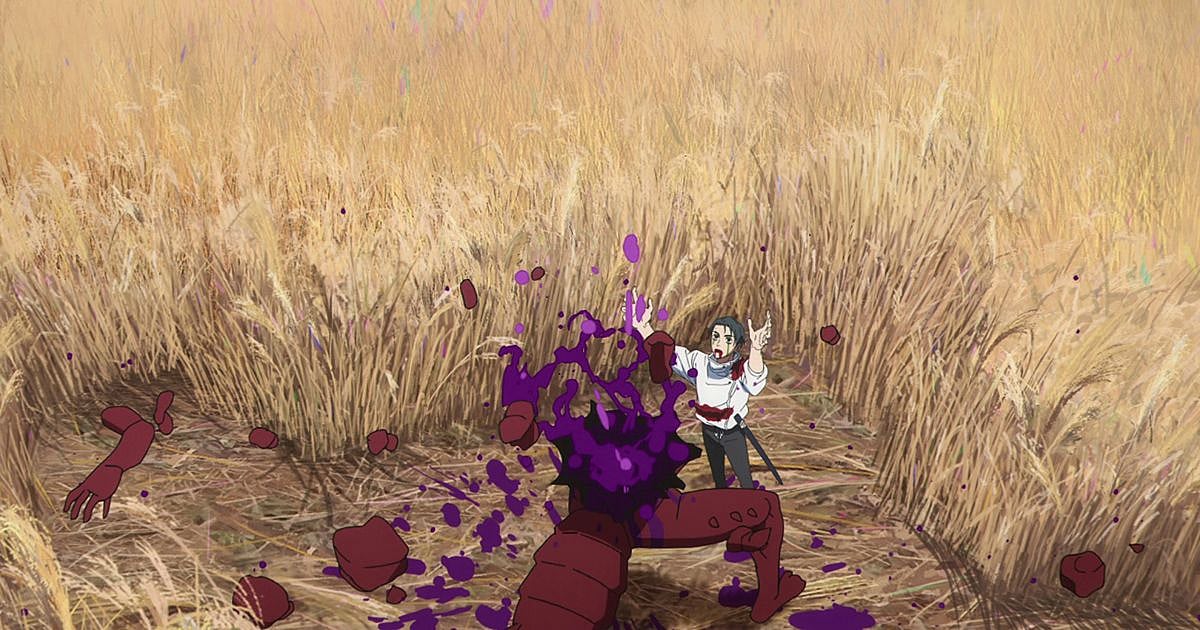
Kurourushi had only stayed dormant because of Dhruv. With the deadlock broken, the special-grade cockroach cursed spirit wakes up starving and heads straight for the nearest food source: the civilians. The scene is not subtle. Cursed cockroaches strip the flesh off a person in seconds. Yuta destroys the initial swarm with a blastwave from his katana, then uses Rika to collapse a bridge onto the second wave before it reaches the stadium.
What follows is the first real look at Yuta's current power level, and it is calibrated carefully. He knows Ryu and Uro are watching from a distance. He wants to kill Kurourushi without showing either of them what he is actually capable of. The Festering Life Sword is a cursed tool that fires parasitic eggs into targets, and Kurourushi lands hits. Yuta takes damage. He does not immediately reveal his reverse cursed technique or Rika. He extends the fight longer than he needs to in order to keep his cards hidden.
Then he ends it in the most viscerally unpleasant way possible. Yuta grabs Kurourushi's face, presses his mouth to the spirit's skull, and blasts positive energy directly into its brain. Cursed spirits are built from negative cursed energy. The influx of positive energy destroys Kurourushi from the inside out instantly.
Uro does not wait for Yuta to recover. She attacks the moment Kurourushi disintegrates.
Takako Uro's Sky Manipulation cursed technique explained
Uro's entrance is immediate. She tells Yuta she noticed his reverse cursed technique during the Kurourushi fight, which means he failed to hide the one ability he most wanted to conceal. Before he can fully turn around, she hits him with a wave of destruction from the sky.
Her innate technique, Sky Manipulation, treats the atmosphere as a physical surface she can grab, warp, tear, and redirect. The result is that attacks through the air do not travel in straight lines when Uro is involved. She grabs empty space beside her and pulls it taut like a curtain. She distorts the space around Yuta's arm mid-punch, making it appear elongated and formless while she lands an elbow to his jaw. She breaks space in front of him and the force from the rupture blasts him backward.
It takes Yuta several exchanges to understand what is happening. His guard keeps failing because Uro's technique does not follow normal physical logic. When he figures it out, he compares it to lens distortion: the space is warped, but the people inside it are unharmed. He also notices that Uro divulged her technique to him during their exchange, which in JJK means she received a power boost for it.
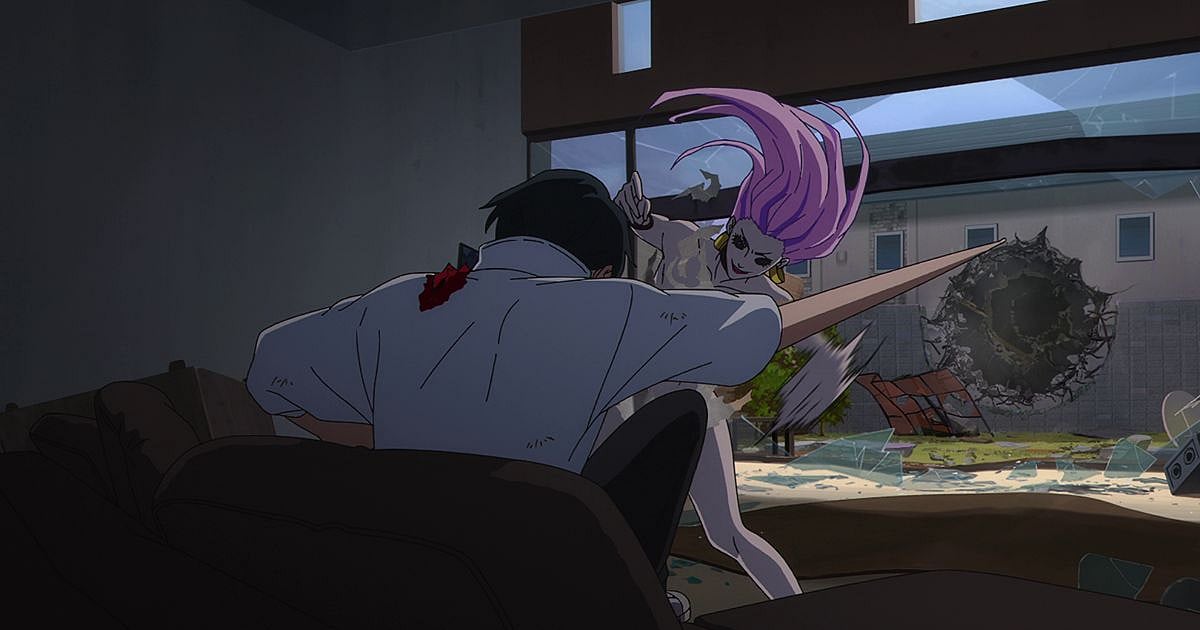
Yuta tries to understand her. He asks why she is killing people in the Culling Game. Uro explains she has regrets from her previous life and needs the points for whatever Kenjaku is planning next. Yuta cannot sympathize with someone killing strangers for self-serving reasons, and he says so. Uro accuses him of being a Fujiwara descendant, the clan that executed her as a scapegoat centuries ago. The scene adds a layer to a character who could have been a pure obstacle.
The conversation gets interrupted by Ryu, who fires a Granite Blast at both of them. Not because he is allied with either fighter. Because their talking is making him hungry.
Ryu Ishigori's cursed technique, 400 years of hunger, and the fight he came back for
Ryu Ishigori is a sorcerer who outputs the same amount of cursed energy whether his technique is active or not. That is not a common trait. Most sorcerers rely on their innate technique to amplify their output. Ryu does not need to. Granite Blast is raw, compressed cursed energy fired like artillery, with a blast radius wide enough to hit two special-grade fighters at once by accident.
He spent 400 years dead, and the only thing he wanted when he came back was a fight worth having. When Yuta walked into the Sendai Colony and broke the deadlock, Ryu decided that this, finally, might be his dessert.
That framing runs through the entire episode and it works. Ryu talks about meals, about setting the table, about hunger. When Yuta keeps surpassing his expectations, Ryu's excitement grows in real time. When the battle-royale phase looks like it might overwhelm Yuta, Ryu compares the experience to walking into a cake shop at closing time and finding empty displays. Then Yuta bounces back, and Ryu is happy again.
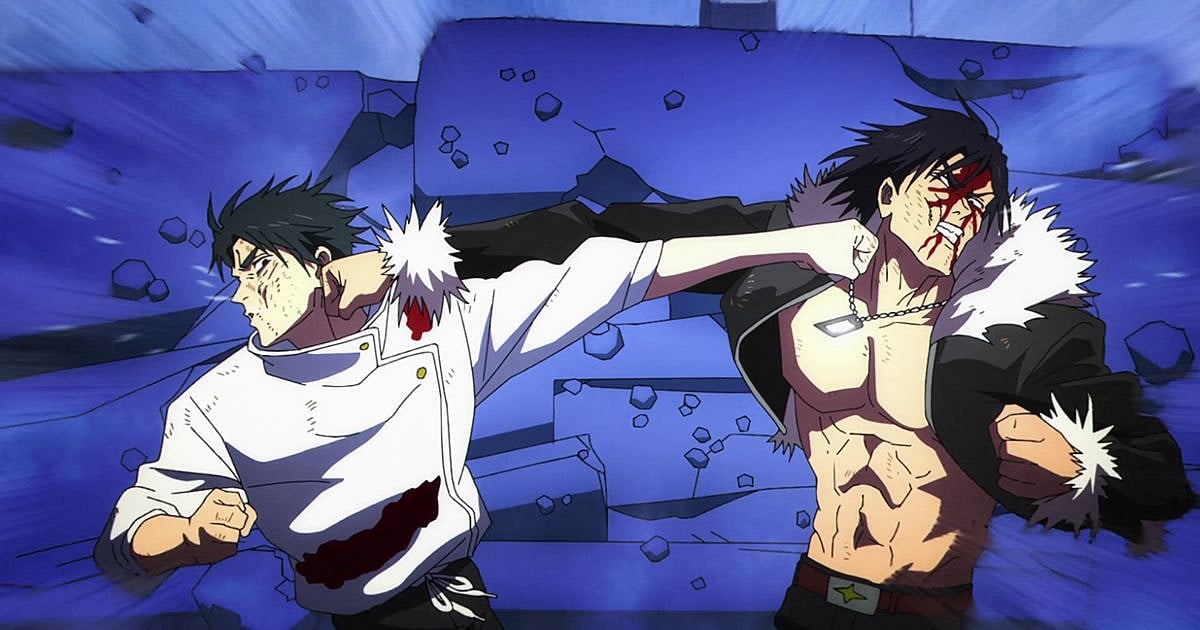
It is one of the more joyful dynamics in the series, partly because Ryu is not really a villain. He is a fighter who has waited four centuries for a proper opponent and is absolutely delighted to finally have one.
Three-way domain expansion in JJK Season 3 Episode 12: how it works and what breaks it
The episode's centrepiece is the simultaneous activation of three domain expansions. Ryu signals the climax by repeatedly striking his chest. All three sorcerers read the room at the same time and open their domains simultaneously.
Overlapping domains cancel out each other's guaranteed-hit effect. This is established JJK mechanics: when two domains clash, the stronger one wins, but when three open at once, the barriers fight each other for dominance and the environment becomes unstable. None of the three fighters can land automatic hits. The fight drops back to raw ability, which at this level means raw cursed energy and whoever can think fastest in an arena that is actively breaking apart.
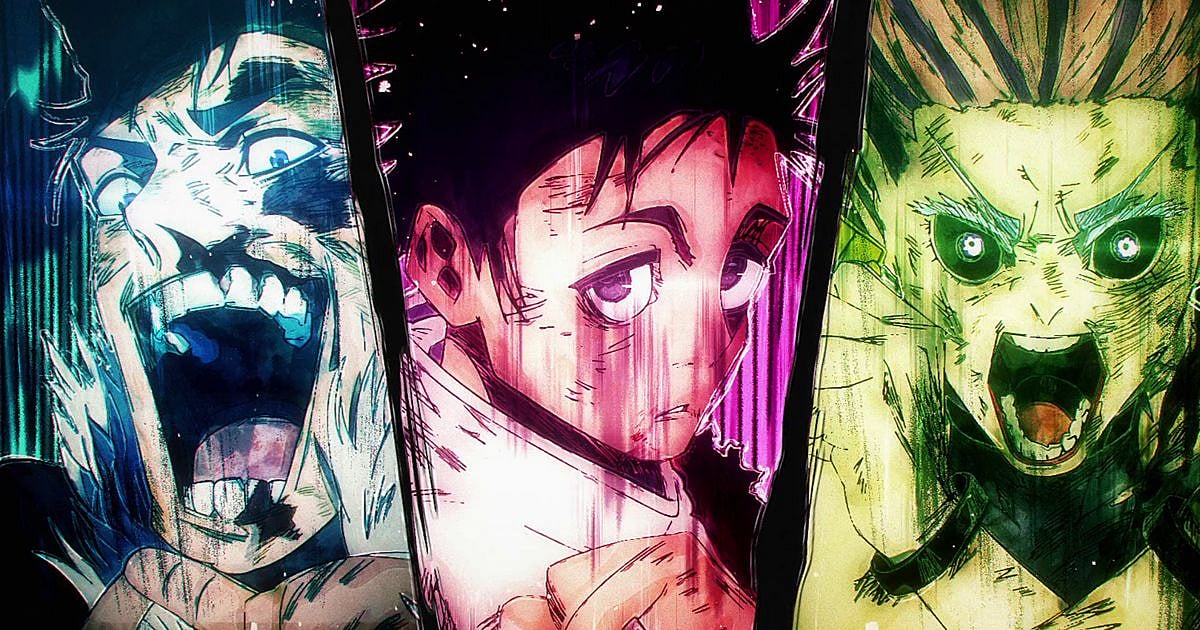
Then Kurourushi walks back in.
Before Yuta killed it, the cockroach spirit had reproduced via parthenogenesis. The parent died. The offspring, carrying the full weight of the country's cursed energy of fear, re-enters the barrier from the outside. A fourth domain interacting with three already-unstable ones is too much. All three barriers collapse.
What follows is immediate chaos. Uro sees Kurourushi and recognises that her technique is a bad matchup against it. She is distracted for a split second. That is all Yuta needs. He kicks her down and lets the cockroach spirit take its shot. Uro tries to activate her technique to defend herself, but using domain expansion burns out a sorcerer's cursed technique temporarily. She cannot. Kurourushi's Festering Life Sword severs her left arm. Rika devours it before it hits the ground.
Ryu blasts Kurourushi and Uro simultaneously with Granite Blast, incapacitating both. He fixes his hair, looks at Yuta, and tells him the table is finally set.
How Yuta defeats Ryu Ishigori using Copy and Uro's own technique
With Uro and Kurourushi out of the immediate picture, Yuta and Ryu go one-on-one. Yuta puts on the ring that fully manifests Rika. He uses Toge Inumaki's Cursed Speech, copied from his friend, to freeze Uro in place during one of the earlier exchanges. He deploys Dhruv's shikigami technique using Copy, producing hair-based shikigami whose orbital trajectories form a domain by themselves, and Uro recognises the technique as Dhruv's and understands in that moment that Yuta's actual ability is Copy.
Ryu's Granite Blasts push Rika back, dealing enough cumulative damage that Yuta's five-minute manifestation limit runs out and she unsummons. At this point, Yuta has one move left. During the window before the five minutes expired, he copied Uro's Sky Manipulation.
Ryu charges his final, maximum-output Granite Blast. It is the largest, cleanest expression of his technique in the episode, and MAPPA treats it accordingly. The charge sequence is given time and space. The beam is enormous.
Yuta grabs the sky.
He bends it, catches the beam inside the warped space, and redirects the entire blast back at Ryu. The beam clash that results is the kind of battle shonen moment that exists specifically to be exactly this: two fighters who could have held back, choosing not to. Yuta could have fired first. He let Ryu charge to full power. Ryu clocks this and appreciates it. They hit each other with everything simultaneously.
Ryu takes the redirected blast. He is down. He thanks Yuta. His stomach is finally full. He transfers all his Culling Game points and survives, because Yuta is not Megumi, and leaving Ryu alive after a fight like that is the correct choice. Ryu tells Yuta he is too soft for letting him live. Then he adds that it was a good fight.
The Aizo full version plays over the ending sequence, and the dessert visuals that accompany it are exactly the right call. Ryu's arc has been about hunger since the moment he was introduced. The song, the imagery, and the delivery of his "my stomach's full" line align completely. It is the kind of ending that makes you sit with it for a minute.
Director Gosso, MAPPA's animation, and what JJK Season 3 Part 1 achieved
There is a version of this review that gets into episode-level animation credits and director minutiae, and that version will exist in the comments section of various forums for the next several months. What needs to be said here is this: Shota Goshozono directed this cour in a way that no battle shonen season has been directed before.
Every episode had something going on visually that did not need to be there. The scene with Yuji washing blood off his hands and the entire frame going washed-out. The outline colours in the Noaya versus Choso fight going yellow. Red and green in the Higuruma episode. The Kill Bill sequence. Maki breaking free from Ranta's eyes. The rotoscoping. The seven-second fist fight between Megumi and Reggie that runs out of context like a crime. The deliberate, almost confrontational weirdness of every Takaba scene. The Sendai Colony episode, from the first frame to the last.
Gosso's direction was not universally popular. Some viewers found the art house choices distracting. That reaction is understandable, and it is also wrong. The reason nearly every scene in this cour was as engaging as it was, including the dialogue-heavy ones, is that there was always a visual decision being made. It was never enough to be a 1:1 adaptation. Something different was always happening on screen. That does not happen by accident. It happens because a director took a hard-won extra mile on every single episode for twelve weeks.
If Gosso is leaving after this cour, as the rumours suggest, whoever replaces him has an almost impossibly high bar. The animators, the art directors, the sound team, and the music supervisors all delivered. But the direction is what made this season feel like something that changes what people expect from anime adaptations going forward.
This cour produced no weak episodes. Among its strongest: the Maki versus Zenin Clan in Episode 4, the Higuruma fight in Episode 9, and of course this finale that may very well be at the top of it. Not because it is the most structurally elegant, but because it closes everything the Sendai Colony setup promised, delivers Yuta at full power, gives Ryu Ishigori one of the best send-offs in the series, and does all of it in 28 minutes across eight chapters without a single moment that feels rushed.
Ryu said it best. My stomach's full.
What manga chapters does JJK Season 3 Episode 12 cover?
The episode covers Chapters 174 through 181, encompassing Yuta's full run through the Sendai Colony. Chapter 174 is the Kurourushi confrontation. Chapters 175 through 178 cover the escalating three-way fight between Yuta, Uro, and Ryu, including the domain expansion sequence. Chapters 179 through 181 cover Kurourushi's return, the domain collapse, Uro's elimination, and the final Yuta versus Ryu exchange.
Eight chapters in one extended episode is the fastest pacing of the entire season. It works because the Sendai Colony arc is built differently from the Tokyo fights. The Tokyo Colony operated on tactical accumulation, where every reversal required the audience to track spatial logic and technique mechanics — as seen clearly in the Megumi versus Reggie Star fight across Episodes 10 and 11. The Sendai Colony operates on escalation. Each beat is louder than the last, and the material is structured to sustain that momentum rather than slow it down. MAPPA read the source correctly and matched the pacing to what the chapters asked for rather than applying the same rhythm as the Megumi fights.
Culling Game Part 2 has no confirmed release date. Leaks and rumours point to January 2027.

Author
Vignesh Raghuram is the Editor of Outlook Respawn, where he leads editorial strategy across gaming, esports, and pop culture. With a decade of experience in gaming journalism, he has established himself as a trusted voice in the industry.

Related Articles