






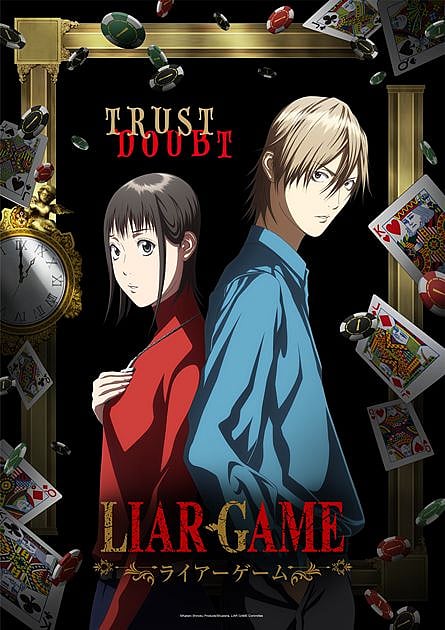
Liar Game anime teaser visual (©Kaitani Shinobu Products/Shueisha, LIAR GAME Committee)
Liar Game Anime Review: Slow Burn, Strong Base

Liar Game has waited 20 years for an anime adaptation. Shinobu Kaitani's psychological thriller manga, which ran in Weekly Young Jump from 2005 to 2015, has already been picked apart and reassembled across multiple mediums. The 2007 Fuji Television J-Drama starring Toda Erika and Matsuda Shota became a cult hit in its own right, running for two seasons and spawning two theatrical films (The Final Stage in 2010 and Reborn in 2012). A Korean drama adaptation followed on tvN in 2014. A stage play showed up in 2023. By the time Madhouse announced the anime at Anime NYC 2025, the IP had been adapted into nearly every format except the one its audience had been asking for the longest.
So the question was never whether the source material deserved the treatment. It was whether an anime could translate a manga built almost entirely on dialogue, deception, and game theory into something that actually works on screen, and whether it could offer something the J-Drama hadn't already done.
Liar Game's cross-format journey mirrors a broader trend of manga-to-live-action adaptations that has only accelerated in 2026.
Liar Game's opening gambit plays it safe
The premise gets established fast. Nao Kanzaki, a college student so aggressively honest that she's earned the nickname "Naive Nao," receives 100 million yen in a package alongside an invitation to the Liar Game Tournament. The rules are straightforward: steal your opponent's money by any means necessary, or end up 100 million yen in debt. Her first opponent is her former teacher, Kazuo Fujisawa, a man she once trusted. When he predictably swindles her, she turns to Shinichi Akiyama, a recently released con artist for help.
If you've read the manga, watched the J-Drama, or caught the Korean version, none of this will surprise you. If you haven't, the first episodes do a competent job of laying the groundwork, even if the execution doesn't quite match the premise's potential.
The voice cast is doing solid work. Saya Hitomi brings the right mix of panic and stubborn sincerity to Nao, though the character's naive schtick can wear thin when the writing leans too hard on it. The real standout so far is Nobuo Tobita as Fujisawa. His shift from kindly teacher to desperate, cornered antagonist carries more emotional weight than anything else. When Nao and Akiyama finally confront him, the voice acting reaches a peak that the rest of the production hasn't matched yet.
And that's where the problems start to show. For a show about high-stakes psychological warfare, the tension is oddly flat. It never really feels like Nao is in genuine danger. The games, at this stage, are simple enough that the outcomes feel predetermined. The show spells out its strategies and counter-strategies with enough exposition that there's little room left for the viewer to piece things together on their own. Manga readers know the games get significantly more complex and ruthless in later arcs. But for anime-only viewers sampling this in a packed spring season, over-explained schemes with predictable payoffs is a tough sell.
The animation, too, sits in an awkward spot. Madhouse's pedigree (Death Note, Monster, Kaiji) raises expectations, but Liar Game mostly delivers static shots and talking heads, which is understandable given the source material's emphasis on dialogue over action. Some of the character animation during basic movement is a bit rough around the edges, particularly the way Nao runs and walks, though it's a minor gripe in a show that lives and dies by its conversations rather than its action cuts.
Where the production does excel is in its music. Yugo Kanno's score brings a tension that the pacing sometimes lacks on its own, and the opening theme "Bubble" (あぶく) by Yorushika is a standout. The accompanying visuals set a mood and tone for the series that the episodes themselves are still working towards.
It's worth noting that chief director Yuzo Sato previously helmed Kaiji and Akagi, two of the best anime adaptations of high-stakes gambling manga. You can see traces of that DNA here, particularly in how the show frames its confrontation scenes and uses silence before a reveal. But Liar Game hasn't yet found the same rhythm. Kaiji's first episode dropped you into a desperate, sweaty nightmare. Liar Game's feel more like a careful tutorial.
That said, there's enough here to stick with. The Liar Game manga's best arcs, the Minority Game, the Contraband Game, the increasingly psychotic rivalry with Yokoya, are all still ahead. If Madhouse and Sato are pacing this for a two-cour run (the show is confirmed to air for six months without breaks), these first episodes might read better in retrospect as a slow, deliberate setup.
For now, Liar Game is a competent adaptation that plays it safe with strong source material. If you're a fan of the manga or seinen thrillers in general, it's worth your time. If you're an anime-only viewer deciding what to pick up this season, give it until episode four or five before making your call. The best hands haven't been dealt yet.
Overall Rating: 3.25/5
Liar Game streams on Crunchyroll from April 6th

Author
Vignesh Raghuram is the Editor of Outlook Respawn, where he leads editorial strategy across gaming, esports, and pop culture. With a decade of experience in gaming journalism, he has established himself as a trusted voice in the industry.




Related Articles