




Highlights
- To bypass app store discoverability issues, 53% of mobile developers are porting games to web browsers within 12 months.
- Web gaming acts as a powerful trial funnel, with 62% of players later purchasing games and many spending over $50 monthly.
- Developers are leveraging instant-play browser tech to reach audiences shifting away from passive social media scrolling.
If you feel like trying to find a fresh, fun game on your phone has turned into an exhausting scroll through cloned apps and sponsored placement, you aren't alone. The people making the games are exhausted, too. In a massive shift for the digital ecosystem, 53% of mobile game developers plan to port their titles over to web browsers within the next 12 months.
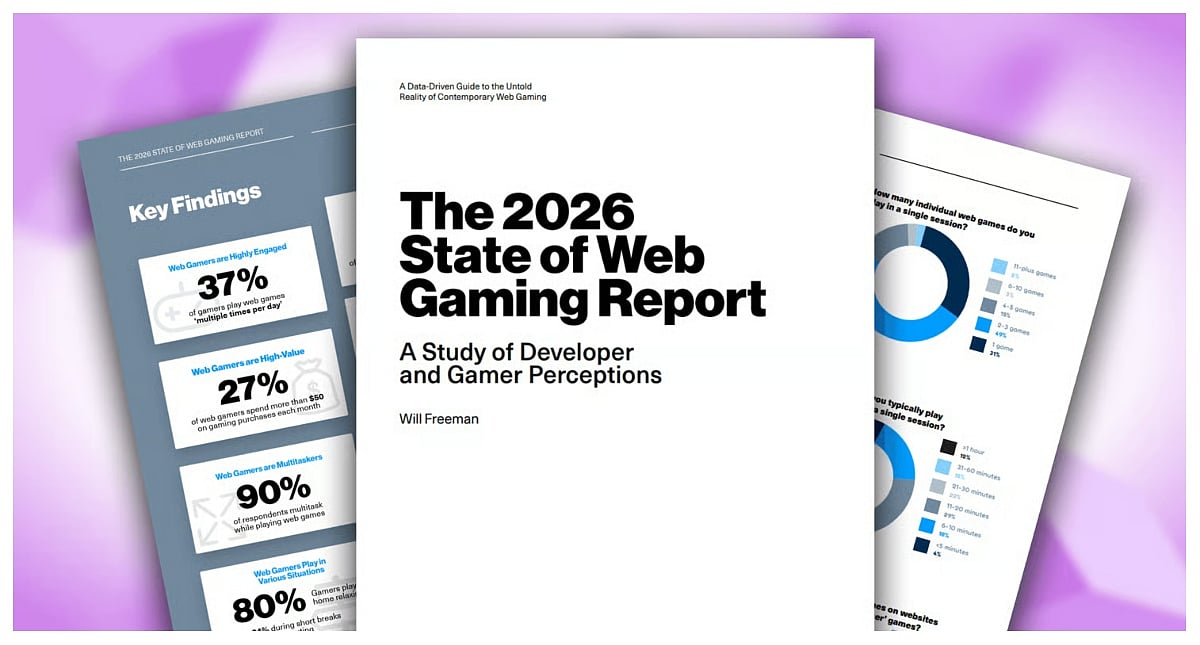
Web games are reportedly countering discoverability challenges in the modern games landscape, with 53% of developers now seeing the format as a method to reach new users. The data comes via the newly released 2026 State of Web Gaming Report, commissioned by gaming platform Poki, which highlights a stark reality: as getting noticed on traditional app stores becomes a nightmare, studios are treating the open web as a serious distribution channel rather than a throwback to early-2000s Flash nostalgia.
Independent, MRS-certified research firm Atomik Research gathered the data by surveying 400 game developers and 2,000 web gamers across the United States and the United Kingdom, with fieldwork completed in May 2026. Their findings show the browser rush is uniquely mobile-led. While 53% of mobile companies plan to make the browser pivot this year, only 41% of traditional PC and console developers told researchers they plan to do the same.
The exodus is being driven almost entirely by storefront friction. Of the developers surveyed, 70% work primarily on iOS and Android. When asked about the upside of a browser launch, 53% pointed to the ability to capture brand-new audiences instantly, while 47% cited the chance to unlock fresh revenue streams, as per Pocketgamer.biz.
For publishers, the ultimate selling point of the web is its quiet transformation into the gaming industry’s most effective trial funnel. 62% of web gamers were said to have downloaded or bought a game after first playing it on the web. Among dedicated daily players, that conversion figure skyrocketed to 72%.
High Engagement Beyond the Solitaire Stereotype
If developers are worried that browser gamers are just bored office workers killing five minutes on Solitaire, the consumer data suggests they are worrying about the wrong audience. Modern web gamers are highly engaged, with 37% of them playing web games multiple times daily. When asked why they show up, 58% said they play browser games because they are free, while 56% favor the format for its instant accessibility and lack of a download bar.
Crucially, they aren’t all free-to-play freeloaders. Among web gamers, 27% spend over $50 on game purchases every month, proving browser audiences hold genuine commercial value. This group also appreciates the tech behind the screen, with 92% describing modern HTML5 games as being high in quality. Furthermore, almost two-thirds of these web players also own a dedicated games console, most prominently PlayStation hardware.
When these gamers do open their wallets, their habits split fascinatingly down operating system lines. Android owners were found to be more likely to spend small amounts up to $10 in games than iOS owners, and were also more likely to make mid-to-high purchases between $101 and $200. On the other hand, iOS owners dominated the middle ground, proving more likely to spend between $11 and $100, while also holding the crown for extreme whale spending of $201 or more.
State of Web Gaming Report
Technical Barriers and Live-Service Worries
Still, developers view the browser push as practical rather than effortless. 53% of the studios surveyed admitted that technical barriers remain their biggest headache when trying to make complex mobile code run smoothly inside Google Chrome or Safari. Another 36% expressed lingering worries over whether browser platforms actually possess enough active, high-retention gamers to keep a live-service game afloat.
Speaking to PocketGamer.biz, Poki Chief Operating Officer Stein Janssen acknowledged those tech hurdles, noting that while engines like Unity have made exporting code simpler, porting is only half the battle. "More pertinent is the fact that improvements in browser tech mean the mobile web can provide a gaming experience that matches what is available in native apps," Janssen said.
"That’s obviously with the added benefit of instant play and no downloads, meaning web gaming perfectly matches modern media habits, which demand low friction.” Janssen said that “in a mature mobile market where launching new games is so uncertain, midsize and large publishers are looking for new pockets of growth for established titles."
The report showed more than a quarter of web gamers are actively increasing their playtime relative to their social media usage, choosing to play actively rather than sit passively scrolling. With social media bans for young people already passed in Australia and upcoming for the UK, Janssen suggested web games will likely be a prime beneficiary of that displaced attention, cementing the humble web browser as one of the most sensible places left on earth to launch a video game.