




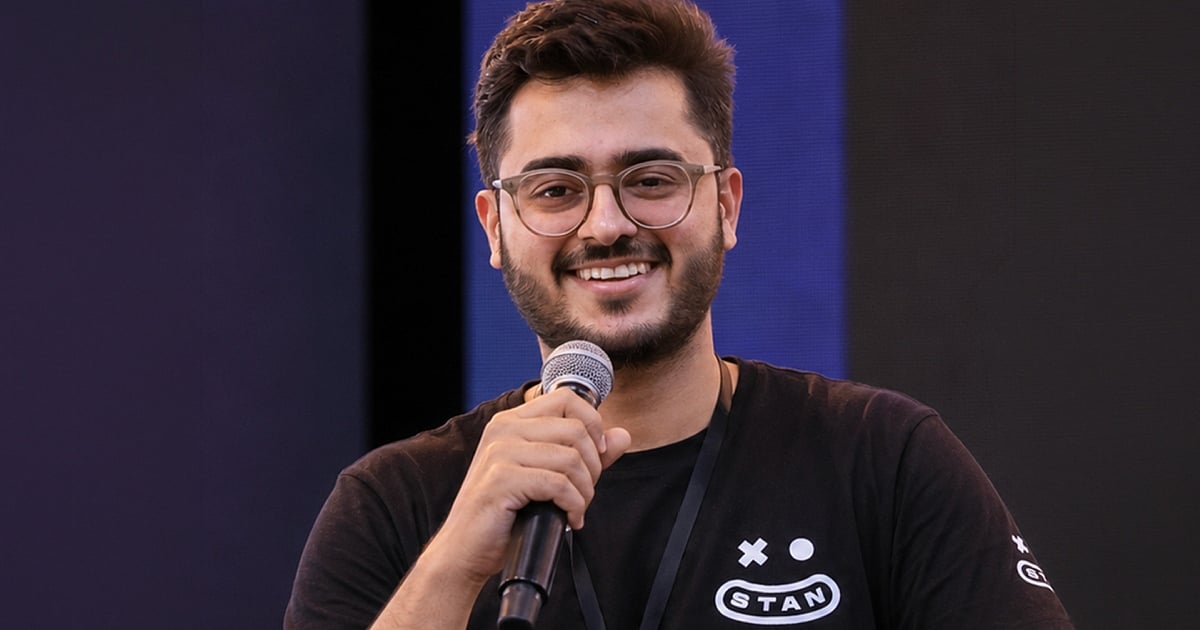
This story was authored by Parth Chadha, co-founder and chief executive of STAN
Every few months a deck lands in an investor's inbox making the same pitch: India has more than half a billion gamers, Gen Z lives inside games, put content in front of them and monetization will follow. I have spent the last several years building against that assumption, and I can tell you exactly where it breaks. India's gaming generation, the 13 to 25 year olds who came of age after cheap data arrived, is not an audience waiting to be monetized. It is an economy waiting for infrastructure. Which of those two sentences you believe decides everything you build.
The scale is real. FICCI-EY counts more than 568 million gamers in India, 97% of them on mobile. Industry estimates place the market at around $3.7 billion USD today, headed to $9.1Bby 2029. But scale is the least interesting fact about this generation. The interesting fact is behavioral: gaming is not a pastime slotted between other activities for them. It is the default social layer. It is where friendships form, status is earned, language evolves and money changes hands. The television generation watched together. This generation squads up.
Constraints are the curriculum
Building for this generation means building inside constraints that would break most product playbooks. A mid-range Android phone. A network that dips every evening. A user who switches between Hindi and English mid-sentence, and between three apps mid-minute. Patience measured in seconds. Willingness to pay measured in ten-rupee increments.
I think of it as a formula: a global product is Indian constraints multiplied by Indian scale. India is the superset of edge cases. If your product survives a Tier 3 hostel Wi-Fi connection and a Hinglish argument at midnight, it will survive anywhere. The constraint is not the obstacle. The constraint is the curriculum.
What they are actually asking for
The biggest misunderstanding of the gaming generation is the belief that they want more content. They do not. Content is abundant, free and one thumb-flick away. What is scarce is belonging: a room where you are known by name, where status can be earned through skill or contribution, and where the rules are visibly fair.
In all my years of building consumer products, I have never heard a user ask for AI, and rarely for a feature. They ask, in a hundred different phrasings, for two things: a safe room and a fair shot. On STAN, more than 650,000 small communities are active every day. Not one giant feed. Hundreds of thousands of small rooms. The demand curve of this generation bends towards intimacy at scale, and any founder shipping another algorithmic firehose is answering a question nobody asked.
Trust is an equation, and it compounds
If belonging is the product, trust is the infrastructure. I treat trust as an equation: comprehension multiplied by fairness multiplied by speed.
Comprehension means your systems must genuinely understand this generation: Hinglish, Tanglish, gaming slang, banter that looks like abuse and abuse that hides as banter. Fairness means punishment lands on the right people; every wrongful ban converts a loyal member into an evangelist against you, and the whole room watches how you rule. Speed means flags acted on in seconds and resolved within the hour, because a toxic room at 9 pm is a dead room by 9.15pm.
When we rebuilt moderation around those three variables, with AI that comprehends Indian speech in context, 28-day retention rose 23%. Google later published the result as a case study. The lesson generalizes far beyond us: safety is an accuracy problem before it is a policy problem and solved properly it is not a cost center. It is a revenue line. This generation can smell an unfair room within minutes, and it pays, in attention and in money, for rooms that are ruled well.
Bharat does not just play. Bharat pays.
The most commercially consequential thing we have learned is where the money actually lives. 67% of our users come from Tier 2 and Tier 3 India. They account for 72% of monetized engagement, and their average revenue per user runs 17-18% higher than metro users.
Read that again, because it inverts a decade of consumer internet doctrine. The assumption was that small-town India engages but does not pay. The truth is that small-town India does not pay for access to content. It pays for identity: a badge, a rank, standing inside a community, proximity to a creator it considers its own. A metro user has a dozen competing avenues for status. For a nineteen-year-old in Indore or Guwahati, the community is the avenue. Pricing, product and creator strategy all change once you accept that payment here is an act of belonging, not a transaction for media. It also places a duty on the platform: if belonging is what people pay for, the economics must visibly flow back into the gaming community, above all to its creators.
The creator middle class is the real story
BCG estimates that only 8-10%of creators in India monetize effectively. That gap is where the real opportunity in Indian consumer tech sits. The superstar layer of the creator economy is well served. The middle is not.
More than 2.5M creators run communities on our platform, and over 300,000 of them now earn sustainable monthly income from it. Not crore a year sponsorship money. But, salary money, in towns where that salary changes household decisions. The mechanism matters as much as the number: ranking and discovery systems that score current performance rather than lifetime fame keeping mobility alive, so a newcomer from a small town can outrank an established name within weeks if the work is better. Fair mobility is not idealism. It is retention strategy. When creators believe the ladder is real, they stay, and their communities stay with them.
AI as mechanism, not novelty
Every consumer deck now carries an AI slide, so here is the filter I apply. Mechanism is AI aimed at your biggest leak. Novelty is AI aimed at your surface. A chatbot bolted onto an app is a novelty. AI that repairs the exact point where you lose users or creators is a mechanism.
Our biggest leaks were safety and creator onboarding, so that is where the AI went: moderation that understands Indian speech, and an onboarding flow that cut creator approval from 48 hours to 7 seconds. We have moved through four model generations, and retention improved after each swap, because the pipeline, the evaluation signals and the outcome data are ours even when the model is not. The model is rented; your outcome data is owned. Log outcomes, not just outputs. In the model era, your moat is whatever survives a model swap.
Build for them, and you build for what India becomes
The gaming generation is not a niche. It is a preview. The behaviors forming inside gaming communities today, micro-payments for status, creator-led commerce, community as the primary social unit, and vernacular-first interfaces, which will define mainstream Indian consumer behavior over the next decade, in the same way this cohort will staff the two-million-strong AVGC workforce the Union Budget is preparing for.
So, the honest answer to how you build a consumer tech platform for India's gaming generation is that you stop building a content platform at all. Build trust infrastructure for communities. Make the economics flow to the people who hold those communities together. Apply AI where it repairs your biggest leak, not where it demos best. Get those three right, and this generation will build the rest of the platform for you. They always do. That is exactly what makes them worth building for.