


- Publishers at Comic Con India 2026 revealed that the country’s comics market is limited more by accessibility issues like licensing gaps, instead of readership counts.
- India’s comic book market revenue is mostly driven by collectors who invest in premium editions rather than casual, price-sensitive buyers.
- Indian publishers are still creating transmedia ecosystems, trying to catch up to the rapid-paced screen-to-retail pipeline of global IPs.
The stadium is further from the city centre than it was the year before, which, more than anything, explains the slightly less dense crowd. The observation was made by Ritesh Singh, the proprietor of Thoughts and Tales. Singh began his career at Oxford Bookstore right here in Kolkata and spent six and a half years in Penguin Random House before starting on his own, working tirelessly without complaint. “It is my city,” he says simply. “I love everything about it when it comes to books.”
With licensed copies of Penguin Random House, sourced by his company, Ritesh informs of a sales number that tells a more compelling story. Across two days of the Comic Con 2026, Kolkata edition, Ritesh’s venture had amassed ₹6.5 lakh, which is a slight decline from the ₹10 lakh they earned at the same event last year, when the venue was closer to the city. However, not worried, he told Outlook Respawn that he has sold here before and will sell here again.
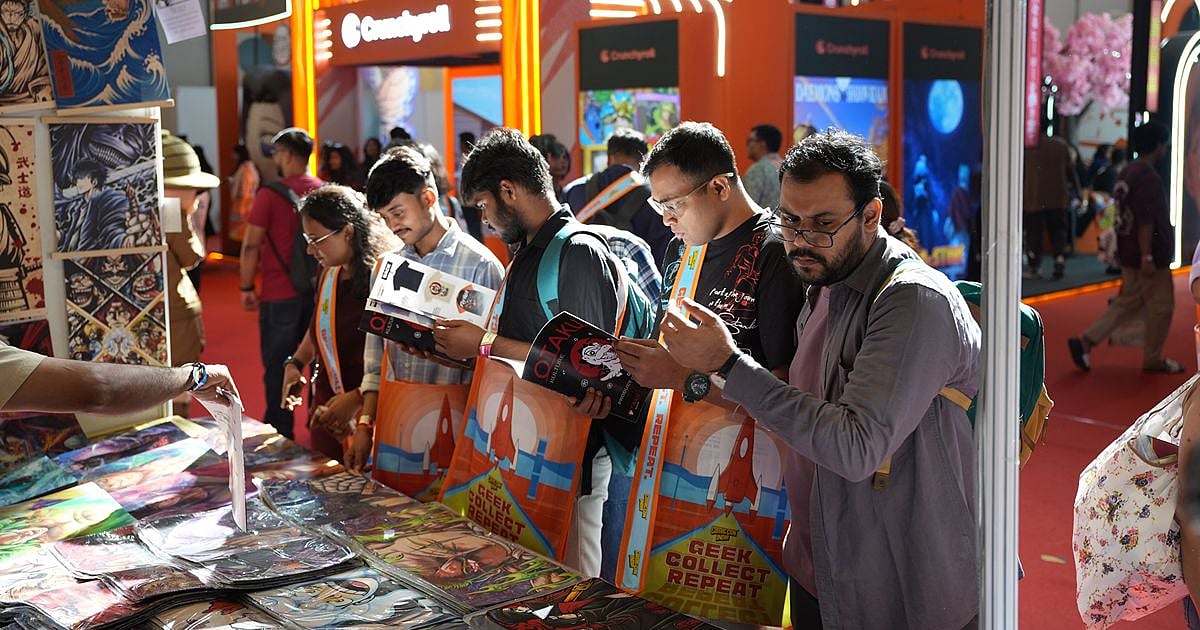
This is the second edition of Kolkata Comic Con, and throughout conversations with executives in three publisher booths, a picture comes to life, which is not of a market in crisis, but of the dynamic nature. People from all over India, who grew up buying comics off the AH Wheeler stand at railway stations, now aged probably in their thirties, all gathered at the Kolkata Comic Con. Not just to spend on their favorite fandoms, but to revisit things they loved.
Vinland Saga and others at Penguin Random House India
Global Comics, Local Demand: The Retail Reality
Ritesh Singh’s booth carried the full weight of global comics culture, including Indian comics and photobooks, manga titles from Kodansha and Seven Seas, distributed internationally by Penguin Random House and brought to India via his company, Thoughts and Tales. Titles like Blue Lock sit alongside something far older, like Astro Boy, by Osamu Tezuka. Although these books are rare, Singh does not treat them as a rarity at all.

“Osamu Tezuka is the kind of father of manga, we used to call. The first book by him was Astro Boy, and it’s a classic. It sells a lot.”Ritesh Singh, Thoughts & Tales
The engine driving new manga readers, as per Singh, is not the books but the screen. People watch an anime series on sites like Crunchyroll or pick up One Piece on Netflix. Notably, its live-action adaptation has sent the franchise’s popularity “to another level,” which indirectly prompts people to come looking for the physical volumes. A Lego version of One Piece is reportedly also in development, amidst the fandom compounds.
And as for DC and Marvel titles, including the Star Wars books, and other official publications, Singh says that they are here by license. Every image in the kept volumes has been officially approved. Notably, the conversation with Singh highlighted that the right to sell them in India exists independently of whether official brand outlets are functional in the country. Singh sells them as a licensed distributor, and this distinction matters to him.
Astro Boy Manga at Penguin Random House India
The table was stacked heavily with hardcovers, even when paperbacks are cheaper and easier to carry. To this, Singh answers, “While some titles, like Batman, offer both, paperbacks often do not suit premium, color-heavy superhero books simply because the bindings don't last very long.” Therefore, someone purchasing a hardcover is not making a luxury choice, but a structural one.
“As a collector,” he explains, “I have read paperbacks. Now I am collecting my shelf with the hardback, deluxe editions.” The market has therefore, indicatively layered itself with compact editions at the lowest price point, followed by standard paperbacks above it, and then deluxe hardcovers for the collector’s shelf.
Other graphic novels, photo, comic books at Penguin Random House India
THOUGHTS & TALES — EVENT SALES SNAPSHOT
Sales, Kolkata Comic Con 2026 (2 days): ₹6.5 lakh
Sales, Kolkata Comic Con 2025: ~₹10 lakh
Likely cause of variance: Venue relocation
Publishers represented: Kodansha, Seven Seas, via Penguin Random House, as well as DC, Marvel
Singh's prior role: 6.5 years at Penguin Random House
Singh said that after his career began in Kolkata, the city has never left him. “There are readers,” he says, when asked about the readership and the crowd. “Calcutta has always been my best place where people come and buy.”
Building Indian IP: Amar Chitra Katha and Tinkle’s Push Beyond Mythology
While visiting the Amar Chitra Katha and Tinkle booth, Outlook Respawn found Savio Mascarenhas, the Group Art Director for ACK. We asked if the indigenous brand, which had a long history of mythological stories in visuals, had something in mind for a superhero genre. Savio revealed that there already is a superhero IP about a young girl from a fictional town near Aizawl (Mizoram, India). Her name is WingStar, and her father is a scientist. At the age of ten, she fights villains and has been waiting for the big moment for years, which Mascarenhas says is nearly here.
Tinkle WingStar
“WingStar is one of the very first superheroes from Tinkle Comics,” he said. “She is going to come into animation very soon.” The studio handling it is Zebu Studios in Bangalore, already known for animating Suppandi, one of Tinkle’s oldest and most loved characters. The girl from the northeast represents a requirement that ACK believes it needs to build: an Indian superhero with regional taste, a character who does not come down from myth but is invented entirely in a new way, carrying the texture of a particular, living part of the country.
“We really wanted to give something to India. That is actually one of the very first superheroes from Tinkle Comics.”Savio Mascarenhas, Group Art Director, Amar Chitra Katha
Savio also said that apart from Suppandi, Shikari Shambhu, another character from the top of Tinkle’s character roster, is also being taken into animation. Additionally, new characters, yet to be revealed, are also steadily multiplying. However, the non-mythological growth, the move toward what Mascarenhas calls “a different universe,” is a strategic priority at this point. Amar Chitra Katha has always done mythology and history, but the future asks for more.
Based on this, ACK’s education angle is already paying off. They have been collaborating with schools to put comics into curricula, not as a fun read, but as serious learning tools. The pitch is pedagogically sound. For instance a child reading a comic about the Rani of Jhansi alongside their history textbook will learn more vividly, than reading only text. “The child will understand the story much better,” Mascarenhas says. Interestingly, subscriptions to the ACK digital library are provided to schools that look for it, while reading sessions are also built into class time. “To get the child interested, we have to give them content which they like, and the medium is important.”
In fact, ACK’s scope of educational work runs further than history and mythology. The brand has produced comic-format books on IIT Madras and IIT Delhi, as well as “a very educational book talking about the (Indian) Constitution in comic book format.” Notably, the latter one was commissioned by the Andhra Pradesh government, as revealed by the Group Art Director.
On the question of Kolkata and Bengal specifically, Mascarenhas is warm and specific, noting that the city’s readership is quite deep and old. “We have a huge readership here,” he says. “People who are in their thirties and forties who grew up reading — for them, it is a big thing to come and meet the creators.”
ACK/Tinkle had earlier adapted Bengali classics, including Devi Chowdhurani, and is also working on an upcoming volume called Musicians of India. The product will feature Bhimsen Joshi, Bismillah Khan, Hari Prasad Chaurasia, and Bhupen Hazarika, four legends of the Indian music landscape in one visual format.
Just like old titles seen for Penguin, ACK collector editions also tap into the nostalgia economy, where the profit is significantly tangible. ACK has been repackaging its oldest Tinkle issues, going back to 1982, in what they call the Origins, with special covers and added pages. Its Set 1 was launched at San Diego Comic Con in 2024, while Set 2 arrived in 2025. The volumes carry a dollar price for the diaspora market, and an Indian price for everyone else. Notably, both sets sold with a strong demand. “We knew there was a huge nostalgia crowd over there,” Mascarenhas says of San Diego, “and they would love to be connected to India through these comics.”
Mobile capture (In this picture - Savio Mascarenhas, the Group Art Director for ACK)
AMAR CHITRA KATHA — KEY FIGURES
Founded: 1966 (60th anniversary in 2026)
Print vs. digital readership split: ~60% print / 40% digital
Origins Set 1 launch: San Diego Comic Con, 2024
Origins Set 2 launch: 2025
Comic price ceiling: ~₹500
Wingstar Animation Studio: Zebu Studios, Bangalore
Next year is the sixtieth anniversary of Amar Chitra Katha, and Mascarenhas defines it as a year of “going all out” with celebrations, more collector editions, and releases that will mark the occasion with grace. The brand went through the diminishing railway bookstalls where generations of Indian children bought their first comic books, which have now moved online and into major bookstores.
The pandemic additionally forced the digital pivot of ACK. They launched an app, offered it free for a month during lockdown, and their readership experienced a spike. “Everybody was reading all our content on the app, absolutely free — we got a huge readership through that campaign.” After restrictions were lifted, demand for print copies surged as well. The outcome of the demand was Tinkle Gold, a physical edition that compiled two years of content created during the pandemic. The balance settled at roughly 60% print, 40% digital, which Mascarenhas projects to be growing.
The print strongholds, as he describes them, are the south, including Kerala, Tamil Nadu, Andhra Pradesh, Karnataka, and the northeast, and Kolkata. Digital pockets do exist across the metros; however, video is the next frontier, with animated films on schedule.
Manga Boom Amidst Missing Rights: India’s Import-Driven Market
As discussions about Indian IPs rose, one publisher chose to be an exception: Viz Media and Simon & Schuster. Notably, their operation in Kolkata is built around a single, quiet fact that they are, by their own account, one of the only retailers in the city maintaining a full, year-round range of manga at all times. As per their statement, they stock throughout the year. They have attended the Kolkata International Book Fair, Anime India, and now Comic Con. The unit numbers are striking for Comic Con 2026, with roughly 752,000 units sold across their operations.
However, when asked about the localization of an Indian edition of any Japanese IP, or an original Indian content, the answer from the Storyteller Bookstore’s Mayura Mishra (collaborating with Viz and Simon & Schuster) is quite assertive: “No, I don’t think we are thinking at all of publishing in India.” The Japanese publishers remain very conservative of their rights, including Indian ones. “The problem is availability,” says the Simon & Schuster representative, Indranil Nandi, who explained that despite having significant buyer demand for localized formats and Indian print runs of manga, Viz Media has also not yet extended any Indian rights. Ideally, everything sold here is imported. Nonetheless, it also shows the demand for Japanese IP in the country.
“India is a very good hub for this. A multicultural country. There is no dearth of stories.”Simon & Schuster representative, Kolkata Comic Con
But there is a slight obstacle for those who have grown up watching Naruto or reading Amar Chitra Katha in that aspect. Although the representative’s point is purely observational, it maps India’s multicultural density, the depth of its storytelling tradition, and multilingual imagination. Interestingly, all of it represents untapped creative territory for a manga-style format, which may substantially increase sales to “a huge extent,” according to the representatives. When speaking about a domestically produced IP from Simon & Schuster’s side, they said, “Might be, actually. Very difficult to comment right now.” The representatives “are looking at spreading out, spreading the word of anime and manga.” And the die-hards, as they note, will “find us wherever we go.”
Naruto: Road to Ninja
The broader digital picture supports their optimism. With streaming sites like Netflix and Crunchyroll releasing timeless anime like Naruto and One Piece, in a series format in multiple languages, manga and other comics have become an extended reading, which is first observed through screens. “Ever since people started reading less text and more visuals, the sales have definitely gone up,” the representative says. This is Kolkata’s second Comic Con, and according to them, “the response has been overwhelming,” showcasing India and Bengal’s love for visual lore.