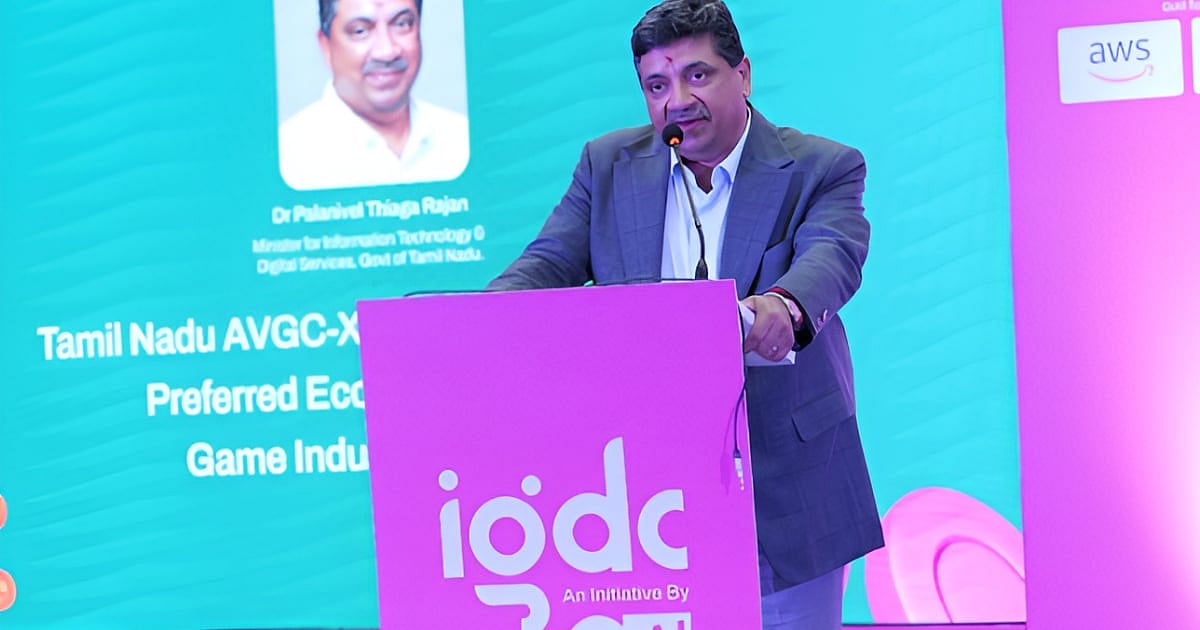
Tamil Nadu IT and Digital Services Minister P. Thiaga Rajan at IGDC Chennai in November 2025, where he first confirmed the AVGC-XR policy was in its final approval stage. The policy was formally notified on March 12, 2026. (Image: Outlook Respawn)
Tamil Nadu Launches AVGC-XR Policy, Sets Target of 200+ Startups
Five-year framework backed by IP collateralisation, labour-law relaxations and curriculum integration across 300–400 colleges

Highlights
- Tamil Nadu's AVGC-XR Policy 2026 targets 200+ startups, 2 lakh jobs and 20% of India's animation, VFX, gaming and XR market by 2030, backed by a ₹50-crore Centre of Excellence in Chennai with regional spokes in five cities.
- The policy introduces ₹250 crore in R&D funding, startup grants up to ₹1 crore, and structured incentives for large studios.
- Online money games are explicitly banned under the policy, while esports gets formal recognition under the National Sports Governance Act 2025.
The Government of Tamil Nadu has formally approved its AVGC-XR Policy 2026, a five-year framework that aims to turn the state into a national hub for animation, visual effects, gaming, comics and extended reality. The policy, issued via Government Order on March 12 by the Information Technology and Digital Services Department, targets the creation of at least 200 AVGC-XR startups by 2030, the growth of 100 companies in the sector, and roughly 20% of India's AVGC-XR market — translating to approximately two lakh jobs.
The order follows more than two years of stakeholder consultations led by ELCOT, the Electronics Corporation of Tamil Nadu. It lands as multiple Indian states jostle for creative-technology investment and the central government's AVGC-XR Promotion Task Force projects the sector could create 20 lakh jobs nationally over the coming decade.
IT and Digital Services Minister P. Thiaga Rajan, who has been the policy's most visible champion since announcing it was nearing release at IGDC Chennai last November, framed AVGC-XR in the policy booklet as a convergence point for AI, advanced computing, industrial design, healthcare and education — sectors where Tamil Nadu already holds competitive advantages. The policy document itself makes a pointed argument: AVGC-XR represents a future-proof industry where human creativity and cultural experience remain irreplaceable even as AI advances, making it a domain of high-value, resilient employment.
Tamil Nadu AVGC-XR Policy: Infrastructure, Funding and IP Collateralisation Explained
The infrastructure centrepiece is the ELCOT Viyan AVGC-XR Centre of Excellence, announced in the 2025–26 state budget at an estimated cost of ₹50 crore.
Phase 1 is a plug-and-play facility in Chennai with private offices, a performance-capture studio with green-matte capability, market-intelligence and XR testing labs, hardware-rental facilities and an immersive writer's room.
Phase 2 scales capacity and adds a vocational education centre, photogrammetry studio, audio and foley services, 2D/3D art studios and QA facilities.
Phase 3 envisions a purpose-built hub at CMRL Tower, Vadapalani. Regional spokes are planned for Coimbatore, Madurai, Tiruchirappalli, Salem and Tirunelveli, functioning as common-facility centres, finishing schools and subsidized workspaces for MSMEs.
Area | Details |
Policy period | 5 years from notification (March 12, 2026), with annual reviews and a mid-term review after Year 2 |
Startup target | At least 200 AVGC-XR startups by 2030 |
Company target | 100 AVGC-XR companies, including 20 high-profile firms by revenue |
Job creation target | ~2 lakh jobs; capture ~20% of India's AVGC-XR market |
Talent retention | Minimum 60% retention of AVGC-XR talent within Tamil Nadu |
Centre of Excellence | ELCOT Viyan AVGC-XR CoE in Chennai (₹50 crore); plug-and-play studios, performance capture, XR testing labs, market-intelligence lab |
Regional hubs | Spoke centres in Coimbatore, Madurai, Tiruchirappalli, Salem and Tirunelveli |
R&D fund | ₹250 crore Research & Technology Fund for AVGC-XR relevant R&D |
Startup funding | Eligibility under TANSEED, TANFUND, SC/ST StartUp Fund, iTNT Fund; Digital Accelerator scheme up to ₹1 crore per startup |
IP collateralisation | TIIC to offer term loans against AVGC-XR intellectual property — a first for any Indian state |
IP filing rebates | 100% rebate on filing costs; ₹20 lakh cap (international), ₹8 lakh cap (domestic) |
Conference incentive | ₹40 crore over 5 years (₹8 crore/year) to attract major AVGC-XR events to Chennai |
Education reform | 8 AVGC-XR streams as credit-based electives in mainstream degrees; AVGC-XR in State Board school curriculum; Digital Arts Centres in 300–400 colleges |
Scholarships | 60 full + 110 partial scholarships/year under Naan Mudhalvan for underrepresented groups |
Labour relaxations | Exemptions from Shops & Establishments Act (work hours); self-certification across multiple labour regulations |
Online money games | Explicitly banned; no policy support |
Esports | Under Youth Welfare & Sports Department, aligned with National Sports Governance Act 2025 |
Large company incentives | Payroll subsidies, capex support, lease/rent incentives, stamp-duty exemptions, electricity concessions (min. 80 employees in Category A districts, 40 in Category B) |
Nodal agency | ELCOT, with a dedicated AVGC-XR Cell and single-window clearance system |
On the money side, the policy maps AVGC-XR eligibility onto existing state funding instruments — TANSEED, TANFUND, the SC/ST StartUp Fund, the iTNT Foundation Fund, and a Digital Accelerator scheme offering up to ₹1 crore per startup — rather than creating new ones, a design choice meant to speed up implementation. A Research & Technology Fund with a corpus of ₹250 crore will back R&D in computer graphics, AI, software engineering and data analytics. Up to ₹40 crore over five years is set aside to attract major AVGC-XR conferences to Chennai. For larger companies, structured incentive packages cover payroll subsidies, capex support, lease incentives, stamp-duty exemptions and electricity-tariff concessions, with employment thresholds starting at 80 personnel in Chennai and Coimbatore City or 40 in tier-two districts.
The provision that could matter most in the long run is the IP-collateralisation framework. The policy acknowledges that IP accounts for over 80% of the value chain in AVGC-XR, yet Indian banks do not recognize media and entertainment IP as loan collateral. To fix this, TIIC will classify AVGC-XR as a supported sector and offer term loans against intellectual properties, with a validation process covering ownership verification, revenue history and independent third-party valuation. If it works at scale, other states dealing with the same credit-access problem will be watching closely. Companies can also claim 100% rebates on IP filing costs — ₹20 lakh cap for international filings, ₹8 lakh for domestic — with up to five sanctions per company over the policy period.
On education, the policy mandates standardized curricula across eight AVGC-XR streams to be integrated as credit-based electives within mainstream degrees — computer science, visual communication, business administration, commerce — and introduces AVGC-XR subjects into the Tamil Nadu State Board school curriculum. Digital Arts Centres are planned in 300–400 colleges. A Naan Mudhalvan scholarship programme offers 60 full scholarships and 110 partial scholarships annually for candidates from underrepresented groups. Professor of Practice and Train the Trainer programmes subsidize institutions that hire active industry professionals as faculty.
Gaming Regulation in Tamil Nadu: Online Money Games Banned, Esports Recognized
AVGC-XR companies get exemptions from provisions of the Tamil Nadu Shops and Establishments Act on work hours and from certain festival-holiday mandates, with self-certification permitted across multiple labour regulations. The policy explicitly bans online money games and provides no support for them. Esports are defined separately, aligned with the National Sports Governance Act 2025, and placed under the Youth Welfare and Sports Department.
One provision that will resonate with game studios: the state will recommend that the central government amend the National Industrial Classification to assign distinct codes for online video games versus online money games. The current blanket NIC code (58203) subjects legitimate studios to high-risk banking restrictions designed for gambling platforms, creating real problems with opening current accounts and accessing payment gateways.
How Tamil Nadu's AVGC-XR Policy Compares to Other Indian States
Tamil Nadu is not the first mover here. As Outlook Respawn's comparison of state and national AVGC policies noted last year, Karnataka has an operational Centre of Excellence, Telangana has IMAGE City, Maharashtra's policy targets ₹50,000 crore in investments by 2050, and Kerala's draft aims for 50,000 jobs and 250 establishments by 2029. These efforts are evolving largely in silos, with different incentive structures, definitions and institutional setups.
Tamil Nadu's pitch rests on structural advantages stated directly in the policy: India's second-largest state economy at $420 billion GDP; the lowest cost of living among the country's six major AVGC-XR hubs; a startup count that grew from 2,300 to over 12,000 between 2021 and 2025; India's third-largest film industry generating over $420 million annually; and Chennai's position as one of the top three Indian markets for AAA console and PC games. The policy also makes a cultural argument — Tamil Nadu has India's strongest comic-book market, with Tamil being the only Indian language in which Franco-Belgian comics are officially distributed, and Chennai records the longest theatrical runs for anime films in the country.
The policy is now in force. ELCOT is the nodal agency, with a dedicated AVGC-XR Cell running a single-window system for the sector. A Steering Committee will conduct biannual reviews. Whether the state can deliver at the scale these targets demand — in an election year, with competing fiscal priorities — will determine if this becomes a turning point for India's creative economy or another framework waiting on execution.

Author
Vignesh Raghuram is the Editor of Outlook Respawn, where he leads editorial strategy across gaming, esports, and pop culture. With a decade of experience in gaming journalism, he has established himself as a trusted voice in the industry.