




Highlights
- South Korea is targeting a $265 billion USD K-culture industry by 2030, with exports projected to hit the $110B-mark.
- Even though South Korea and Japan are utilizing similar soft-power strategies, the former is moving faster via its fandom-driven economics.
- With a 2026 cultural budget of roughly $5B, South Korea is treating cultural exports as a major economic growth driver alongside semiconductors and automobiles.
Under South Korean President Lee Jae Myung’s administration, the country’s Culture Minister Chae Hwi-young announced that the government is targeting a ₩400 trillion (~ $265 billion USD) K-culture market by 2030, up from its earlier goal of ₩300T (~ $199B). The exports are simultaneously expected to hit $110B, which is about triple its previous $35B aim.
The leap is real. However, it is also, in part, a matter of definition. As reported by Yonhap, the ministry has grown the K-culture category to include inbound tourism spending and exports of Korean food, beauty, and fashion. Interestingly, these sectors were previously excluded from cultural-industry statistics.
K-Culture Redefined: Exports Hit $71.8B
Under this wide-end push, K-culture exports already achieved the $71.8B mark in 2025, putting the sector in third place as a top Korean export, after semiconductors and automobiles, said The Korea Herald. Nearly 80% of that figure comes from the freshly added lifestyle segments; notably, content and arts exports alone account for $14.2B of the total, a bit upwards of $13.36B before the terms were redefined.
"We cannot insist that the entire K-food, K-beauty and K-fashion industries are K-culture," Culture Minister Chae addressed the press, per The Korea Herald. "But the export portion reflects demand created by foreign consumers' attraction to our K-culture."
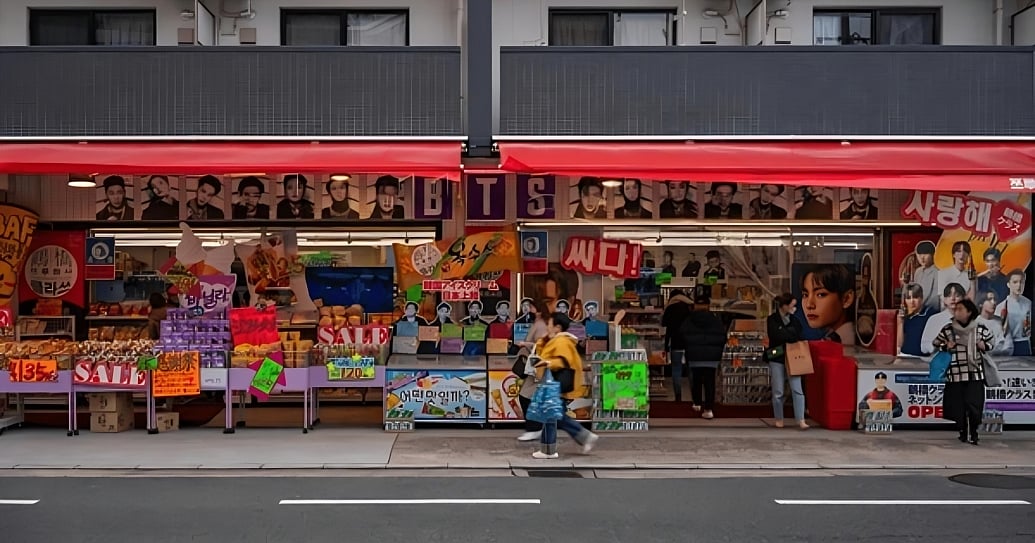
BTS V x Tirtir: K-Beauty meets K-pop (Image Credit: Instagram)
The redefined terms while also organizing the traditional business lines. Notably, the older "cultural creative industry" metric truncated from ₩205T (~ $136B) in 2023 to ₩191.2T (~ $127B) in 2025 after the ministry cancelled the categories that were not genuinely deemed to be K-content; one such category is portal commerce.
BTS-Led Tourism Drives Economic Growth
South Korea’s cultural boost is supported by strong tourism results. Inbound arrivals to the country rose by 17% in the second half of 2025 from 2024, while it grew again by 22% in the first half of 2026, as per ministry figures cited by The Korea Herald. Notably, HYBE’s global K-pop group, BTS' full seven-member comeback amplified that pull in such a manner that hotel prices skyrocketed, with ministers and authorities intervening in the issue.
Spotify x BTS: SWIMSIDE (Image Credit: Photo by Kevin Mazur/Kevin Mazur/Getty Images for Spotify)
Recently, the band itself and President Lee addressed the price gouging issue in Busan ahead of their concerts next month. Authorities are now conducting strict checks alongside voluntary resolution efforts. To sustain the fan demand, which is somewhat faltering due to these high accommodation prices, many free to budget friendly stay options are being put forward by religious institutions, universities, and government youth hostels.
The Global Expansion of K-Culture: The Public-Private Push
To hold on to the momentum of the K-culture growth, the ministry is pivoting from what Chae described, per The Korea Herald, as a "support" to an "investment" architecture, with expanded financial and tax incentives for cultural exports. To strongly back this interest, a global K-culture festival tentatively branded as Fanomenon or Phenomenon, is set to launch in South Korea in December 2027, with a global expansion planned in the year next. Simultaneously, the government is planning to set up K-culture performance centers across seven major international cities.
South Korea vs Japan: The Soft-Power Economy Race
South Korea’s cultural expansion strategy has similarities with Japan's playbook. Japan, under its New Cool Japan Strategy, which was inaugurated in the year 2024, set a goal of JP¥50T (~ $314B) by 2033 for foreign consumer spending across many sectors. These included food and food culture, content, fashion and cosmetics, and inbound tourism, alongside a separate individual target of JP¥20T (~ $125B) for content, including games, anime, manga, and films, as reported by Japan Today.
Overseas sales of Japanese content reached JP¥4.7T (~ $29B) in 2022, and JP¥5.8T (~ $36.4B; as per current exchange rates), which is close to microchip exports, pushing the government to label the content industry as a "basic industry" of the country, as per a Malay Mail report. Japan's momentum had only grown since that time; as per The Japan Times, the anime film Demon Slayer: Infinity Castle grossed over JP¥100B (~ $793M; as per then-exchange rates) in worldwide revenue in 2025, making it the first Japanese film ever to do so.
Demon Slayer: Infinity Castle (Image Credit: Crunchyroll)
Both governments are, at root, making a similar move of utilizing cultural affinity to transform into export revenue, with food, fashion, and tourism being the monetization layer placed underneath the content itself to support this capitalizing framework. This chain, followed by both countries, leverages content which drives consumer interest, thereby lifting product exports, which feeds inbound tourism. As per a Medium article, Japan's strategy even includes plans to utilize anime and manga IP in diplomatic and promotional campaigns, making these cultural assets as foreign policy tools. In the case of South Korea, K-pop artists majorly take up this place, for instance, how BTS and SEVENTEEN have become UN ambassadors.
Nevertheless, the identical approach emulated by the two countries depicts a funding gap. South Korea's Ministry of Culture had set a budget of ₩7.85T (~ $5.2B) for 2026 cultural sector support, per The Korea Herald. Whereas Japan's last government funding for content promotion amounts to only JP¥25.3B (~ $158M; current exchange rate), prompting the ruling Liberal Democratic Party to propose a fourfold increase in that allocation to over JP¥100B (~ $62.8M).
Why South Korea is Overtaking Japan in Cultural Exports: The Fandom Economy
The root cause of the difference between the two soft-power models lies in the organic pull and real-time global mobilization. Although Japanese content has a wide audience and a strong base of Western fans, its “Cool Japan” move had earlier faced severe criticism for overseas financial deficits and rigid, state-led distribution models. However, South Korea overcame such issues to engineer a globally synchronized, direct-to-consumer fandom ecosystem and not just a fanbase for its content, which produces measurable economic engagement almost instantaneously.
Powered by K-pop assets like BTS and K-dramas, Seoul grips on large-scale international touring and social-media participation, which Tokyo's top-down approach is yet to achieve. This reflects a paradigm shift that is exclusively quantified by engagement metrics like the Fan Activity Index in the upcoming Global-K Chart, which will be launched by Tencent Music, Melon (from Kakao), and LINE Music.
"K-culture is already one of Korea's top three core export industries, earning foreign currency," said Minister Chae, as noted by Yonhap. Although Seoul and Tokyo are running the same race, with unique assets and levels of state push behind them. What was once a soft power has now grown into an industrial policy, where both nations, especially South Korea, are betting on its coming years’ growth.