




Game Development Careers: From Art to Programming to QA
Inside the sprawling ecosystem of talent that transforms pixels into billion-dollar entertainment

Highlights
- Game development requires a team of specialists across eight core departments, from production to quality assurance.
- Jobs range from creative roles like artists and designers to technical specialists like programmers and animators.
- The global industry has regional specializations, with Western markets focused on console games and India on mobile development.
When you fire up your PlayStation or swipe through mobile games during your commute, you're experiencing the culmination of hundreds of specialized professionals working in concert. The video game industry, now worth approximately $275 billion globally according to recent industry reports, with some projections reaching over $700 billion by 2034, has evolved far beyond the stereotype of a few programmers hunched over computers in a garage.
Today's major game studios operate like miniature Hollywood productions, employing armies of artists, designers, programmers, and specialists whose individual contributions blend seamlessly into the final product. Understanding these roles offers a fascinating glimpse into one of the world's most collaborative creative industries.
The Production Department
At the heart of every successful game lies the production team: the strategic masterminds who transform creative chaos into shipped products. These are the project managers of the digital age, wielding spreadsheets and scheduling software instead of traditional tools.
Producers are essentially the translators between the creative vision and business reality. The Games Producer leads the entire project like a film director, while Associate Producers manage specific teams, and Project Managers handle the daily logistics that keep development on track.
Interestingly, many production professionals begin their careers in Quality Assurance, where they gain a comprehensive understanding of the entire development pipeline, providing a natural launching pad for future leadership roles.
The Design Department
If production provides the structure, design supplies the soul. Game designers are the architects of experience, crafting the rules and systems that determine whether players will spend five minutes or five hundred hours in a virtual world.
The design umbrella covers an impressive range of specializations. Game designers focus on core mechanics: how combat feels, how economies balance, how progression systems hook players. Level designers are the spatial architects, constructing the maps and environments where players actually live. Meanwhile, Narrative Designers weave the stories that give context to all that clicking and shooting.
The role has evolved dramatically with technology. Modern designers must be fluent in game engines like Unity and Unreal Engine, prototyping their ideas directly rather than relying solely on written documents. As games have grown in complexity, so has the specialization: a massive multiplayer game like World of Warcraft employs designers who focus exclusively on single systems within the larger experience.
Art Department
Gaming's visual revolution owes everything to the art department, where traditional artistic skills meet cutting-edge digital tools. These professionals don't just make games look good: they create the visual language that players instinctively understand.
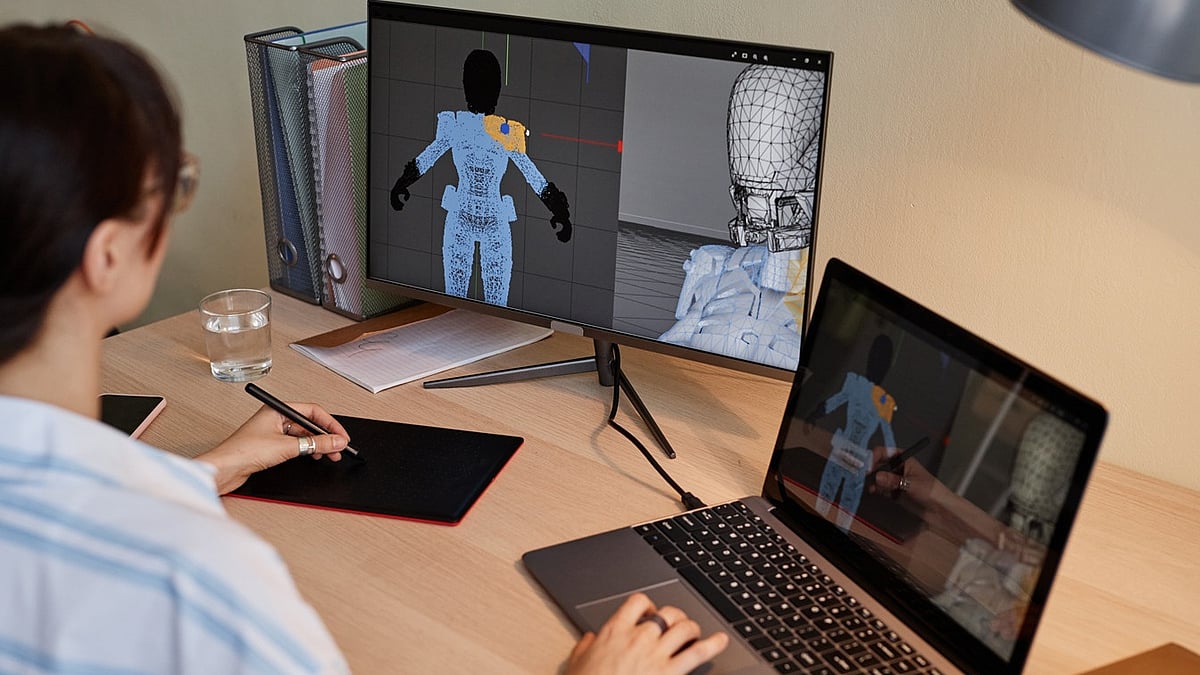
The hierarchy flows from Art Directors, who establish the overall visual style, down to specialized roles: Concept Artists sketch the initial ideas, 3D Modeling Artists build the digital sculptures of characters and objects, Environment Artists construct entire worlds, and UI Artists design the interfaces that players interact with constantly.
The technical demands are formidable. Today's game artists must master not only traditional skills like drawing and color theory, but also sophisticated software packages like Maya, Blender, and ZBrush. It's a field where artistic vision meets technical precision.
The Magicians: Animation Department
Static models become living, breathing characters through the work of animators: the professionals responsible for what industry insiders call "game feel." Every sword swing, every explosion, every character expression that makes players believe in the virtual world stems from their expertise.
Character Animators bring personalities to life through movement, while VFX Animators specialize in the spectacular: fire, magic, destruction. Perhaps most crucial are Technical Animators, who build the digital "skeletons" that allow models to move naturally. These professionals command some of the industry's highest salaries due to their unique blend of artistic and technical skills.
The Bridge Builders: Technical Art Department
Where art meets programming, technical artists solve the impossible puzzles. They ensure that an artist's beautiful concept can actually run at 60 frames per second on a mobile phone, or that a designer's ambitious vision won't crash the game engine.
These roles represent some of the industry's most secure positions, requiring rare combinations of artistic sensibility and programming prowess. Shader Artists write the code that makes surfaces look convincingly metallic or translucent. Pipeline Technical Artists create tools that automate tedious tasks, freeing up creative professionals to focus on creativity rather than technical busywork.
The Sonic Architects: Audio Department
Modern games are symphonies of sound, and audio professionals craft every note. From the subtle rustle of leaves that makes a forest feel alive to the thunderous orchestral scores that accompany epic battles, sound design creates emotional connections that visuals alone cannot achieve.
Sound Designers create the effects that give weight and impact to player actions. Music Composers write dynamic scores that adapt to gameplay. Audio Programmers build the technical systems that make interactive soundtracks possible. The field has become increasingly sophisticated, with specialized software like Wwise and FMOD allowing designers to create complex, responsive audio without extensive programming knowledge.
The Foundation: Programming Department
Behind every seamless gameplay experience lies thousands of lines of code, written by programmers who specialize in different aspects of game technology. Game Engine Programmers build the fundamental systems that power graphics and physics. Gameplay Programmers translate design documents into interactive systems. AI Programmers create the artificial intelligence that makes computer-controlled characters believable opponents or allies.
The programming languages vary by platform and studio. C++ remains the gold standard for high-performance console games, while C# and Unity dominate mobile development. Network Programmers face the unique challenge of making multiplayer experiences work smoothly across different internet connections and geographic regions.
The Guardians: Quality Assurance Department
Before any game reaches players, it passes through the meticulous scrutiny of Quality Assurance professionals. Far from simply "playing games all day," QA work requires systematic methodology and detailed documentation to catch the bugs that could ruin player experiences.
QA Testers methodically play through game sections, documenting every glitch and inconsistency. Compatibility Testers ensure games work across diverse hardware configurations. Performance Testers analyze frame rates and memory usage. The field is becoming increasingly technical, with QA Engineers writing automated testing code.
Notably, QA often serves as the gaming industry's entry point, particularly in markets like India, which has become a global hub for QA outsourcing. The role offers newcomers comprehensive exposure to game development processes while building skills for potential advancement.
A Global Industry with Regional Flavors
The gaming industry's global nature creates interesting regional specializations. While Western markets focus heavily on big-budget console and PC games requiring highly specialized roles (think C++ programmers and lighting artists), India's mobile-first approach has created enormous demand for Unity developers and C# programmers. The Asia & MENA gaming markets alone represent $87.6 billion in 2024, with Niko Partners projecting growth to nearly $100 billion by 2028.
This specialization reflects broader market trends. India's gaming landscape exemplifies this regional focus, with its mobile-first market driving extraordinary growth. Indian online gamers reached 488 million in 2024, according to EY reports, with the market valued around $943 million and expected to surpass $1 billion in 2025. Industry analysts project growth rates between 17-20% annually, with some forecasts like Lumikai suggesting the market could reach $9.2 billion by 2029.
As gaming continues its explosive growth, particularly in emerging markets, the industry's job landscape will continue evolving. New technologies like virtual reality, augmented reality, and cloud gaming promise to create entirely new categories of specialized roles. Whether your talents lie in artistic expression, technical problem-solving, creative storytelling, or meticulous quality control, there's likely a place in the vast ecosystem that transforms simple ideas into the interactive entertainment that defines modern digital culture.
The next time you lose yourself in a favorite game, consider the hidden army of professionals whose specialized skills combined to create that experience. In gaming, as in few other industries, individual expertise truly becomes greater than the sum of its parts.

Author
Krishna Goswami is a content writer at Outlook India, where she delves into the vibrant worlds of pop culture, gaming, and esports. A graduate of the Indian Institute of Mass Communication (IIMC) with a PG Diploma in English Journalism, she brings a strong journalistic foundation to her work. Her prior newsroom experience equips her to deliver sharp, insightful, and engaging content on the latest trends in the digital world.
Krishna Goswami is a content writer at Outlook India, where she delves into the vibrant worlds of pop culture, gaming, and esports. A graduate of the Indian Institute of Mass Communication (IIMC) with a PG Diploma in English Journalism, she brings a strong journalistic foundation to her work. Her prior newsroom experience equips her to deliver sharp, insightful, and engaging content on the latest trends in the digital world.



Related Articles