
Anime Streaming Audience Is Bigger Than Brands Realize
Anime Streaming Audience Emerges as High-Value Segment
Nielsen data shows anime fans drive cross-platform engagement, reshaping streaming and advertising strategies.

Highlights
- Nielsen identifies anime streaming audiences as a high-value segment.
- Streaming giants like Netflix and Crunchyroll are scaling anime investments and cross-media strategies to capture growing demand.
- Anime’s rise is fueling broader Asian content consumption and reshaping media strategies.
The global anime streaming audience is evolving into one of the most commercially valuable viewer segments, according to a new report by Nielsen. In 2025, more than 45B minutes of anime content were streamed in the United States alone, with cross-media consumption and stronger spending behavior compared to average viewers.
The Nielsen report positions anime fans as a powerful cultural and economic force shaping the future of content, a characterization that would have seemed overstated even five years ago. However, within the last three years, anime streaming has been growing steadily, with anime-niche streamer Crunchyroll recording 4.2B minutes of anime streaming in February 2026.
The figure was 3.9B minutes in 2025 at the same period, reflecting a 7.69% year-on-year growth. Netflix, another major anime streaming platform, recorded 4.4B anime viewing hours in the first half of 2025.
The increasing anime consumption is in part a result of streaming platforms recalibrating content strategy around anime and streaming it globally with regional dubs and subs. Netflix has already announced 40 projects for 2026, which the platform will be streaming globally, effectively engaging viewers from other audience segments.
Anime has a Diverse, High-Earning Viewer Base
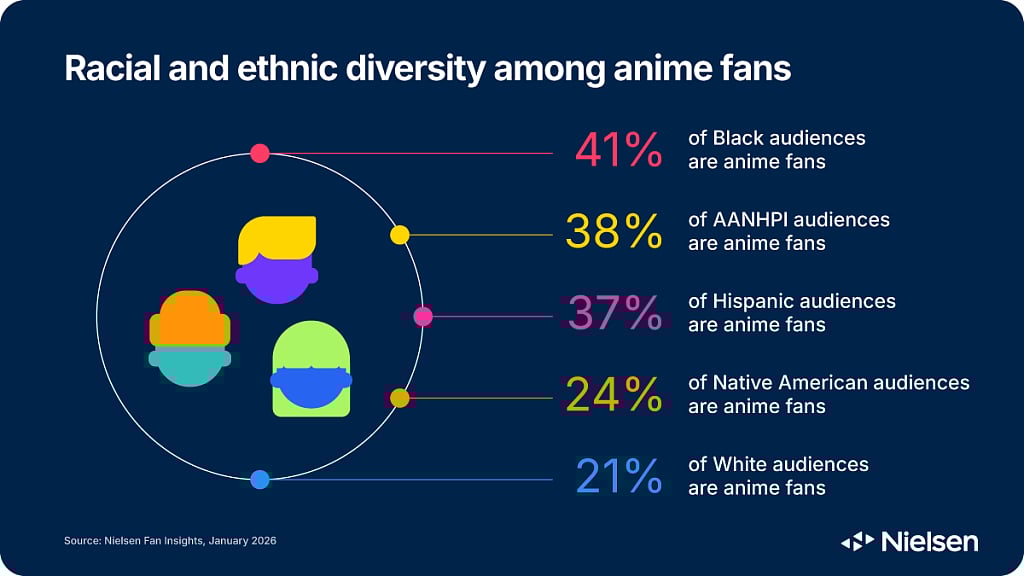
The Nielsen report defines anime fan demographics with a racial and ethnic diversity that has high identification rates across most ethnic groups. Approximately 41% of the anime audience is Black, and 37% are Hispanic, whereas the data drops to 21% in the case of White audience.
Anime viewers tend to fall within younger age brackets, mostly Gen Z and Millennials. However, Nielsen notes they also exhibit higher-than-average household incomes, with nearly 25% of millennial anime audience earning over $100K annually and 18% surpassing the $125K mark.
2026 The Nielsen Company (US), LLC.
Around 60% of anime fans are the chief earners in their household, which rises to 68% in the case of the millennial anime audience. The financial capacity also results in anime audience segments being multi-category consumers within the digital ecosystem.
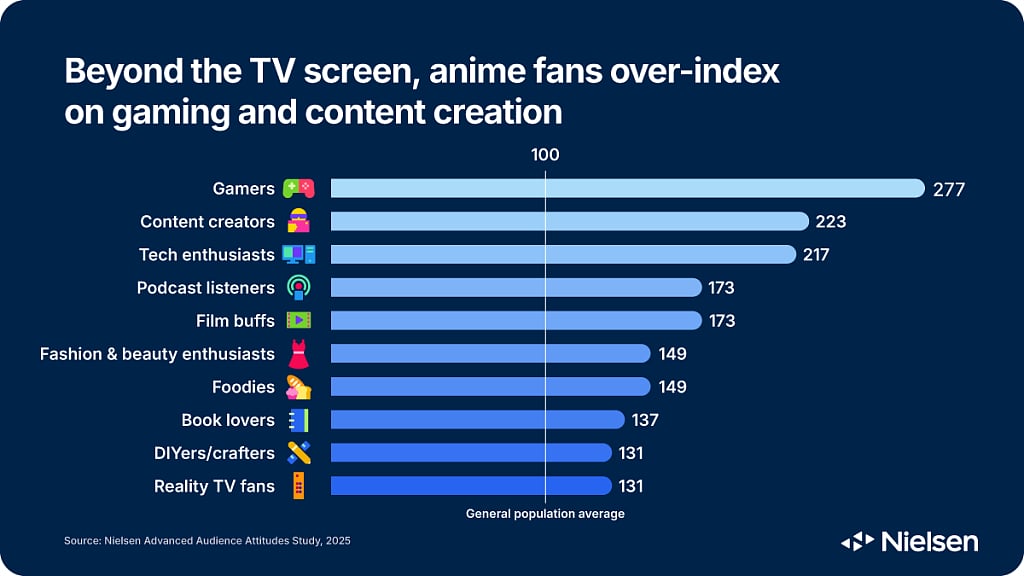
The data indicates that anime fans have a broader range of interests than the average audience, spanning gaming, technology, movies, books, and fashion. Their spending across gaming, merchandise, live events, and subscription platforms simultaneously makes them a high-value consumer segment for brands that have historically overlooked the anime streaming audience.
This behavior amplifies the value of anime intellectual property. A single title can generate revenue across several media expansions, extending its lifecycle beyond the initial streaming run.
Anime Viewership Fuels Cross-Cultural Content Growth
Anime viewership growth has driven mainstream interest in other Asian cultural programming, including Alice in Borderland and Squid Game. The audience that migrated through anime is slowly becoming a foundational viewer base for a wider category of Asian-origin content.
Nielsen has highlighted the viewership demand of Netflix’s One Piece live-action series, which topped Netflix’s Global Top 10 chart with 16.8M views on the platform. The show drew a racially diverse audience, with 46% of it being White, 16% Black, 9% Asian, and 25% Hispanic.
2026 The Nielsen Company (US), LLC.
The data points that anime-adjacent programming is a successful way to engage AANHPI audiences. 69% of this segment are more likely to connect with a fanbase that embraces their cultural identity.
Anime Streaming: From Subculture to Mainstream Media Infrastructure
Nielsen’s findings reinforce that anime is transitioning from a subcultural niche to a core component within global media infrastructure. Netflix's exclusive six-series deal with production studio MAPPA, valued at over $150 million USD in 2026, illustrates how platforms are financing the anime supply chain directly.
Anime streaming audiences are not only bringing engagement, but also commercial benefit for streaming. Crunchyroll surpassed 15M paid subscribers as of 2024, driven in part by simulcast availability.
In markets across the United States and Asia, anime titles like Jujutsu Kaisen, Solo Leveling, One Piece, and the like regularly rank among top-performing content on major streamers. This reflects both increased availability and changing audience preferences.
Demon Slayer: Mugen Train (2020), Demon Slayer:Infinity Castle (2025), Your Name (2016), and Suzume (2023) have already demonstrated the theatrical power of anime movies. Demon Slayer:Infinity Castle earned over $700M, at par with Western animated movies and proving the demand for Japanese and broader Asian animation.
The Nielsen report frames this moment as an opportunity for most brands to act on their marketing strategies by recognizing the anime streaming audience. Given their earnings data, the racial diversity, and the scale of cross-media consumption, they have already become a strategic priority for platforms, advertisers, and marketers.

Author
Kamalikaa Biswas is a content writer at Outlook Respawn specializing in pop culture. She holds a Master's in English Literature from University of Delhi and leverages her media industry experience to deliver insightful content on the latest youth culture trends.