




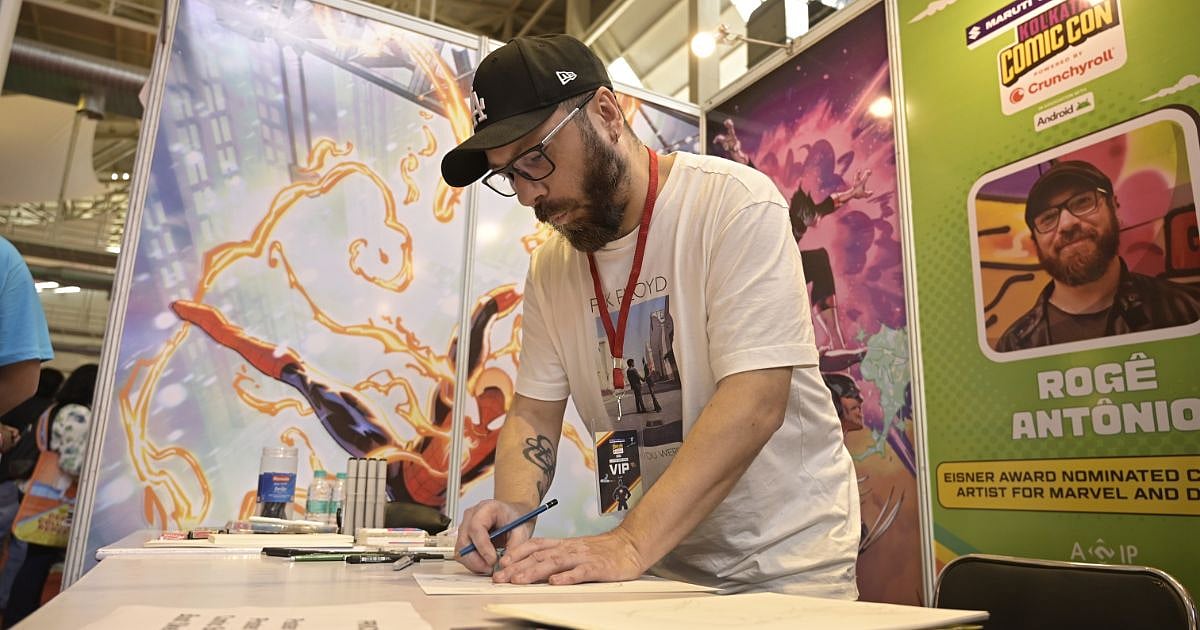
DC and Marvel Veteran Rogê Antônio at Kolkata Comic Con 2026
Comic Con 2026: Marvel Veteran on Global Influences on Comic Art
At Kolkata Comic Con 2026, DC and Marvel's Rogê Antônio discussed how manga aesthetics and AI disruption are reshaping global comics from opposite ends.

Highlights
- At Kolkata Comic Con 2026, Rogê Antônio highlighted the growing impact of manga and global subcultures on Western comics artists.
- Antônio criticized AI-generated art, emphasizing that creativity lies in the human process and emotional intent.
- The discussion underscored comics as a global pipeline, with events like Comic Con India reflecting increasing cross-cultural exchange.
Brazilian comic artist Rogê Antônio, known for his work on Marvel and DC titles such as She-Hulk, Deadpool, Nightwing, and Carnage, brought a distinctly global perspective to Kolkata Comic Con 2026. The event, held at Biswa Bangla Exhibition Centre, drew 30K attendees and featured cross-border creator sessions, underscoring India’s growing role in the global comics ecosystem.
Antônio appeared at the “Creators Across Borders” session on April 11. A São Paulo-based illustrator, he discussed, with Outlook Respawn, the growing convergence of global influences and subculture on comic artists.
Despite his current professional life in the Big Two publishers, Antônio grew up not on American superhero comics, but on Brazilian indie publications and Japanese manga. His remarks during the conversation reflected three intersecting pressures on the industry: the rise of AI tools, the globalization of creative labor, and the widening influence of non-Western art forms.
Beyond Marvel and DC: Manga and Subculture Shaped Rogê Antônio’s Creative Vision
Antônio credited his creative vision as a mixture of indie subcultures and Japanese Manga. “I think my favorite comic is Akira. The manga Akira. Katsuhiro Otomo's style influenced me all the time,” he said.
Akira, Otomo's 1988 breakthrough film, was one of the first Japanese anime productions that gained popularity across Western markets. Otomo's dense, kinetic page architecture and hyper-detailed linework occupy a different visual universe from the clean heroic anatomy that defined the Big Two through the 1990s.
The manga influence gets prominent in Antônio’s works, such as Carnage and Cyclops’ panels. Antônio defined Carnage as a “pure, chaotic, and artistic mayhem.”
Apart from manga, Antônio also cited music as a definitive force behind his artistic vision. “Punk rock music and hardcore music” shaped his approach, he said, a reminder that the most significant influences on visual artists often arrive from media subcultures.
Art is About the Process: Antônio’s Argument on AI in the Creative Field
Whereas Antônio’s statement on manga influence is a reflection of globalization of Western comics, his stance on AI is conventional, yet practical. “I don't like AI because I think art should be made by humans,” he said, emphasizing that artistic value lies in the process, not just the output.
He further added that AI-generated work lacks the emotional intent of human-created art, noting that AI can’t do that for him. He extended the argument to music, stating, "I don't want to hear music made by an AI, because it says nothing to me.”
His arguments align with industry stances taken across the Western and Eastern visual literature industry. At New York Comic Con 2025, DC Comics President Jim Lee declared, “AI doesn't dream. It doesn't feel. It doesn't make art. It aggregates it,” adding that DC would never support AI-generated artwork.
Every Medium has its Own Space in the Creative Industry
One of Antônio's more considered positions concerns the relationship between comics and their screen adaptations. When asked whether cross-media expansions have changed how he approaches source material, he stated, “I don't think so. I think it's different media and each one has its own space.”
Publishers have used comics as content pipelines for film and series, where directorial choices play a key role in determining how and which characters transition to the screen. Antônio's view pushes back against the assumption that a comics illustrator’s art changes in response to Hollywood's priorities.
From Brazil to Kolkata Comic Con 2026: Comics as a Global Pipeline
For Antônio, comics' globalization works as a driving force behind his life and creative vision. He emphasized the cultural impact of fandom-driven events like Comic Con Kolkata, stating that he had never imagined coming to India; it is comics that brought him here.
He also highlighted the different cultural landscape of Kolkata and how the event exceeded his expectations. For his upcoming projects, he mentions, “I'm doing a new title for Marvel, but I really can't talk about it.” He mentions that the title already exists; however, he will be doing a new arc featuring four issues.
Comic Con India CEO Shefali Johnson framed the cultural stakes at the event, stating, “From literature to music, theatre, to cinema, or be it fine arts or art, creativity here is not just culture, it is a part of Bengal's identity.” However, Antônio was cautious about overstating the industry impact of such events on publishing decisions, suggesting that editorial influence remains concentrated elsewhere.
Rogê Antônio’s appearance at Kolkata Comic Con 2026 illustrates how visual literature or comics are evolving at the intersection of global markets and creative identity. As the industry simultaneously grapples with the rise of manga, the rise of AI, and rapid globalization, Antônio’s perspective underscores a growing interconnected creative landscape, that continues to face persistent structural challenges.
Author
Kamalikaa Biswas is a content writer at Outlook Respawn specializing in pop culture. She holds a Master's in English Literature from University of Delhi and leverages her media industry experience to deliver insightful content on the latest youth culture trends.
Related Articles