Mobile Game Development as a Career: India's Largest Gaming Niche
Mobile Game Development as a Career: India's Largest Gaming Niche
Mobile game development careers in India: Salaries, key sub-segments, and how to get started.

Highlights
- India's mobile gaming market reached $3.5B in 2025, making it the country's largest gaming segment.
- Studios are hiring across mobile development, live ops, game design, and analytics, with Unity remaining the dominant engine.
- Portfolios and shipped games matter more than certificates, especially for entry-level mobile gaming roles.
India's gaming market was valued at $4.38 billion USD in 2025, with mobile platforms accounting for around 80% of the market. The sector is projected to reach $9.89B by 2031. The country recorded 8.45B game downloads in fiscal year (FY) 2024-25, making it the world's largest mobile gaming market by download volume and accounting for an estimated 15.5% of global game downloads.
For anyone weighing a career in game development in 2026, the segment is not a secondary option. It is an increasingly important part of the job market.
What most career guides miss is that mobile gaming in India is not one industry. It is five sub-segments operating under one platform, each hiring differently, paying differently, and demanding a distinct skill stack. The sub-segment a mobile game developer enters shapes everything, from the engine they learn to the studio that will hire them.
India's Five Mobile Gaming Sub-Segments: What Each One Requires
Hyper-casual games are the highest-download sub-segment in the ecosystem. The top 100 hyper-casual games globally generated over 2.4B downloads in the first half of 2025. Revenue is advertising-driven. Studios hire fast-cycle Unity developers, ad monetization integrators, and user acquisition managers who can prototype and test concepts in weeks rather than months.
Casual puzzle and card games form the culturally dominant layer of Indian mobile gaming. Titles built around Ludo, Rummy, and word-game formats benefit from familiarity that few other markets can replicate. Studios in this segment hire user interface (UI) and user experience (UX) designers, game economy specialists, and backend engineers who support real-time social play at scale.
Midcore and role-playing game (RPG) titles, including battle royale (BR), multiplayer online battle arena (MOBA), and role-playing experiences, carry the highest technical complexity. In-app purchase revenue in India's midcore segment grew 53% year over year in 2024, driven by Battlegrounds Mobile India (BGMI), Garena Free Fire Max (FF Max), and Clash of Clans (CoC). These studios hire graphics programmers, multiplayer engineers, 3D environment artists, and narrative designers.
Real-money gaming (RMG) was the largest revenue-generating segment in India's gaming industry, accounting for approximately 83-84% of total revenue in FY22. The Promotion and Regulation of Online Gaming Act (PROGA) 2025 was passed by Parliament on Aug 21-22, 2025, imposing a blanket ban on all money-based gaming without distinguishing between games of skill and games of chance.
PROGA enforcement began when the Online Gaming Authority of India (OGAI) launched on May 1, 2026. Platforms such as Dream11, Gameskraft, Games24x7, and Mobile Premier League (MPL) suspended real-money services and shifted toward alternative business lines. Talent from the segment has since migrated to midcore, casual, and original intellectual property (IP) studios.
Esports is recognized as one of the five major segments of India's gaming industry. While many esports titles overlap with midcore gaming, the segment operates through competitive ecosystems, tournaments, teams, broadcasting, and sponsorships. Following the RMG ban, esports remained exempt and continued to attract investment and audience growth.
Organizations in this space hire tournament operations managers, esports analysts, community managers, broadcast producers, and partnership specialists to support competitive gaming ecosystems.
Top Indian Mobile Studios and the Roles They Hire for
SuperGaming (Pune) raised $15M in a Series B funding round in August 2025, led by Skycatcher and Steadview Capital, to scale Indus Battle Royale and its proprietary SuperPlatform technology stack. The studio recruits 3D environment artists, gameplay engineers, multiplayer backend developers, and UI designers, reflecting the broad mix of technical and creative disciplines required to build large-scale multiplayer games and supporting infrastructure.
Mayhem Studios (Bengaluru), an MPL subsidiary, hires teams spanning animation, art, cinematics, game design, engineering, and UI/UX production. Its flagship title, Underworld Gang Wars (UGW), is a battle royale game built around Indian locations, characters, and cultural themes. The game is notable for its localized setting, with environments such as Dhantara, and requires talent across both creative and technical production roles.
Moonfrog Labs (Bengaluru), owned by Stillfront Group, operates Teen Patti Gold and Ludo Club, two of India's largest mobile gaming titles. The studio's hiring focuses on mobile engineers, product managers, and data analysts responsible for player retention, live operations, and game economy management. Its recruitment strategy reflects the importance of analytics and product management in maintaining high-retention social and board game experiences.
Gametion Technologies (Navi Mumbai), the studio behind Ludo King, hires Unity developers, UI designers, and backend engineers to support one of the world's most downloaded mobile board games. Ludo King surpassed 1B downloads on the Google Play Store in 2024 and remains one of the leading titles in the global board game category.
Octro (Noida) focuses on casual and skill-based mobile games, recruits Android and iOS developers, real-time multiplayer backend engineers, and quality assurance (QA) specialists. Known for large-scale multiplayer titles such as Indian Rummy, the company prioritizes backend infrastructure, networking systems, and QA functions to support high concurrent user loads and platform stability.
Nazara Technologies (Mumbai) operates across multiple gaming and digital entertainment segments, including esports through NODWIN Gaming, gamified learning through Paper Boat Apps (Kiddopia), and sports media through Sportskeeda. As a diversified gaming group, Nazara hires mobile engineers, product leads, esports event managers, content strategists, and other specialists across its gaming, esports, education, and media businesses.
Live Ops Careers: The Role Most Aspirants Overlook
Live operations is one of the fastest-growing career tracks in India's mobile gaming industry and one of the least visible to candidates outside the sector. Live ops teams are responsible for keeping games active after launch by introducing new content, running limited-time events, and creating incentives that encourage players to return. They also monitor player behavior and performance metrics to identify what is working and where engagement can be improved.
At the entry level, a Live Ops Specialist configures in-game events using internal tools, validates releases with QA teams, and maintains deployment calendars. Mid-level professionals typically manage A/B testing, analyze event performance, optimize offer pricing, and track retention metrics. Senior live ops leaders oversee the long-term retention and monetization strategy of a title throughout its lifecycle.
The practical skills required for live ops careers include analytics platforms such as Firebase, GameAnalytics, and Amplitude, along with a working knowledge of A/B testing. Professionals in these roles must also be able to interpret D1, D7, and D30 retention curves and use those insights to make data-driven decisions. While coding is not usually required, understanding what is technically feasible within a development cycle is an important advantage.
Several major gaming companies actively recruit for live ops positions, including:
- Dream11 / Dream Game Studios: Senior Game Designer (LiveOps) and Sports Operations roles.
- Mobile Premier League (MPL): Product Manager, Revenue, and Live Ops positions.
- Zynga India (Bengaluru): Live Ops Managers and Game Design Director roles for live-service games.
- Scopely (Bengaluru): LiveOps Manager positions focused on event execution and optimization.
- PlaySimple Games: Product managers and LiveOps coordinators supporting engagement and content updates.
- Games24x7 (Bengaluru): Live Operations and Data Management roles.
- Ubisoft India (Pune/Mumbai): Live Ops Designer positions supporting global game events.
- CrazyLabs (Mumbai): Game Owner (LiveOps) and content strategy roles.
- Nilee Games: LiveOps & Monetization Specialist positions.
- Junglee Games: Live operations roles supporting tournaments and player engagement.
- Zupee: Live operations and tournament management positions.
- iXie Gaming: LiveOps coordinator roles focused on offers, events, and content deployment.
- P99SOFT (Hyderabad): LiveOps Coordinator positions supporting international publishing clients.
The breadth of hiring across publishers, studios, and service providers highlights how live operations has evolved into a specialized discipline. As more mobile games adopt live-service models, demand for professionals who can combine analytics, event planning, monetization, and player engagement is expected to continue growing.
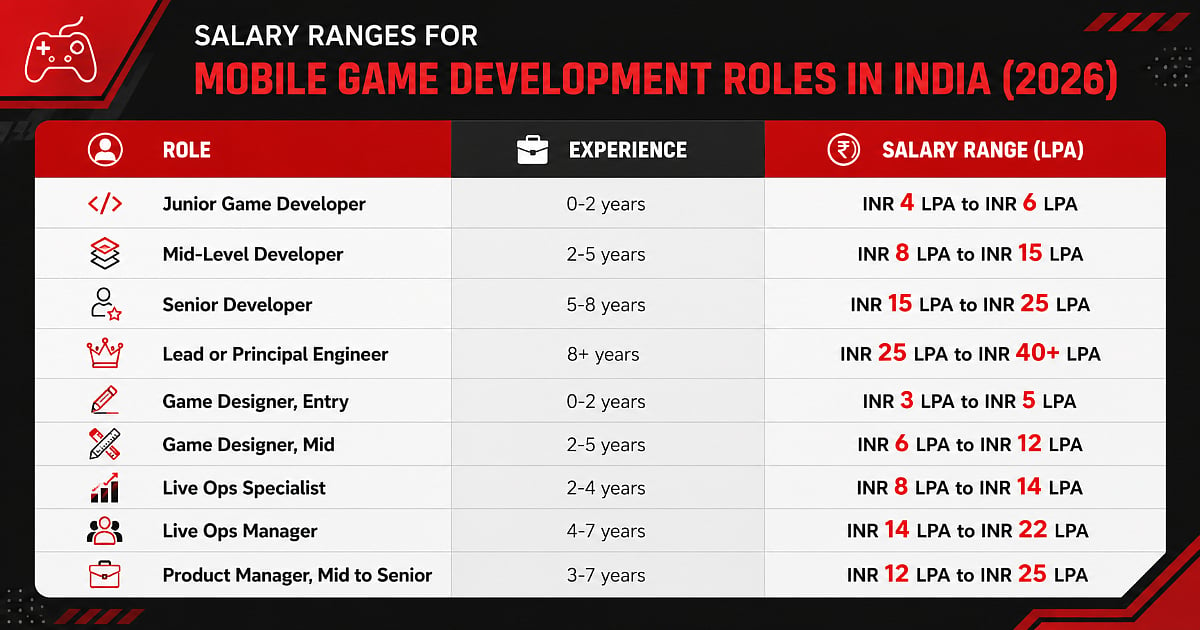
Salary Ranges for Mobile Game Development Roles in India (2026)
Outlook Respawn
Freshers entering the mobile gaming industry typically earn between INR 4 LPA and INR 6 LPA, although entry-level compensation can start closer to INR 3.3 LPA depending on the studio and role. Developers with five to seven years of experience regularly cross the INR 20 LPA mark, particularly in high-demand technical disciplines.
Studios place greater emphasis on shipped games, portfolios, and demonstrated proficiency in engines such as Unity and Unreal than on formal academic credentials. Candidates who can showcase completed projects or commercial releases often have a significant advantage during hiring.
Bengaluru, Hyderabad, and Pune offer some of the highest compensation levels in the industry due to their concentration of game studios and sustained demand for experienced talent. Specialists in multiplayer networking, graphics programming, and augmented reality (AR) and virtual reality (VR) development can command salary premiums of 20% to 30% above standard compensation ranges.
Free-to-Play vs Premium Mobile: The Skill Stack Difference
Free-to-play (F2P) games remove the upfront purchase barrier and generate revenue through microtransactions, advertising, and in-app purchases. As the dominant business model in India and most global mobile gaming markets, F2P development relies heavily on data analytics to balance monetization with player engagement and trust.
The F2P skill stack typically centers on Unity, the industry's most widely used mobile game engine. Developers are expected to integrate monetization SDKs such as Unity Ads, AdMob, and IronSource, implement analytics frameworks, conduct A/B testing, and build retention systems such as battle passes, progression loops, daily login rewards, and limited-time events. Understanding player behavior, conversion funnels, and game economy design is often as important as core programming skills.
Premium mobile games, where players pay upfront for access, represent a much smaller segment in India due to widespread price sensitivity. However, the model places greater emphasis on gameplay quality, visual presentation, and content depth because revenue depends on convincing players to purchase the game before experiencing it.
While Unreal Engine (UE) is often associated with high-end, visually intensive premium titles, both Unreal and Unity are widely used across premium and F2P development. High-production-value F2P games such as PUBG Mobile and Genshin Impact demonstrate that UE can also support large-scale live-service and monetization systems, while successful premium titles such as Vampire Survivors have been built using Unity.
As a result, premium-focused roles place greater emphasis on gameplay programming, shader development, graphics optimization, level design, and narrative design. Monetization systems, live operations, and retention analytics generally play a smaller role than they do in F2P development. However, analytics and telemetry data are still commonly used to understand player behavior, identify friction points, and improve the overall gameplay experience.
Similarly, post-launch support remains important for premium games, although it is more likely to focus on updates, expansions, bug fixes, and downloadable content (DLC) rather than the continuous live-service events common in F2P titles.
The distinction ultimately comes down less to engine choice and more to business model priorities. F2P development is driven by retention, analytics, and monetization optimization, while premium development places greater weight on gameplay quality, presentation, and the overall player experience. In practical terms, the choice is often between building a continuously evolving service and crafting a complete, curated, and highly polished standalone experience.
How to Start a Career in Mobile Game Development in India
Step 1: Choose a Discipline
Programming, game design, art, and live ops production follow distinct hiring paths. Commit to one specialization before investing time in learning the required tools and workflows.
Step 2: Learn Unity for Mobile
Unity remains the primary engine across India's mobile gaming industry due to its cross-platform support for Android and iOS. Focus on C# scripting, physics systems, UI implementation, and the mobile build pipeline. Developers targeting midcore, hardcore, or high-fidelity projects should also learn Unreal Engine, which is becoming increasingly relevant for larger productions.
Step 3: Ship Something Small
Release a prototype on the Google Play Store. A shipped game, however modest, carries more weight with studio hiring teams than certificates or course completions. In 2026, portfolios remain the most important factor for entry-level candidates.
Step 4: Study Monetization and Analytics
For F2P career paths, learn in-app purchase (IAP) flows, rewarded ad placement, Firebase integration, and standard retention metrics such as D1, D7, and D30 retention. As studios shift toward ad-supported and IAP-driven models, understanding player analytics and monetization systems has become a core skill. Unity's free live-service design courses cover many of the fundamentals.
Step 5: Enter the Community
The International Game Developers Association (IGDA) India chapters and the India Game Developer Conference (IGDC) remain among the industry's most important networking channels. Entry-level and internship opportunities at studios such as Moonfrog Labs, Octro, Gametion, SuperGaming, and 99Games often surface through these communities before formal job postings go live.
Step 6: Target Entry Roles Precisely
Junior Unity Developer and Associate Product Manager (Live Ops) remain among the most accessible titles for candidates without prior studio experience. QA Tester and Associate Game Designer positions also provide common entry points into the industry.
Step 7: Upskill Continuously
Artificial intelligence (AI)-assisted development tools are increasingly becoming part of professional workflows. Studios now value candidates who can use tools such as GitHub Copilot and other productivity-focused AI systems to accelerate development while maintaining quality. Demonstrated current knowledge often advances careers faster than accumulated years of experience alone.
India's gaming industry was projected to generate over 2.5L jobs by 2026 as part of the country's broader push to expand its creative economy. Following the implementation of the PROGA 2025 on May 1, 2026, investment and talent have shifted away from real-money gaming and toward casual, hyper-casual games, midcore, social, educational, and original IP-driven game development.
While overall industry growth projections remain strong, the post-PROGA market increasingly revolves around F2P monetization, in-app purchases, and advertising-supported business models. Studios are investing heavily in culturally rooted Indian content designed for both domestic and international audiences.
For a mobile game developer entering the sector in 2026, the five-segment map is the practical starting point. The sub-segment chosen today determines the studios, skills, and career opportunities available.
Author
Probaho Santra is a content writer at Outlook India with a master’s degree in journalism. Outside work, he enjoys photography, exploring new tech trends, and staying connected with the esports world.